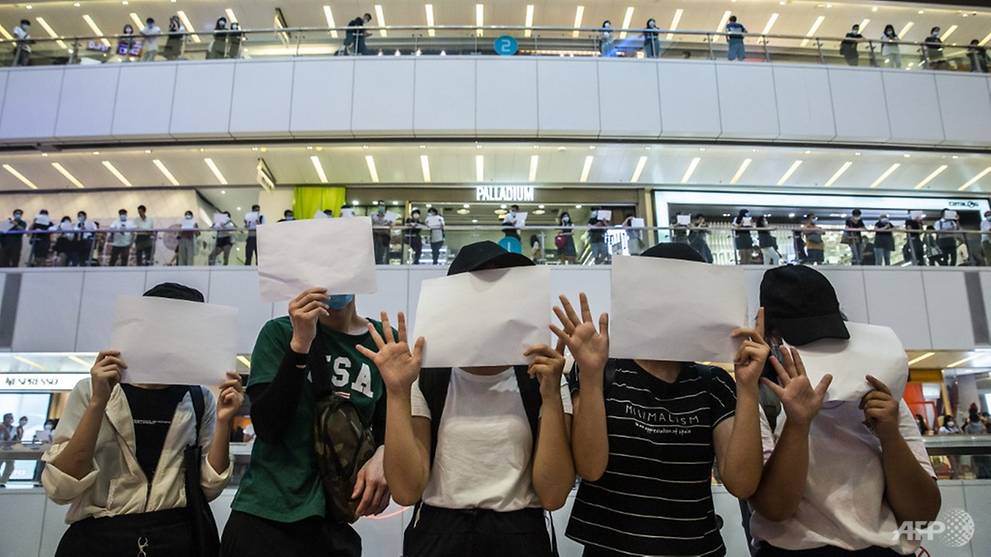
SYDNEY: Australian Prime Minister Scott Morrison on Thursday (Jul 9) announced measures to assist Hong Kong citizens start a new life in Australia, including extending visas by five years, after Beijing imposed a new security law on the Asian financial hub.
Morrison also suspended an extradition agreement with Hong Kong. Under the security law Hong Kong suspects can be sent for trial in Communist Party-controlled courts in mainland China.
Morrison said the new national security law introduced last week in Hong Kong was a fundamental change of circumstances and Australia would suspend the extradition agreement.
"There will be citizens of Hong Kong who may be looking to move elsewhere, to start a new life somewhere else, to take their skills, their businesses," Morrison said.
He announced visa measures that would assist Hong Kong citizens already in Australia to stay. Hong Kong students who graduate in Australia will have the opportunity to stay for five years and apply for permanent residency after that time.
Hong Kong citizens on temporary work visas in Australia would also be eligible to extend these for five years, and later apply for permanent residency.
Morrison said there are 10,000 Hong Kong citizens in Australia on student visas or temporary work visas.
Australia also made a pitch for international financial services, consulting and media businesses with regional headquarters in Hong Kong to relocate to Australia, and said it would offer incentives and visas packages to relocate staff.
"We want them to look to Australia, to come, to set up shop," said acting immigration minister Alan Tudge.
Australia changed its travel advisory for Hong Kong, where around 100,000 Australians live and work, to say "reconsider your need to remain in Hong Kong" if they are concerned about the new law.
The travel advice for Hong Kong warns Australians "may be at increased risk of detention on vaguely defined national security grounds".
Hong Kong's new security law punishes acts of secession, subversion, terrorism and collusion with foreign forces with up to life in prison.
The new law has pushed China's freest city onto a more authoritarian path and drawn condemnation from some Western governments, lawyers and rights groups.
Australia's Foreign Minister Marise Payne held a teleconference overnight with her counterparts in the Five Eyes security arrangement, which includes the UK, US, New Zealand and Canada, about Hong Kong and the new security law, Payne and UK foreign secretary Dominic Raab said on Twitter.
RIO DE JANEIRO: Brazilian President Jair Bolsonaro has gone all in on hydroxychloroquine to help his coronavirus-ravaged country beat COVID-19. He has pushed his government to make the malaria drug widely available and encouraged Brazilians to take it, both to prevent the disease and to treat it.
Now the far-right populist is putting his convictions to the ultimate test: Bolsonaro on Tuesday (Jul 7) announced that he had tested positive for the disease and was taking hydroxychloroquine.
Bolsonaro said in a televised interview that he had taken an initial two doses, in conjunction with the antibiotic azithromycin, and felt better almost immediately. His only regret, he said, was not using it sooner.
"If I had taken hydroxychloroquine preventively, I would still be working" instead of heading into quarantine, Bolsonaro said.
Later, in a separate video, he gulped down a third pill. He said he was aware of other treatments, but noted none of them had been proven to work.
"I trust in hydroxychloroquine," he said. "And you?"
Bolsonaro's illness is a potent symbol of his government's botched response to the outbreak. More than 1.7 million people in Brazil have tested positive for coronavirus and nearly 68,000 have died. Only the United States has performed worse.
A forceful critic of stay-at-home measures, Bolsonaro, 65, has largely shunned masks and derided the coronavirus as a "little flu." Instead, he has placed his faith in hydroxychloroquine and chloroquine, turning them into the centrepiece of his government's virus-beating playbook.
The two medications are often used against malaria, while hydroxychloroquine is also used to treat certain automimmune diseases. Some countries authorised the drugs to be tried on COVID-19 patients, and some doctors anecdotally have reported encouraging results.
Still, evidence is mounting that these drugs have no benefit for hospitalised patients. The US Food and Drug administration in June, for example, revoked its emergency use authorisation for hydroxychloroquine and chloroquine, saying it was no longer likely that the medications were effective at treating COVID-19 in these patients.
Bolsonaro has been undeterred by such pronouncements. He has pushed his Health Ministry to expand access to the drugs and dispensed with two Health Ministers - Luiz Henrique Mandetta and Nelson Teich - who had urged a more cautious approach.
Eduardo Pazuello - an active-duty Army general, who took over on an interim basis on May 15, and remains in the job to this day - has proven more obedient.
Under his watch, the ministry has broadened access to the drugs, and public sector doctors are now allowed to prescribe them for almost anyone who has tested positive for the coronavirus, not just the sickest patients. They can even be used by pregnant women and children with certain health conditions.
The president's office declined to comment for this article, directing questions to the Health Ministry. The Health Ministry did not respond.
FILE PHOTO: Brazil's President Jair Bolsonaro adjusts his protective face mask during a press statement to announce federal judiciary measures to curb the spread of the coronavirus disease (COVID-19) in Brasilia, Brazil March 18, 2020. Picture taken March 18, 2020. REUTERS/Adriano Machado/File Photo
To understand how Bolsonaro's administration embraced this unconventional strategy, Reuters interviewed more than two dozen people, including current and former health officials involved in the federal response, as well as physicians, scientists and public health experts.
What emerged was a picture of a leader worried about the crippling effects of lockdowns imposed by governors and mayors across Brazil, and eager for a quick fix to re-open the economy.
Bolsonaro was initially inspired by his political idol, US President Donald Trump, who was an early advocate of hydroxychloroquine, a dozen sources said. But Bolsonaro has gone much further than his US counterpart.
At his command, the Army has drastically ramped up production of chloroquine.
His new-look Health Ministry, now led by soldiers and Bolsonaro loyalists, has eagerly promoted the antimalarials as the best hope against COVID-19.
And Brazilian public entities, such as state governments and federal ministries, have snapped up the drugs on the open market. So far this year, they have spent a total of 2.3 million reais (US$429,706) on hydroxychloroquine - up 6,592 per cent compared with the total amount spent in 2019, according to a Reuters review of government data. These bodies have also spent 1.51 million reais on chloroquine so far in 2020, compared with 626,472 reais in 2019.
Mandetta, the Health Minister fired by Bolsonaro in April, said the president's drumbeat of support for the drugs had hampered efforts to impose stay-at-home measures and slow the spread of the virus in Brazil.
"That made many people believe that the cure was ready, that it already existed, that you didn't need to worry, that you could just take this medicine, that would solve the problem," Mandetta told Reuters.
Teich, Mandetta's replacement who resigned after less than a month on the job, did not respond to requests for comment.
Since leaving, he has said publicly that he resigned due to disagreements with Bolsonaro, who was pressuring him to broaden access to hydroxychloroquine and chloroquine. Exclusive Reuters reporting reveals that Teich hoped to persuade Bolsonaro to wait for results from a fast-tracked hydroxychloroquine trial, but was unable to convince the president, according to four people familiar with the situation.
Marcia Castro, a native Brazilian and professor at the Harvard TH Chan School of Public Health, said it was a "totally absurd" strategy to prioritise unproven drugs over reliable tools such as testing, tracing and social distancing.
"It's a profoundly lamentable situation, and it's no coincidence that we now have more than 60,000 deaths," she said.
Bolsonaro's interest in hydroxychloroquine and chloroquine has its roots in early reports from China and France about the drugs' potential to help COVID-19 victims, according to six people who spoke with Reuters.
In mid-February, Chinese state-run media reported that health experts there had "confirmed" chloroquine "has a certain curative effect." Around that time, a French microbiologist, Didier Raoult, also began to laud the drugs.
Raoult's advocacy of hydroxychloroquine and chloroquine was picked up by right-wing bloggers and libertarian thinkers. Then, on Mar 19, Trump waded into the debate. "I think it could be a game changer," said Trump, who claims to have briefly taken hydroxychloroquine as a prophylactic.
Bolsonaro was particularly swayed by Trump's comments, six people said. Bolsonaro had met with the US leader earlier that month at Trump's Mar-a-Lago resort in Florida, and several members of the Brazilian entourage returned sick to Brazil.
"It's the idea of a miraculous cure," said one recently departed cabinet minister, speaking on condition of anonymity. "(Bolsonaro) believes in those magic solutions. And I also think, in part, it is to copy Trump."
The White House pointed Reuters to a statement on May 31, when it announced it had sent 2 million doses of hydroxychloroquine to Brazil "as a demonstration of ... solidarity" between two countries which share a "longstanding collaboration on health issues."
On Mar 21, two days after Trump's comments, Bolsonaro announced he was ordering the Army Chemical and Pharmaceutical Laboratory to ramp up chloroquine production in Brazil for use as a COVID-19 treatment. Following that directive, the lab, located in Rio de Janeiro, has manufactured 2.25 million 150mg chloroquine pills, the Army told Reuters.
By comparison, the lab produced a total of 265,000 tablets in the previous three years combined, according to production data obtained through a freedom of information request filed by opposition lawmaker Ivan Valente and viewed by Reuters.
Brazil's armed forces have used chloroquine to ward off malaria in the nation's jungles for decades, and Bolsonaro, a former Army captain, has put military men in key positions. At least 27 current or former soldiers have recently joined the Health Ministry, replacing experienced public health officials, according to a Reuters tally. Meanwhile, current or former soldiers make up nearly half of Bolsonaro's 23-seat cabinet.
Five sources told Reuters that the longstanding usage of the drugs by members of the armed forces helped allay safety fears among Bolsonaro's military advisors.
"The majority of them served in the Amazon," said Osmar Terra, Bolsonaro's former Citizenship Minister, who has informally advised the government during the crisis. "All of them have used hydroxychloroquine for a long time."
Brazil's Army did not respond to a request for comment.
The Health Ministry said it has distributed 4.4 million chloroquine tablets to the states. It is unclear how widely they are being administered, as Brazil's physicians are free to prescribe the drugs as they see fit. But a huge number of Brazilians probably have access to them, officials, physicians and public health experts said.
Thaysa Drummond, an infectologist treating COVID-19 patients at the Eduardo de Menezes Hospital in Belo Horizonte, said a lot of patients arriving - either from primary care clinics, or other hospitals - had previously been given the drugs.
"In practice, lots of doctors are prescribing it," she said. Her hospital was not, she added, "because there is no robust, quality scientific evidence that supports their use."
Potential side effects of hydroxychloroquine and chloroquine include vision loss and heart rhythm problems.
FILE PHOTO: A nurse shows a pill of hydroxychloroquine, amid the coronavirus disease (COVID-19) outbreak, at Nossa Senhora da Conceicao hospital in Porto Alegre, Brazil, April 23, 2020. REUTERS/Diego Vara
NEW VOICES
Health Ministry officials initially expressed caution about the drugs, wanting to wait for credible clinical trial data, according to a dozen people familiar with the situation.
So Bolsonaro turned to outside medical professionals who shared his enthusiasm.
They included a São Paulo-based oncologist named Nise Yamaguchi. Virtually unknown in epidemiology and public-health circles, Yamaguchi said she took an early interest in hydroxychloroquine due to Raoult's work and the Chinese studies.
She had appeared on Brazilian radio and television touting the potential promise of these treatments. Bolsonaro took notice, and on Apr 3 he dispatched an Air Force plane to bring her to the capital for a chat, Yamaguchi told Reuters. The president's office declined to comment on Yamaguchi's account.
At their meeting, Yamaguchi told Reuters that Bolsonaro showed her press reports about Raoult's hydroxychloroquine study. He wanted to know "why it couldn't be used more widely" in Brazil, she said. Yamaguchi said she told the president she was concerned about a lack of supply, in part because India, one of the world's biggest suppliers of generic medicine, had imposed a March export ban on hydroxychloroquine to meet its own domestic demand.
The following day, Bolsonaro announced publicly he had asked Indian Prime Minister Narendra Modi to loosen restrictions. Three days later, amid growing international pressure, India relaxed its export ban. Modi's office did not respond to a request for comment. In India, which now has the world's third-worst coronavirus outbreak after Brazil, doctors have also widely prescribed hydroxychloroquine.
Bolsonaro soon tasked Yamaguchi with designing guidelines to steer Brazilian doctors on how to use the antimalarials, a task usually reserved for government health officials, three former Health Ministry sources said.
On Apr 16, Bolsonaro fired Mandetta, the health minister. The two had been sparring publicly for weeks over Bolsonaro's aversion to stay-at-home measures and support of hydroxychloroquine and chloroquine.
That same day, Brazil's Federal Medical Council (CFM), which is in charge of medical licensing and ethics, agreed on guidelines for how and when doctors could prescribe the drugs.
Bolsonaro replaced Mandetta with Teich, an oncologist with no public health experience. By mid-May, Bolsonaro was publicly pushing Teich to deliver a new protocol to allow doctors to prescribe hydroxychloroquine and chloroquine for early-stage patients.
Teich was reluctant to do so without more evidence that the drug was effective and safe for this use, according to four people familiar with the situation. So his team crafted a plan to win over the president - a domestic hydroxychloroquine study that would provide partial results within weeks, according to the people.
They reached out to Álvaro Avezum, a São Paulo cardiologist who was part of a coalition conducting robust clinical trials into possible COVID-19 treatments, the people said. One of those studies was investigating whether patients with less severe symptoms could use hydroxychloroquine to prevent hospitalization.
Teich's team thought research that could potentially confirm the benefits of such early intervention might appeal to Bolsonaro, who has sought to make Brazilians less fearful of contracting COVID-19 so they can get back to work, the people said.
On the condition of Health Ministry support, Avezum agreed to fast-track the study, two sources said. Avezum declined to comment on those talks, but said the aim was to be as efficient as possible.
In public, Bolsonaro was ratcheting up the pressure on his health minister to sign off on the new protocol.
"It's not whether Teich likes it or not, ok? It's what's happening," Bolsonaro said to reporters on May 13. "We've got hundreds of deaths a day. If there's a possibility to lower that number with chloroquine, why not use it?"
The following day, Teich met with Bolsonaro to discuss the hydroxychloroquine clinical trial. The encounter did not go well. Bolsonaro told Teich he wanted the drug approved for wider use, and he wanted it now.
"I'm the one who makes decisions," the president said, according to two sources with knowledge of that meeting.
Teich resigned the following day.
Brazil's Health Minister Nelson Teich gestures during a news conference, amid the coronavirus disease (COVID-19) outbreak in Brasilia, Brazil May 15, 2020. REUTERS/Adriano Machado
VIRULENT TIMES
Hydroxychloroquine and chloroquine are now flashpoints in Brazil's polarised politics. People's views of the drugs have become something of a referendum on their president, much like masks in the United States.
Brazilian physician Marcus Lacerda got caught in the turmoil. In late March, he began a randomised trial in the northern rainforest city of Manaus to investigate the safety and efficacy of two different doses of chloroquine - one high, and one low - on hospitalized patients with severe COVID-19.
When the trial's monitoring group noticed an increased lethality in the high-dosage group, it halted the study. Sixteen people taking higher chloroquine doses died, compared with six in the low-dosage group.
The results were quickly rejected by the drug's supporters. Bolsonaro's son Eduardo, a federal lawmaker, tweeted that the study had been designed to "disqualify chloroquine," and he accused the investigators of being leftist partisans.
Lacerda said his life became a nightmare. Bolsonaro fans, angered by results from a study which appeared to portray the president's favoured drug as lethal, sent a deluge of messages to his Facebook account. They called him an "assassin," a "monster" and a "pseudo-scientist."
"Your time will come," one Facebook user warned.
Because of death threats, Lacerda required armed guards for a few weeks. Life has gradually returned to normal, but he remains shaken by the online hate. "It has an incalculable effect on people's lives," he told Reuters.
Bolsonaro's age places him at risk from COVID-19. Still, given the fact that Brazil's current mortality rate is less than 5 per cent, and Bolsonaro, as president, will have access to high-quality medical care, he stands a good chance of recovering.
If he does, many expect him to credit hydroxychloroquine for his survival.
Wildo Araujo, a former Health Ministry official who co-authored one of Brazil's first major COVID-19 studies, said such a claim would further politicise the drug. It would also be baseless, he added, as the efficacy of drugs can only be proved with large, randomised, placebo-controlled trials.
"The statement of one individual doesn't prove anything," he said. "(Bolsonaro) will use ... that narrative. But from a scientific point of view, it doesn't have any value at all."
WASHINGTON: Coronavirus infections in the United States topped the three million mark Wednesday (Jul 8), as President Donald Trump began withdrawing the country from the World Health Organization.
The US remains by far the worst affected country, with over 131,000 deaths, while Brazil - whose virus-skeptic President Jair Bolsnoaro has tested positive for the disease - is a distant second with close to 67,000 deaths from almost 1.7 million cases.
Despite the figures, both Trump and Bolsonaro have continued to argue against lockdowns and other restrictive measures, reflecting a wider divide over the response to the crisis.
Trump Wednesday called for students to return in the fall despite the virus surging in several southern state hotspots.
Meanwhile, millions in the Australian city of Melbourne were preparing for a return to lockdown to fight an upsurge that is seeing more than 100 new cases reported each day, with panic buyers stripping supermarket shelves.
But there were signs in Europe that harsh restrictions would be difficult to reimpose, with thousands protesting in Serbia against a weekend curfew and France vowing not to have a blanket lockdown again.
The virus has infected almost 12 million people worldwide and killed more than 500,000 since it emerged in China late last year.
Having just a handful of cases at the start of February, the US infection rate passed the one million milestone on Apr 28 and hit two million on Jun 11, according to an AFP tally of official sources.
All the while, the death toll has been creeping up to its current figure of 131,480, almost one-quarter of the global total.
Top US infectious diseases expert Anthony Fauci has warned that the country is still "knee-deep" in only its first coronavirus wave, but Trump said on Tuesday America was "in a good place" and that he disagreed with Fauci.
To the consternation of experts and political opponents, Trump formally started withdrawing from the WHO on Tuesday, making good on threats to deprive the UN body of some $400 million in funding after he accused it of being too close to China.
Joe Biden, who will face him in a presidential election in November, promised to rejoin the WHO "and restore our leadership on the world stage" if he wins.
Underlining America's unilateral approach, the government Wednesday announced more than US$2 billion in funding for research into vaccines and treatments.
In its biggest grant yet, US$1.6 billion was awarded to biotech firm Novavax.
The company has agreed to deliver 100 million doses if successful and said it would now move with "extraordinary urgency".
Several potential vaccines are being developed around the world - US$1.2 billion was recently awarded to drug firm AstraZeneca as part of another project in Britain.
Following in the footsteps of world leaders including British Prime Minister Boris Johnson, Bolsonaro was the latest statesman to test positive for COVID-19.
He has consistently played down the risks of the disease, mocking it as a "little flu".
The 65-year-old said he felt "tiredness, illness and a fever" but insisted he was feeling "good, calm" and took off his mask to emphasize the point.
Experts have criticized the US and Brazil for stoking the virus by failing to enforce rigorous social distancing measures and lockdowns.
In Europe, where millions lived for months under severe restrictions, the possibility of returning to that scenario triggered violent protests in Serbia.
Dozens were hurt, police cars set alight and the parliament building breached as thousands protested in Belgrade after the government said it would reimpose a weekend curfew.
Outrage focused on President Aleksandar Vucic, who branded the protesters "fascists" but later said the curfew could be reconsidered.
"EXTRAORDINARY SOLIDARITY"
Mindful of potentially disastrous consequences of attempting to thrust millions back into their homes, France's new prime minister aimed to soothe fears by promising no new full shutdown.
"We're not going to impose a lockdown like the one we did last March, because we've learned ... that the economic and human consequences from a total lockdown are disastrous," Jean Castex said, promising "targeted" measures instead.
France is among the European nations attempting to frame a national response to the crisis while also leading European Union's attempts to repair the massive economic damage.
German Angela Merkel said Brussels needed to reach a deal quickly on a proposed $843 million package to help crisis-hit economies in the bloc.
"We need extraordinary solidarity," she said ahead of an upcoming EU summit.
Australia neither suffered the kind of outbreak that ravaged Europe, nor the economic damage from draconian lockdowns.
But seeking to staunch a surge of cases in its second-biggest city, it is sealing off the state of Victoria - a move that sparked panic-buying and prompted supermarkets to introduce limits on the purchase of some goods.
"This is not the situation that anybody wanted to be in, but it is the reality that we must confront," said Victoria premier Daniel Andrews.
HONG KONG: Hong Kong authorities on Wednesday (Jul 8) banned school students from singing Glory to Hong Kong, the unofficial anthem of the protest movement, just hours after Beijing set up its new national security bureau in the Chinese-ruled city.
New security legislation imposed on Hong Kong by Beijing requires the Asian financial hub to "promote national security education in schools and universities and through social organisations, the media, the Internet".
The school anthem ban will further stoked concerns that new security laws will crush freedoms in China's freest city, days after public libraries removed books by some prominent activists from their shelves.
Authorities also banned protest slogans as the new laws came into force last week.
The sweeping legislation that Beijing imposed on the former British colony punishes what China defines as secession, subversion, terrorism and collusion with foreign forces, with up to life in prison.
Secretary for Education Kevin Yeung, responding to a question from a lawmaker, said students should not participate in class boycotts, chant slogans, form human chains or sing songs that contain political messages.
"The song Glory to Hong Kong, originated from the social incidents since June last year, contains strong political messages and is closely related to the social and political incidents, violence and illegal incidents that have lasted for months," Yeung said.
"Schools must not allow students to play, sing or broadcast it in schools."
Earlier on Wednesday, China opened its new national security office, turning a hotel near a city-centre park that has been one of the most popular venues for protests into its new headquarters.
Both Hong Kong and Chinese government officials have said the new law is vital to plug gaping holes in national security defences exposed by the anti-government and anti-China protests that rocked the city in the past year.
They have argued the city failed to pass such laws by itself as required under its mini-constitution, known as the Basic Law.
Critics of the law see it as a tool to crush dissent, while supporters say it will bring stability to the city.
In a statement last month, China's Hong Kong Liaison Office, Beijing's top representative office in the city, blamed political groups "with ulterior motives" for "shocking chaos" in Hong Kong education.
HONG KONG: China opened a new office on Wednesday (Jul 8) for its intelligence agents to operate openly in Hong Kong for the first time under a tough new security law, in a public display of its tightening control over the finance hub.
The new base is located in a rapidly converted hotel overlooking the city's Victoria Park, a location that has hosted pro-democracy protests for years, including an annual vigil marking Beijing's deadly Tiananmen crackdown.
A plaque bearing the security agency's name was unveiled early on Wednesday in front of Hong Kong government and mainland officials -- including Beijing's top envoy to the city and the commander of the Chinese army barracks in Hong Kong.
Pedestrians walk past a plaque outside the Office for Safeguarding National Security of the Central People's Government in Hong Kong after its official inauguration on Jul 8, 2020. (Photo: AFP/Anthony Wallace)
Police blocked roads around the former Metropark Hotel and surrounded it with water-filled barriers. A Chinese flag was unfurled on a pole erected outside the building.
Hong Kong leader Carrie Lam hailed the opening as "a historic moment" that will help safeguard national security.
"Today's unveiling ceremony is a historic moment because we are witnessing another milestone in the establishment of a sound legal system and enforcement mechanism for maintaining national security in Hong Kong," Chief Executive Carrie Lam said at a speech during an inauguration ceremony for the new office.
Beijing imposed a new security law on Hong Kong last week targeting acts of subversion, secession, terrorism and foreign collusion.
The law is the most radical change in Hong Kong's freedoms and autonomy since Britain handed the city back to China in 1997.
Similar national security laws are used to crush dissent on the mainland and police in Hong Kong have already made arrests for people voicing certain political views now deemed illegal, such as advocating independence or autonomy.
SPEAR TIP OF SECURITY APPARATUS
The content of the security law was kept secret until it was enacted last Tuesday, bypassing Hong Kong's legislature.
China has said it will have jurisdiction over the most serious cases, toppling the legal firewall that has existed between its party-controlled courts and Hong Kong's independent judiciary since the 1997 handover.
A Chinese flag flutters outside the Office for Safeguarding National Security of the Central People's Government in Hong Kong after its official inauguration on Jul 8, 2020. (Photo: AFP/Anthony Wallace)
Among the many precedent-breaking provisions the law contains is authorisation for China's security apparatus to work openly inside Hong Kong, with powers to investigate and prosecute national security crimes.
Until now Hong Kong's own police and judiciary had complete jurisdiction over the financial hub.
But China argues national security is the responsibility of the central government and says the laws are needed to restore stability. It has described the law as a "sword" hanging over the heads of critics.
On the mainland, China's secret police are the spear tip of a highly efficient and ruthless security apparatus that pursues critics and scrubs the public sphere of dissent.
Not much is known about the new security office China has opened in Hong Kong beyond its top leadership.
Last week Beijing appointed Zheng Yanxiong to head up the agency.
A party hardliner and a speaker of Hong Kong's Cantonese dialect, Zheng is best known for his involvement in a clampdown against protests across the border in neighbouring Guangdong province.
At Wednesday's ceremony Zheng said the agency would "strengthen our working liaison and coordination" with mainland bodies already in the city, including the local garrison of the People's Liberation Army.
His two deputies have been named. The first is Li Jiangzhou, a veteran public security officer who has worked in the Liaison Office, the body that represents Beijing in Hong Kong.
Little is publicly known about the second deputy, Sun Qingye. Last week the South China Morning Post described Sun as a senior official from China's intelligence agency, according to government sources.
Beijing's new security law says agents working for the office are exempt from Hong Kong's laws while carrying out their duties.
The opening of the new office comes little more than a day after Hong Kong announced expanded search and surveillance powers for police investigating national security crimes.
A Chinese emblem (left) is seen displayed outside the Office for Safeguarding National Security of the Central People's Government in Hong Kong on Jul 8, 2020. (Photo: AFP/Anthony Wallace)
The new rules also empower Hong Kong police to order Internet takedown notices if posts and comments are deemed to breach national security.
A host of United States tech giants, including Facebook, Google and Microsoft have said they have stopped considering requests by Hong Kong's government for information on users because of the new law.