Senin, 19 Juli 2021

'Dead body carrier': COVID-19 surge overwhelms Myanmar burial volunteers - CNA

YANGON: With hospitals in junta-run Myanmar empty of pro-democracy medical staff and coronavirus cases surging nationwide, volunteers are going house-to-house to collect the fast-rising number of victims dying in their homes.

Early each morning, Than Than Soe's phone starts ringing with requests from family members of those who have died in the commercial capital Yangon.

She writes the name, address and contact number of the victim in a ledger and dispatches a team to their home.

"We are running our service without resting," she told AFP at the bustling office of her volunteer group.

Every day "my team is collecting between 30 to 40 dead bodies ... I think other teams will be the same like us".

"Sometimes, there are two dead bodies in one house."

Medical workers who were at the forefront of Myanmar's Covid-19 response before the coup have
Volunteers wearing personal protective equipment (PPE) pray in front of bodies of people who died from the coronavirus during their funeral at a cemetery in Mandalay on Jul 14, 2021. (Photo: AFP/STR)

Hospitals around the country are empty of both doctors and patients because of a long-running strike against the military regime that seized power in February.

Widespread anger at the coup - and fear of being seen to cooperate with the regime - is also keeping many away from military-run hospitals, leaving volunteers to source precious oxygen and bring the dead for cremation.

Sann Oo, who began working as a volunteer driver when the pandemic's first wave hit Myanmar last year, says a typical working day is now at least 13 hours long.

"We used to send patients to hospitals," he told AFP. "We asked patients 'which hospital do you wanna go to?'

"But now it's different. When we receive incoming calls, we have to ask, 'Which cemetery?'"

Authorities reported almost 5,500 cases on Saturday, up from about 50 per day in early May, but analysts say the true toll is likely much higher.

With medical staff on strike against the junta, volunteers are taking on the risky job of disposing
Volunteers wearing personal protective equipment (PPE) bury the bodies of people who died from the coronavirus after their funeral at a cemetery in Mandalay on Jul 14, 2021. (Photo: AFP/STR)

At the house of one victim, Sann Oo and the team strap the corpse onto a stretcher, cover it with a blanket and navigate the narrow wooden staircase down to the street.

They carry the stretcher to the van while another volunteer hits a gong used in Buddhist funeral rites.

As they arrive at the Kyi Su crematorium there are at least eight other ambulances already parked outside.

The words "Dead Body Carrier" adorn the windscreen of one of the vehicles.

"ONLY BAD NEWS"

Medical workers who were at the forefront of Myanmar's COVID-19 response before the coup have been targeted after leading early mass protests against junta rule.

Top health officials, including the head of Myanmar's vaccination programme, have been detained and hundreds of others have gone underground to avoid arrest.

READ: COVID-19 response runs underground in junta-ruled Myanmar

READ: Myanmar funeral services overwhelmed as COVID-19 toll mounts

Last week, the State Administration Council - as the junta dubs itself - called for doctors and nurses to volunteer for the COVID-19 effort, admitting it was facing "difficulties" in controlling the surge.

State media reported Saturday that authorities were rushing in oxygen supplies from neighbouring Thailand and China.

The UN's special rapporteur for human rights in Myanmar last week warned the country was at risk of "becoming a COVID-19 super-spreader state".

Than Than Soe said two of her team had tested positive since the recent spike, and one has died.

"Everything I hear is only bad news," she added.

One man her office helped called his brother at the Kyi Su cemetery, where his mother was about to be cremated, and asked him to wait for the ambulance bringing their father, who had just died.

READ: Inside a Myanmar clinic fighting a new surge of COVID-19

"I want them to meet one last time," he sobbed into the phone.

For Than Than Soe, such scenes have become constant.

"Sometimes I don't pick up the phone and don't want to answer calls," she said.

"It's not because I don't want to do my duties ... it's because I'm suffering a lot of pain."

BOOKMARK THIS: Our comprehensive coverage of the coronavirus outbreak and its developments

Download our app or subscribe to our Telegram channel for the latest updates on the coronavirus outbreak: https://cna.asia/telegram

Adblock test (Why?)


https://news.google.com/__i/rss/rd/articles/CBMiZ2h0dHBzOi8vd3d3LmNoYW5uZWxuZXdzYXNpYS5jb20vbmV3cy9hc2lhL2NvdmlkLTE5LXN1cmdlLW15YW5tYXItdm9sdW50ZWVycy1kZWFkLWJvZGllcy1idXJpYWwtMTUyNDc3MTjSAQA?oc=5

2021-07-19 03:05:53Z
CBMiZ2h0dHBzOi8vd3d3LmNoYW5uZWxuZXdzYXNpYS5jb20vbmV3cy9hc2lhL2NvdmlkLTE5LXN1cmdlLW15YW5tYXItdm9sdW50ZWVycy1kZWFkLWJvZGllcy1idXJpYWwtMTUyNDc3MTjSAQA

China signals end to $2.7 trillion US stock listing juggernaut - The Straits Times

HONG KONG (BLOOMBERG) - For two decades, Chinese tech firms have flocked to the US stock market, drawn by a friendly regulatory environment and a vast pool of capital eager to invest in one of the world's fastest-growing economies.

Now, the juggernaut behind hundreds of companies worth US$2 trillion (S$2.72 trillion) appears stopped in its tracks.

Beijing's July 10 announcement that almost all businesses trying to go public in another country will require approval from a newly empowered cyber security regulator amounts to a death knell for Chinese initial public offerings in the United States, according to long-time industry watchers.

"It's unlikely there will be any US-listed Chinese companies in five to 10 years, other than perhaps a few big ones with secondary listings," said Professor Paul Gillis from Peking University's Guanghua School of Management in Beijing.

The clampdown, triggered by Didi Global's decision to push ahead with a New York listing despite objections from regulators, is already sending shockwaves through markets.

A gauge of US-traded Chinese stocks has dropped almost 30 per cent from its recent high. For investors in companies that have yet to list, there is growing uncertainty over when they may get their money back.

Wall Street firms are bracing themselves for lucrative underwriting fees to dry up, while Hong Kong is set to benefit as Chinese companies look for alternative - and politically safer - venues closer to home.

It's hard to overstate the importance US markets have held for Chinese firms. The first wave began selling American depositary receipts - surrogate securities that allow investors to hold overseas shares - in 1999.

Since then, more than 400 Chinese companies picked US exchanges for their primary listings, raising more than US$100 billion, including most of the country's technology industry. Their stocks later benefited from one of the longest bull markets in history.

Hong Kong-based website operator China.com Corp began the trend when it went public on the Nasdaq in 1999 during the dotcom bubble.

The stock, under the symbol CHINA, surged 236 per cent on its debut, enriching founders and backers, and showing Chinese Internet firms a pathway to foreign capital - if they could only find a way around the Communist Party's strict regulatory controls.

Unlike companies in Hong Kong, whose laissez-faire approach to business meant there were few rules on company fund raising, mainland-based private enterprises faced much higher hurdles.

Foreign ownership in many industries, especially in the sensitive Internet industry, was restricted, while an overseas listing required approval from China's State Council, or Cabinet.

To get around these obstacles, a compromise was found in the shape of a variable interest entity (VIE) - a complex corporate structure used by most ADRs including Didi and Alibaba Group Holding.

Under a VIE, which was pioneered by now-private Sina Corp in 2000, Chinese companies are turned into foreign firms with shares that overseas investors can buy. Legally shaky, hard to understand, this solution nonetheless proved acceptable to US investors, Wall Street and the Communist Party alike.

Back in China, the government was taking steps to modernise its stock market, which only reopened in 1990, having been shut 40 years earlier following the Communist revolution. In 2009, the country launched the Nasdaq-style ChiNext board in Shenzhen.

Under Mr Xi Jinping, who became president in 2013, access to the outside world was greatly increased, including exchange trading links with Hong Kong that allowed foreign investors to buy mainland equities directly. In 2018, China began a trial programme to rival ADRs, but it failed to gain traction.

The most radical step came in 2019 when Shanghai opened a new stock venue called Star board, which minimised red tape, allowed unprofitable companies to list onshore for the first time, and got rid of a cap on first-day price moves.

It also scrapped an unwritten valuation ceiling which forced companies to sell their shares at 23 times earnings or less. But mainland exchanges still do not allow for dual-class shares, popular with tech firms because they give founders more voting power. Hong Kong introduced the structure in 2018.

The goal was to create an environment which would enable Chinese tech firms to list successfully at home, and be less reliant on US capital.

This need became all the more pressing as tensions between Beijing and Washington increased during the latter part of former president Donald Trump's presidency. Mr Trump introduced tough new rules that mean Chinese firms may be kicked off exchanges in a few years' time if they refuse to hand over financial information to US regulators.

While secondary listings in Hong Kong picked up, Chinese firms still preferred New York, where it takes weeks rather than months to process an IPO application.

China's strict capital controls meant domestic exchanges could not compete with New York on liquidity and far higher valuations for tech companies. China Inc. raised US$13 billion through first-time share sales in the US this year alone.

After Didi's contentious June 30 IPO, it appears the Communist Party decided it had had enough.

"The death of ADRs was inevitable," said Fraser Howie, author of Red Capitalism: The Fragile Financial Foundation Of China's Extraordinary Rise.

"What's interesting is the mold and template that's achieving that result. It's coming from a mindset of control and clamping down on business. That's very different to a mindset of reform and building markets domestically."

Beijing's move to regulate overseas IPOs coincides with stricter controls over China's technology firms, many of which have near-monopolies in their fields and vast pools of user data. This campaign to rein in the tech industry has accelerated in recent months as Mr Xi seeks to limit the influence of the billionaires who control these firms.

For Chinese companies already listed in the US, what happens next largely depends on what China does with VIEs.

Banning them outright would be unlikely, as it would force firms to delist from foreign exchanges, unwind that structure and then relist - a costly process that would take years. The updated regulations are expected to be ready in a month or two, people familiar with the matter have said.

Hong Kong is increasingly looking like a viable alternative. For one, China plans to exempt Hong Kong IPOs from first seeking the approval of the country's cyber security regulator, Bloomberg reported last week.

In a forced US delisting, firms that already sold shares in Hong Kong - like Alibaba and JD.com - can migrate their primary listing to the city. The delisted US receipts, which can still trade off-exchange, won't be worthless because they represent an economic interest in the company. Hong Kong's open markets and greenback-pegged currency should facilitate the conversion.

Holders can sell their ADRs before they are delisted or convert them into the Hong Kong-listed common stock without much disruption. A company choosing to terminate its ADR programme entirely can also pay out a dollar amount to investors.

Either way, it seems that the two-decade era that saw China's most successful and powerful private firms list in the US is coming to a close. The message from Beijing is clear: the Communist Party will have the final say on pretty much everything, including IPOs.

"It's really important to own companies that are aligned with the direction of the Chinese government," said Mr Tom Masi, co-portfolio manager of GW&K Investment Management's emerging wealth strategy fund, which has half its money invested in Chinese stocks.

"I would not be financing companies that are going to circumvent anything that the Chinese government wants to accomplish."

Adblock test (Why?)


https://news.google.com/__i/rss/rd/articles/CBMiaWh0dHBzOi8vd3d3LnN0cmFpdHN0aW1lcy5jb20vYnVzaW5lc3MvY29tcGFuaWVzLW1hcmtldHMvY2hpbmEtc2lnbmFscy1lbmQtdG8tMjctdHJpbGxpb24tdXMtc3RvY2stbGlzdGluZ9IBAA?oc=5

2021-07-19 00:27:18Z
52781735213390

UK PM Boris Johnson pleads for caution as 'Freedom Day' arrives in England - CNA

LONDON: The British government on Monday (Jul 19) lifted pandemic restrictions on daily life in England, scrapping all social distancing in a step slammed by some as a dangerous leap into the unknown.

On what local media have dubbed "Freedom Day", Prime Minister Boris Johnson's decision to lift regulations in favour of restarting an economy damaged by a series of on-off lockdowns since March 2020 marks a new chapter in the global response to the coronavirus.

From midnight local time (7am, Singapore time), nightclubs were able to reopen and other indoor venues allowed to run at full capacity, while legal mandates covering the wearing of masks and working from home were scrapped.

Prime Minister Boris Johnson - who is self-isolating after his health minister was infected - urged the public to remain prudent and for any laggards to join the two-thirds of UK adults who are now fully vaccinated.

He defended the reopening - dubbed "Freedom Day" by some media -- despite scientists' grave misgivings after daily infection rates in Britain topped 50,000, behind only Indonesia and Brazil.

"If we don't do it now, then we'll be opening up in the autumn, the winter months, when the virus has the advantage of the cold weather," the prime minister said in a video message.

This week's start of summer school holidays offered a "precious firebreak", he said.

"If we don't do it now, we've got to ask ourselves, when will we ever do it?"

Indoor venues like pubs will be able to open at full capacity
Indoor venues like pubs will be able to open at full capacity. (Photo: AFP/Niklas HALLE'N)

If vaccines continue to prove effective in reducing severe illness and deaths even while infections reach record levels, Johnson's decision could inform other highly vaccinated countries' approach to returning to normal.

But the strategy comes with risks - most notably that a variant capable of resisting vaccines could emerge, or that the caseload could grow so severe that the economy grinds to a halt. Given that, Johnson has urged the public to take a cautious approach to the reopening.

"This is the right moment but we’ve got to do it cautiously. We’ve got to remember that this virus is sadly still out there."

READ: UK government in COVID-19 confusion ahead of 'freedom day'

Britain has the seventh highest death toll in the world, 128,708, and is forecast to soon have more new infections each day than it did at the height of a second wave of the virus earlier this year. On Sunday there were 48,161 new cases.

But, outstripping European peers, 87 per cent of Britain's adult population has had one vaccination dose, and more than 68 per cent have had the two doses which provide even more protection. Daily deaths, currently at around 40 per day, are just a fraction of a peak of above 1,800 seen in January.

Johnson sets COVID-19 restrictions for England, with devolved administrations in Scotland, Wales and Northern Ireland making their own policy.

Two-thirds of British adults have now received two coronavirus shots
Two-thirds of British adults have now received two coronavirus shots. (Photo: AFP/Tolga Akmen)

The aim is to speed up Britain's economic recovery after it suffered one of the biggest hits from the pandemic among advanced economies last year.

But that ambition could be thwarted, with the tens of thousands of new infections every day forcing hundreds of thousand of workers to self-isolate: not just people who are infected but people they have been in close contact with.

Businesses have been forced to close and train services cancelled due to staff shortages.

READ: In U-turn, UK PM Boris Johnson to quarantine after COVID-19 contact

READ: UK health minister Javid tests positive for COVID-19

DAMAGING EPISODE

The issue hit close to home this weekend: Johnson and finance minister Rishi Sunak are among those self-isolating after health minister Sajid Javid tested positive for the virus on Saturday. A plan for Johnson and Sunak to dodge the 10-day quarantine requirement was abandoned on Sunday after a public outcry.

That was the latest in a series of episodes that have damaged public trust in the government's handling of the pandemic.

But the success of the vaccine roll-out has helped keep the Conservative prime minister afloat politically.

Nevertheless, the government's own chief medical adviser has warned the crisis could return again surprisingly quickly if case numbers spiral. Johnson himself has highlighted the risk of new variants and urged citizens to complete the vaccine programme.

"Above all, please, please, please, when you're asked to get that second jab ... please come forward and do it," Johnson said.

BOOKMARK THIS: Our comprehensive coverage of the coronavirus outbreak and its developments

Download our app or subscribe to our Telegram channel for the latest updates on the coronavirus outbreak: https://cna.asia/telegram

Adblock test (Why?)


https://news.google.com/__i/rss/rd/articles/CBMicmh0dHBzOi8vd3d3LmNoYW5uZWxuZXdzYXNpYS5jb20vbmV3cy93b3JsZC9jb3ZpZC0xOS1lbmdsYW5kLXBtLWpvaG5zb24tcGxlYWRzLWNhdXRpb24tZnJlZWRvbS1kYXktYXJyaXZlcy0xNTI0Njg2NtIBAA?oc=5

2021-07-18 23:48:45Z
52781738504296

Minggu, 18 Juli 2021

'It's terrifying': Merkel shaken as flood deaths rise to 188 in Europe - CNA

BERCHTESGADEN, Germany: German Chancellor Angela Merkel described the flooding that has devastated parts of Europe as "terrifying" on Sunday (Jul 18) after the death toll across the region rose to 188 and a district of Bavaria was battered by the extreme weather.

Merkel promised swift financial aid after visiting one of the areas worst affected by the record rainfall and floods that have killed at least 157 in Germany alone in recent days, in the country's worst natural disaster in almost six decades.

She also said governments would have to get better and faster in their efforts to tackle the impact of climate change only days after Europe outlined a package of steps towards "net zero" emissions by the middle of the century.

"It is terrifying," she told residents of the small town of Adenau in the state of . "The German language can barely describe the devastation that's taken place."

German Chancellor Angela Merkel visits the flood-ravaged areas in Rhineland-Palatinate State
German Chancellor Angela Merkel and Rhineland-Palatinate State Premier Malu Dreyer talk to a resident during their visit in the flood-ravaged village of Schuld near Bad Neuenahr-Ahrweiler, Rhineland-Palatinate state, Germany, Jul 18, 2021. (Photo: Christof Stache/Pool via REUTERS)

As efforts continued to track down missing people, the devastation continued on Sunday when a district of Bavaria, southern Germany, was hit by flash floods that killed at least one person.

Roads were turned into rivers, some vehicles were swept away and swathes of land buried under thick mud in Berchtesgadener Land. Hundreds of rescue workers were searching for survivors in the district, which borders Austria.

"We were not prepared for this," said Berchtesgadener Land district administrator Bernhard Kern, adding that the situation had deteriorated "drastically" late on Saturday, leaving little time for emergency services to act.

About 110 people have been killed in the worst-hit Ahrweiler district south of Cologne. More bodies are expected to be found there as the flood waters recede, police say.

The European floods, which began on Wednesday, have mainly hit the German states of Rhineland Palatinate, North Rhine-Westphalia as well as parts of Belgium. Entire communities have been cut off, without power or communications.

In North Rhine-Westphalia at least 46 people have died. The death toll in Belgium climbed to 31 on Sunday.

Germany Europe Weather
Merchandise and furnishings from a destroyed drug store are scattered on the floor in Bad Neuenahr, Germany, Friday, July 16, 2021. Massive rainfall has caused flooding in Bad Neuenahr in Rhineland-Palatinate as well as in the entire district of Ahrweiler. (Philipp von Ditfurth/dpa via AP)

READ: Germany's Merkel to visit flood zone as western Europe death toll tops 170

READ: German spa town begins mammoth flood clean-up effort

AID UP, POWER DOWN

The scale of the floods mean they could shake up Germany's general election in September next year.

North Rhine-Westphalia state premier Armin Laschet, the CDU party's candidate to replace Merkel, apologised for laughing in the background while German President Frank-Walter Steinmeier spoke to media after visiting the devastated town of Erftstadt.

The German government will be readying more than 300 million euros (US$354 million) in immediate relief and billions of euros to fix collapsed houses, streets and bridges, Finance Minister Olaf Scholz told weekly newspaper Bild am Sonntag.

"There is huge damage and that much is clear: those who lost their businesses, their houses, cannot stem the losses alone."

APTOPIX Germany Europe Weather
Water stands in the town centre in Bad Muenstereifel, western Germany, Sunday, Jul 18, 2021. (Photo: Oliver Berg/dpa via AP)

There could also be a 10,000 euro short-term payment for businesses affected by the impact of the floods as well as the COVID-19 pandemic, Economy Minister Peter Altmaier told the paper.

Scientists, who have long said that climate change will lead to heavier downpours, said it would still take several weeks to determine its role in these relentless rainfalls.

Belgian Prime Minister Alexander De Croo said the link with climate change was clear.

In Belgium, which will hold a national day of mourning on Tuesday, 163 people are still missing or unreachable. The crisis centre said water levels were falling and a huge clean-up operation was underway. The military was sent in to the eastern town of Pepinster, where a dozen buildings have collapsed, to search for any further victims.

About 37,0000 households were without electricity and Belgian authorities said the supply of clean drinking water was also a major concern.

Germany Europe Weather
An excavator clears debris from the river Ahr, in Ahrbruck, Germany, Sunday Jul 18, 2021. (Photo: Philipp von Ditfurth/dpa via AP)

READ: Germans describe helplessness in face of flood devastation

READ: Germany picks through rubble after deadly European floods

BRIDGES BATTERED

Emergency services officials in the Netherlands said the situation had somewhat stabilised in the southern part of Limburg province, where tens of thousands were evacuated in recent days, although the northern part was still on high alert.

"In the north they are tensely monitoring the dykes and whether they will hold," Jos Teeuwen of the regional water authority told a press conference on Sunday.

In southern Limburg, authorities are still concerned about the safety of traffic infrastructure such as roads and bridges battered by the high water.

The Netherlands has so far only reported property damage from the flooding and no dead or missing people.

In Hallein, an Austrian town near Salzburg, powerful flood waters tore through the town centre on Saturday evening as the Kothbach river burst its banks, but no injuries were reported.

Many areas of Salzburg province and neighbouring provinces remain on alert, with rains set to continue on Sunday. Western Tyrol province reported that water levels in some areas were at highs not seen for more than 30 years.

Parts of Switzerland remained on flood alert, though the threat posed by some of the most at-risk bodies of water like Lake Lucerne and Bern's Aare river has eased.

Adblock test (Why?)


https://news.google.com/__i/rss/rd/articles/CBMidGh0dHBzOi8vd3d3LmNoYW5uZWxuZXdzYXNpYS5jb20vbmV3cy93b3JsZC9nZXJtYW55LWZsb29kcy10ZXJyaWZ5aW5nLW1lcmtlbC1zaGFrZW4tZmxvb2QtZGVhdGhzLXJpc2UtdG8tMTg4LTE1MjQzODE20gEA?oc=5

2021-07-18 22:41:15Z
52781731893730

India stares at potential third wave of Covid-19 - The Straits Times

NEW DELHI - Is a third wave inevitable? That is the question many are asking as an easing of Covid-19 restrictions has led to overcrowding at holiday destinations and marketplaces, even as the authorities warn that the next 100 days would be crucial for India's battle against the virus.

Health experts and epidemiologists believe a third wave of the pandemic is coming in the absence of strictly enforced mask-wearing and social distancing, especially if the virus mutates further.

Please or to continue reading the full article.

Get unlimited access to all stories at $0.99/month

  • Latest headlines and exclusive stories
  • In-depth analyses and award-winning multimedia content
  • Get access to all with our no-contract promotional package at only $0.99/month for the first 3 months*

*Terms and conditions apply.

Adblock test (Why?)


https://news.google.com/__i/rss/rd/articles/CBMiXWh0dHBzOi8vd3d3LnN0cmFpdHN0aW1lcy5jb20vYXNpYS9zb3V0aC1hc2lhL2luZGlhLXN0YXJlcy1hdC1wb3RlbnRpYWwtdGhpcmQtd2F2ZS1vZi1jb3ZpZC0xOdIBAA?oc=5

2021-07-18 09:56:18Z
CBMiXWh0dHBzOi8vd3d3LnN0cmFpdHN0aW1lcy5jb20vYXNpYS9zb3V0aC1hc2lhL2luZGlhLXN0YXJlcy1hdC1wb3RlbnRpYWwtdGhpcmQtd2F2ZS1vZi1jb3ZpZC0xOdIBAA

Indonesia reports record number of doctor deaths from COVID-19 in July - CNA

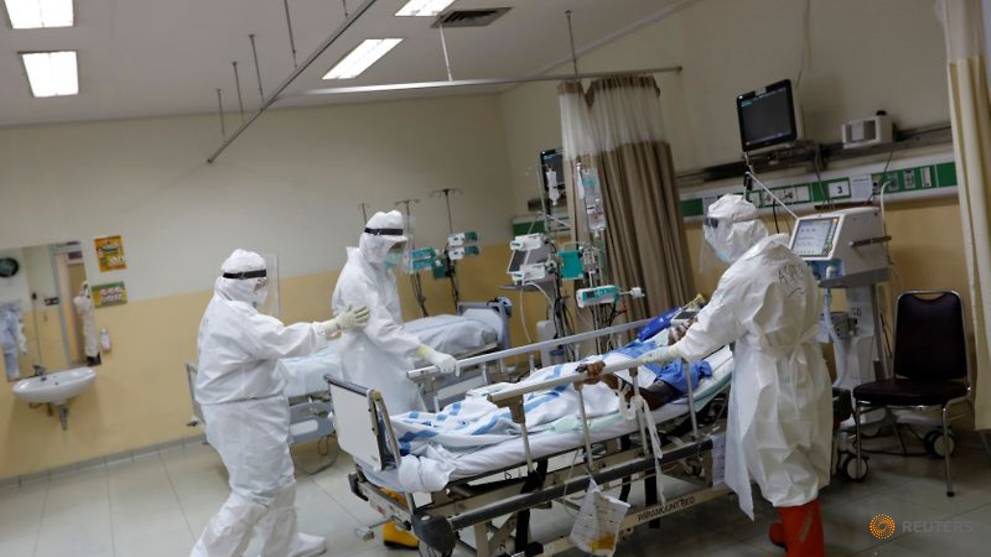
JAKARTA: Deaths of doctors from COVID-19 in Indonesia rose sharply in the first half of July, according to the profession's association, as the Delta variant of the coronavirus fuelled a surge in infections across the country.

A total of 114 doctors died during Jul 1 to Jul 17, the highest number reported for any period of similar length and more than 20 per cent of the 545 total doctor deaths from COVID-19 since the beginning of the pandemic, officials from Indonesia's doctors association (IDI) said during a virtual news conference.

Mahesa Paranadipa, a senior IDI official, said the association was concerned that the medical system may not be able to cope, according to a recording of the event.

"We are worried about the potential of a functional collapse," Paranadipa said. "This is the reported data, not yet data that may not have been reported to us."

Doctors' deaths have increased in Indonesia, the world's fourth most-populous nation, despite a 95 per cent vaccination rate among health workers. This has prompted the government to use a batch of Moderna vaccines as booster shots to China's Sinovac for healthcare workers.

READ: Grappling with 'worst-case scenario', Indonesia faces more COVID-19 pain

READ: Indonesia considers extending restrictions on movement as COVID-19 cases climb

Fuelled by the spread of the more virulent Delta variant, Indonesia has reported more new coronavirus cases than any country in the world in recent days, data from the latest seven-day average from a Reuters tracker showed. It was second only to Brazil in terms of the number of deaths.

Health experts are calling the country the new epicentre of the pandemic. Indonesia reported 44,721 cases and 1,093 new deaths from the virus on Sunday (Jul 18).

The government imposed strict mobility curbs on Jul 3 to slow the spread of the virus. They are set to end on Tuesday, but may be extended.

Adib Khumaidi, head of the IDI's mitigation team, did not immediately respond to Reuters' requests for comments.

BOOKMARK THIS: Our comprehensive coverage of the coronavirus outbreak and its developments

Download our app or subscribe to our Telegram channel for the latest updates on the coronavirus outbreak: https://cna.asia/telegram

Adblock test (Why?)


https://news.google.com/__i/rss/rd/articles/CBMibWh0dHBzOi8vd3d3LmNoYW5uZWxuZXdzYXNpYS5jb20vbmV3cy9hc2lhL2luZG9uZXNpYS1yZXBvcnQtZG9jdG9yLWRlYXRocy1jb3ZpZC0xOS1qdWx5LWRlbHRhLXZhcmlhbnQtMTUyNDQ0MDjSAQA?oc=5

2021-07-18 12:21:43Z
52781731253528

British ministers decide against mass COVID-19 vaccination for teenagers: Report - CNA

Britain has opted against mass COVID-19 vaccinations for all children and teenagers, with ministers instead preparing to offer doses to vulnerable 12 to 15-year-olds and those about to turn 18, the Telegraph newspaper reported late on Saturday (Jul 17).

The Joint Committee on Vaccination and Immunisation (JCVI) is believed to have advised ministers against the rollout of vaccines to all children until further evidence on the risks is available, the report added.

Under guidance the newspaper said are due to be issued on Monday, vaccine doses will be offered to children between 12 and 15 who are deemed vulnerable to COVID-19 or who live with adults who are immunosuppressed or otherwise vulnerable to the virus.

They will also now be offered to all 17-year-olds within three months of their 18th birthday, according to The Telegraph, which reported that the committee would keep the possibility of vaccinating all children "under review."

In response to the report, Britain's Health Department said that "no decisions have been made by ministers on whether people aged 12 to 17 should be routinely offered COVID-19 vaccines."

Britain on Saturday reported 54,674 new COVID-19 cases, a rise on the 51,870 new cases reported on the previous day to post a fresh highest daily total in six months.

British Prime Minister Boris Johnson is removing most pandemic restrictions in England from July 19, saying a rapid rollout of COVID-19 vaccines has largely broken the link between infections and serious illness or death.

Britain's COVID-19 death toll is among the highest in the world but two-thirds of its adult population have been fully vaccinated. 

BOOKMARK THIS: Our comprehensive coverage of the coronavirus outbreak and its developments

Download our app or subscribe to our Telegram channel for the latest updates on the coronavirus outbreak: https://cna.asia/telegram

Adblock test (Why?)


https://news.google.com/__i/rss/rd/articles/CBMicmh0dHBzOi8vd3d3LmNoYW5uZWxuZXdzYXNpYS5jb20vbmV3cy93b3JsZC9icml0aXNoLW1pbmlzdGVycy1kZWNpZGUtYWdhaW5zdC1tYXNzLWNvdmlkLTE5LXZhY2NpbmF0aW9uLWZvci0xNTI0MTg3MNIBAA?oc=5

2021-07-17 21:38:33Z
52781738636287