MUMBAI: People feared they would die if they stepped out of their homes. In the streets, people were weeping beside the dead. Oxygen and hospital beds were in dire shortage.
As new cases in India exceeded 400,000 and deaths exceeded 4,000 on some days last month, even the rich and connected were not spared from the devastating second wave of the COVID-19 pandemic.
But the virus did not kill the spirit of generosity.
In Mumbai, kidney dialysis patient Rozy Saldhana and her husband had basic medical facilities including an oxygen cylinder set up at home for emergencies. Despite her kidney failure, the 52-year-old did not hesitate to give the cylinder to someone else who needed it.
Her husband, Pascol, had received a call from his friend, a school principal. The husband of a teacher needed oxygen but could not get hold of a cylinder.
WATCH: In India, dialysis patient saves dying COVID-19 victims (3:22)
When Saldhana — who has been on dialysis for five years — heard about it, she told her husband to give their cylinder to the man. “Don’t worry about me. I’m fit enough,” her husband recollected her saying.
She did not stop there. She told her husband to sell all her jewellery and buy oxygen to help more people. He received 80,000 rupees (S$1,450) from the sale and did as his wife had asked.
Over in Delhi, a Sikh voluntary organisation called Khalsa Help International has set up makeshift hospital facilities in several locations to treat patients. Its free oxygen support service has saved thousands of lives since late April.
Its founder, Gurpreet Singh Rummy, said the group has not refused anyone. It has served more than 15,000 people, of whom around 8,000 to 10,000 had arrived in a critical state and would have died without oxygen support, he said.
Khalsa Help International’s oxygen support service has saved many lives.
“Whether you’re coming in a rickshaw or a Mercedes-Benz, we treat all equally. Our only priority is the level of oxygen,” he told the programme Insight.
We don’t discriminate on the basis of religion, caste, creed or if one is rich or poor. Our service is for everyone.
While getting supplies is not easy, he told Reuters that the organisation’s volunteers “travel hundreds of kilometres” to fetch oxygen, and “you can’t expect such zeal from most government bodies”.
THE PATH TO CATASTROPHE
Healthcare experts said a highly transmissible strain, complacency and large gatherings were among the reasons behind the second wave.
Last year, India was quick to impose a lockdown from late March. While it caused suffering to migrant workers within the country, it helped contain case numbers, noted Rajesh Parikh, the director of medical research at Jaslok Hospital, one of Mumbai’s top hospitals.
Dr Rajesh Parikh.
But India failed to take advantage of the respite to ramp up facilities and oxygen production, he said.
From October, most safety protocols had been abandoned, and millions of people travelled between states. Large gatherings in the form of Diwali celebrations and weddings made a comeback.
“One of the confounding factors in the second wave has been large gatherings, whether it’s for the Kumbha Mela, a religious gathering, or the political rallies which occurred throughout West Bengal,” said Parikh. These “undoubtedly” amplified the second wave.
Political rallies amplified India's COVID-19 resurgence.
The authorities also incorrectly estimated that India’s population had “possibly acquired herd immunity”, cited K Srinath Reddy, the president of the Public Health Foundation of India.
Antibody surveys were done in a “patchy” and “piecemeal” fashion across the country, with “markedly varying results”, noted the professor. The best results showed widespread detection of antibodies, hence the belief that “most of India” had herd immunity.
“The public wanted to believe it. The businessmen wanted to believe it because they wanted to put the economy back on the rails. The small traders wanted to believe it because they’d suffered a lot,” said the cardiologist and epidemiologist.
“The politicians wanted to believe it because they wanted to go back to election rallies … Even people who wanted to organise religious festivals wanted to believe that good news, because that’s their business as well.”
WATCH: The full episode — India’s COVID catastrophe: What went wrong? (48:05)
Meanwhile, a new viral strain — called the Delta variant, or B.1.617 previously — emerged and spread more quickly than doctors expected.
“We’ve seen that (if) even one person in the family is infected, the entire household comes down with the infection in the next 10 or 12 days,” said Mumbai-based infectious diseases expert Trupti Gilada-Baheti.
VACCINATION A MATTER OF URGENCY
The outcome is immeasurable grief across India. Pune resident Arun Gaikwad, a 47-year-old Indian Air Force officer, lost his wife and half her family in the span of 15 days in March and April.
They had held prayers for his late father-in-law, and one of his brothers-in-law had a cold. In the following days, nearly everyone who had gathered, including Gaikwad’s teenage daughter and son, tested positive for COVID-19.
Arun Gaikwad (left) lost his wife and half her family.
When his wife developed breathing difficulties, he rushed to several hospitals before locating one 40 kilometres away with a ventilator bed available. Two days after she was admitted, she died of cardiac arrest. Two brothers-in-law and his mother-in-law also died.
New cases have declined since last month after lockdowns were imposed. But to prevent a resurgence, doctors say the country must urgently vaccinate its people.
In a population of over 1.3 billion people, over 240 million doses of vaccine have been administered so far.
India must ensure that there are enough vaccines and ramp up its vaccination drive in both cities and villages, said Gilada-Baheti, who works at the Unison Medicare and Research Centre.
Healthcare experts say India must step up its vaccination drive.
“To keep ourselves from a very disastrous third wave, we’ll have to vaccinate a substantial number of a population at phenomenal speed,” said the doctor, who is also a consultant at Prince Aly Khan Hospital and at Masina Hospital.
Effective control measures would also ease the mental strain on healthcare professionals. “Every day in the ward or the ICU is like a battle,” said Gilada-Baheti. “Every day we see victories, and we see losses … It’s heartbreaking.”
Watch this episode of Insight here. The programme airs on Thursdays at 9pm.
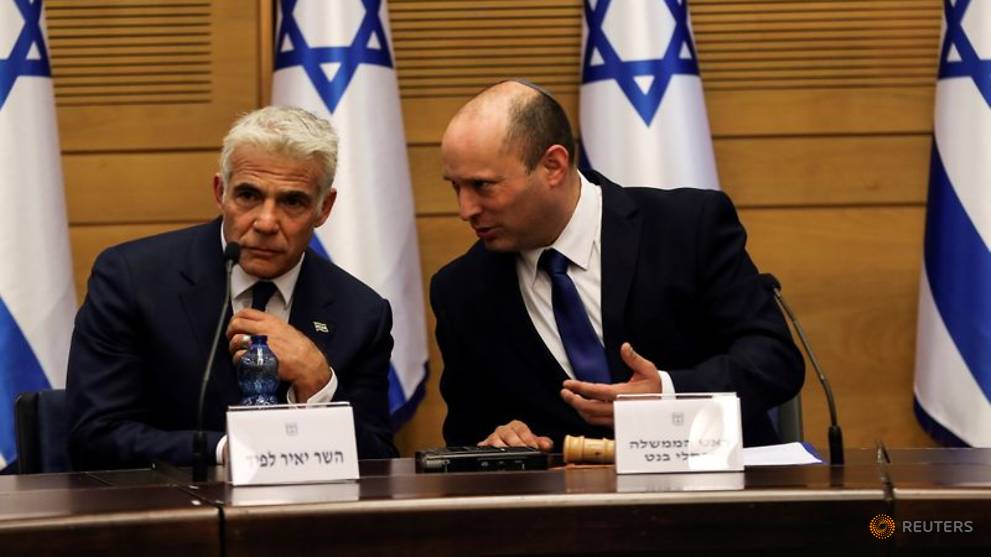
JERUSALEM: The first Israeli government in 12 years not led by Benjamin Netanyahu got down to business on Monday (Jun 14), with the former prime minister shying away from a handover ceremony with successor Naftali Bennett.
The right-wing leader's record run in office ended on Sunday with parliament approving, by a razor-thin majority of 60-59, a new administration led by Bennett, a nationalist whose views mirror Netanyahu's on many issues.
In Tel Aviv, thousands turned out to welcome the result, after four inconclusive elections in two years.
"I am here celebrating the end of an era in Israel," said Erez Biezuner in Rabin Square.
"We want them to succeed and to unite us again," he added, as flag-waving supporters of the new government sang and danced around him.
A combative Netanyahu, 71, said that he would be back sooner than expected.
"If we are destined to go into the opposition, we will do so with our heads held high until we can topple it," he told parliament before Bennett was sworn in.
The traditional handover ceremony was not scheduled at the prime minister's office, where Netanyahu was expected to meet Bennett later on Monday to brief him on state matters.
The last time Netanyahu was unseated as Israel's leader, in 1999, he ended his first term in office with a glass of wine in his hand and affable words of welcome to then Labor Party leader Ehud Barak, who defeated him at the polls.
"Sour, grumpy, not stately – Trump-like until the final moment," Yossi Verter, a political affairs commentator, wrote in the left-leaning Haaretz newspaper.
Asked why there would be no such scene now, Topaz Luk, a senior aide to Netanyahu, told Army Radio: "That's just what happens."
Netanyahu, he said, was "filled with motivation to topple this dangerous government as quickly as possible". Luk declined to disclose Netanyahu's comeback strategy, pointing only to the new administration's slim margin of support in parliament.
Luk said that the incoming government was receiving briefings from Netanyahu's diplomatic and security advisers to ensure an orderly handover.
After holding its first meeting late on Sunday, Bennett's new Cabinet was invited for a traditional group photograph, showcasing incoming governments, at the official residence of President Reuven Rivlin.
UNSEATING NETANYAHU
With little in common other than a desire to unseat Netanyahu, the patchwork coalition of right-wing, centrist, left-wing and Arab parties largely plans to avoid sweeping moves on hot-button issues such as policy towards the Palestinians, and to focus instead on domestic reforms.
Palestinians were unmoved by the change of administration, predicting that Bennett, a former defence chief who advocates annexing parts of the occupied West Bank, would pursue the same right-wing agenda as Netanyahu.
Under the coalition deal, Bennett, a 49-year-old Orthodox Jew and high-tech millionaire, will be replaced as prime minister in 2023 by centrist Yair Lapid, 57, a popular former television host.
United States President Joe Biden congratulated Bennett and Lapid, saying he looked forward to strengthening the "close and enduring" relationship between the two countries.
Addressing parliament on Sunday, Bennett put Biden on notice that he would follow in Netanyahu's footsteps in opposing any US return to the 2015 Iran nuclear deal abrogated by former president Donald Trump.
Netanyahu was Israel's longest-serving leader, and had served consecutive terms as prime minister since 2009.
He used his global stature to resist calls for Palestinian statehood, describing it as a danger to Israel's security. He sought to bypass the Palestinian issue by forging diplomatic deals with regional Arab states, on the back of shared fears of Iran and its nuclear programme.
But he was a divisive figure at home and abroad, weakened by repeated failure to clinch a decisive election victory, and by a corruption trial in which he has denied any wrongdoing.
KUALA LUMPUR - Malaysia's move to start inoculating workers in key economic sectors against Covid-19 before the completion of vaccinations for senior citizens and front-liners has drawn criticisms from several opposition politicians.
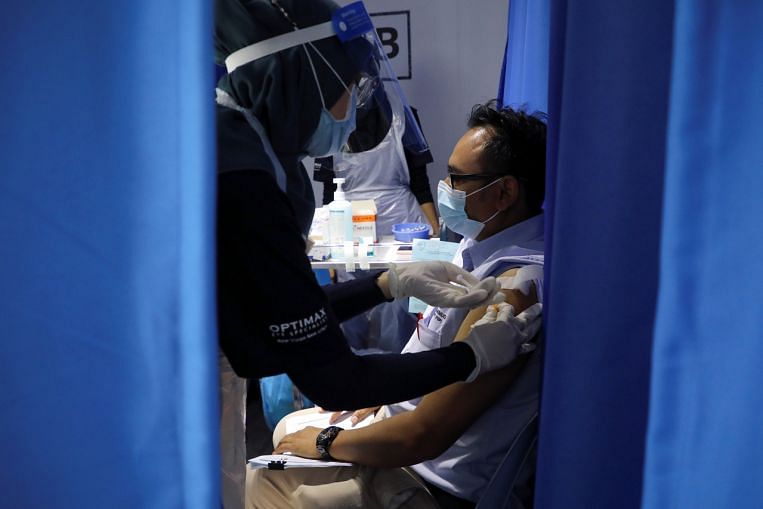
Mr Khairy Jamaluddin, the national coordinating minister for immunisation, said on Monday (June 14) that the government will begin vaccinating industry workers from Wednesday, as part of measures to reduce infections in workplaces that continue to dominate the number of new clusters.
Vaccine centres will be opened for the manufacturing, construction, plantation, retail and hospitality sectors.
A total of 30,000 doses will be set aside to inoculate factory workers this month.
"If we look at the daily Covid-19 data on Sunday, 11 out of 15 clusters are workplace outbreaks, involving almost 200 active cases," Mr Khairy told a news conference.
"This is why we made the decision for the fourth phase, or the pandemic control phase, to kick off as soon as possible to reduce the number of workplace clusters and stop the transmission of infections among workers."
But the move announced last week was slammed by the opposition who pointed out that the vaccination of front-liners and senior citizens has yet to be completed.
The management department director of the federal police, Datuk Ramli Din, revealed last week that 20 per cent of the police force, many of whom have to man roadblocks during the ongoing nationwide lockdown, had yet to be vaccinated.
Opposition Democratic Action Party (DAP) MP and former deputy education minister Teo Nie Ching said on June 10: "KJ (Khairy Jamaluddin) promised in March that teachers would be prioritised in phase two. However as at June 5, only 70,000, or 16.2 per cent, of the teachers under the Ministry of Education had been vaccinated. When will the remaining 83.8 per cent of the teachers get their vaccine?"
While some 57 per cent of senior citizens are expected to be vaccinated by mid-June, it appears the rest may have to wait while the government fast-tracks vaccines for workers, said DAP MP Khoo Poay Tiong on June 9.
"As Khairy himself has repeatedly stated, our supply of Covid-19 vaccines is limited. Starting phase four concurrently with phase two means fewer vaccines would be available for senior citizens. This is a major deviation from the government's own policy. In effect, senior citizens would have to wait longer for their vaccine although they are categorised as a high-risk group."
The states of Pahang, Terengganu and Kelantan, as well as Sabah in Borneo, have the lowest vaccine take-up rates in the country.
As at June 6, the registration rates for Pahang, Kelantan and Terengganu were 43.36 per cent, 36.83 per cent and 43.28 per cent respectively, DAP Pahang assemblyman Chiong Yoke Kong said last week.
Sabah has the lowest rate at 19.75 per cent.
In contrast, Putrajaya and Kuala Lumpur have the highest rates of 100 per cent and 70.65 per cent respectively.
Kelantan, Terengganu and Pahang also have the highest number of people who skipped their vaccine appointments, totalling more than 10,000 in each state.
Believing in fake news, not checking the vaccine app and transport issues, were some of the reasons for missing the appointments, said Mr Chiong.
Prime Minister Muhyiddin Yassin on Sunday said the government is confident that Kuala Lumpur and Putrajaya will achieve herd immunity earlier than expected by August.
Malaysia recorded 4,949 new cases on Monday, with 2,026 of them from Selangor and Kuala Lumpur.
SINGAPORE - Three independent bodies of medical experts here have reiterated that the risk of heart conditions associated with the Covid-19 mRNA vaccine is "very small", and have recommended that people still receive the vaccines in the interest of public health.
The Chapter of Cardiologists at the College of Physicians, the Academy of Medicine and the Singapore Cardiac Society said on Monday (June 14) that the risk posed by Covid-19 to health is much greater than the risk of the jabs.
"We continue to recommend that eligible members of the public go for Covid-19 vaccination as the risk of complications from Covid-19 infection continues to significantly exceed the risk from Covid-19 vaccines," they said in a joint statement.
"The vaccination helps keep the majority of individuals from getting seriously ill from Covid-19 and facilitates herd immunity in the community."
Six people here have been reported to have suffered myocarditis, or inflammation of the heart muscle, and pericarditis, or inflammation of the lining outside the heart, after getting an mRNA vaccine, among whom four are young men less than 30 years old. The other two are a man and a woman both aged above 40.
The Health Sciences Authority (HSA) said most of the cases had occurred within a few days after receiving the second dose of the vaccine, and that all have recovered or been discharged well from hospital.
Current data suggests that there is a very small risk of myocarditis and pericarditis after receiving a second dose of mRNA Covid-19 vaccine, particularly in males under 30 years old.
As a precaution, experts have advised that vaccinated people, especially adolescents and younger men, should avoid strenuous physical activity for one week after their second dose.
The Pfizer-BioNTech and Moderna vaccines, the two used in Singapore's national inoculation programme, are mRNA vaccines.
The three medical bodies on Monday acknowledged that these two countries have observed increased risk of such heart conditions, but noted that the sample size of Singapore is too small to be conclusive.
They added that they are monitoring the situation closely and will advise should there be updates.
BEIJING: China on Monday (Jun 14) accused the G7 of "political manipulation" after it criticised Beijing over its human rights record in Xinjiang and Hong Kong.
In a communique after a three-day summit in England, G7 leaders slammed China over abuses against minorities in the Xinjiang region and activists in Hong Kong, while US President Joe Biden called for Beijing to "start acting more responsibly in terms of international norms on human rights".
The Chinese embassy in the United Kingdom responded angrily on Monday, and accused the G7 of "interfering".
"The Group of Seven takes advantage of Xinjiang-related issues to engage in political manipulation and interfere in China's internal affairs, which we firmly oppose," an embassy spokesman said in a statement.
The statement accused the G7 of "lies, rumours and baseless accusations".
Human rights groups say China has rounded up an estimated 1 million Uyghurs and other minorities in Xinjiang into internment camps, which Beijing says is to eradicate Islamic extremism.
"We will promote our values, including by calling on China to respect human rights and fundamental freedoms," the G7 communique read.
They also called for a new investigation in China into the origins of COVID-19 - prompting a response from the Chinese embassy that the work needs to be done in a "scientific, objective and fair manner", without agreeing to a new probe.
"The current epidemic is still raging around the world, and the traceability work should be carried out by global scientists and should not be politicised," the embassy said.
The coronavirus first emerged in central China in late 2019, and the World Health Organization sent a team of international experts in January to probe its origins.
But their long-delayed report published in March drew no firm conclusions, and the investigation has since faced criticism for lacking transparency and access.
The G7 also announced a new infrastructure fund which President Biden said would be "much more equitable" than China's massive Belt and Road Initiative.
The Chinese embassy statement complained in response that the "accusations against China on economic and trade issues in the communique are inconsistent with the facts and are unreasonable".
SINGAPORE: Mr Jake Goh, 51, a principal of a private preschool, does not mind it when people label him as a conspiracy theorist or an anti-vaccine advocate.
“Whether I am a conspiracy theorist or not, time will tell. I’m not trying to argue with people, I’m just here to offer an alternative view. If they decide to let their children be jabbed, I can only warn them,” said Mr Goh.
He runs two Telegram groups that discuss COVID-19 and vaccine injuries, each with thousands of members surfacing claims that the two authorised vaccines here — Pfizer-BioNTech and Moderna — have caused serious side effects such as stroke.
This is despite the fact that the Singapore Government has authorised the Pfizer-BioNTech vaccine for teens aged 12 to 15, with an expert committee and the Health Sciences Authority (HSA) assessing that the vaccine is safe and efficacious to use for this group.
“You can gather a lot of knowledge from the Internet. Not everything the doctor says about vaccines is correct,” said Mr Goh.
Mr Goh was not always so radical, having dutifully received flu jabs and other types of vaccines in the past. His transformation to become an anti-vaccine advocate began last year during the pandemic, after reading articles about the drug industrial complex behind cholesterol research.
Nowadays, he gets his information from YouTubers who discuss health issues and have a wide following, as well as from health journals that he reads to "get to the source" directly. After all, newspapers can be biased, he claimed.
His contrarian views have led to conflicts with people around him. His best friends removed him from their Facebook friends list because his anti-vaccine posts have become “too extreme” lately.
His sister, who lives in France where some 110,000 people have died from COVID-19, often chides him for telling others not to get the jab when he has not seen firsthand how horrific the disease can become outside of Singapore.
BioNTech and Moderna COVID-19 vaccines. (File photo: Reuters)
But he is immovable in his radical belief that COVID-19 vaccine development was rushed: “People say I believe in conspiracy theories, that I am an anti-vaxxer, that I am crazy. Oh yes, I get that a lot.”
Mr Goh is not the only one who has been socially distanced this way during the pandemic.
Artist Zelda, 34, has also seen her family ties and long-standing relationships strained or severed, as a result of her wild and unsubstantiated claims — such as one proclaiming that vaccines are part of a money-grubbing conspiracy by the “global public health mafia”.
First, it was with her father, who reads the newspapers and has been fully vaccinated, and whom she often had heated arguments with.
To her, official narratives from governments and experts obscure the truth, while alternative viewpoints from YouTube commentators deserve to be heard.
Then, the fallout also spread to her close friends, whom she has known for decades, after she began sharing articles depicting COVID-19 as a lab-made bioweapon, and defending these articles when her friends challenged her.
Sick of arguing whenever Zelda shares articles about such theories on their mutual chat groups, some of her childhood friends have since shut her out of their lives. She declined to give her full name.
Wistfully, one of these friends said “She was always the first one to diffuse an argument. But now she believes so much in this that she’s willing to just abandon friends over it.”
Zelda recounted how voicing out these “alternative facts” during the pandemic had caused people around her to blow a fuse.
With her father, she no longer desires to discuss such theories at the dinner table. “We just say hello and good morning, that sort of thing. It’s much healthier this way.”
Her information comes from dubious sources such as web streaming service Gaia, a paid service which hosts fringe content about alternative healing and conspiracies. The United States-based website features articles discouraging people to get vaccinated against COVID-19.
On YouTube and Facebook, she would consume news from personalities who have been associated with alt-right conspiracies, such as David Wilcock and Ben Swann from the US.
News from the mainstream media outlets are not part of her regular news diet, though some “research” for her wild theories come from legitimate scientific journals with her own interpretation of what it all means.
“In this pandemic, it is quite sobering that the things that we believe in shape us, down to the relationships that we have,” she added, referring to how she is no longer on talking terms with some of her friends.
As Singaporeans, and people elsewhere, suffer from an information overload regarding COVID-19 — where fact, fiction and half-truths abound — it takes patience and effort to engage people with strongly held beliefs that are based on falsehoods, said Ms Tin Pei Ling, Member of Parliament (MP) for MacPherson.
“(They) could have good intentions too. But if one shuts them out completely, it means there are no more chances to give them the right facts, and does not give you the opportunity to understand each other better,” the chairperson of the government parliamentary committee for communications and information said.
Amid the raging pandemic, misinformation about the virus has far more serious implications than just damaged ties between family and friends alone.
If left unchecked, the scourge of malicious falsehoods and misleading half-truths could threaten to derail Singapore’s pandemic strategy, especially its national vaccination exercise that is still underway, experts specialising in infectious diseases, public communications, policy research or national security said.
But along with this progress, the number of incidents involving misinformation has also increased lately, some noted.
In the span of just a month, there were three incidents about coronavirus-related falsehoods in which Singapore’s fake news law, the Protection from Online Falsehoods and Manipulation Act (POFMA), had to be invoked, starting from late April, noted Mr Ryan Lim, founding partner of digital management consultancy QED Consulting.
In that time, Google searches on COVID-19 vaccines had spiked, he added. Presently, “Vaccine Singapore” is the top most searched term here.
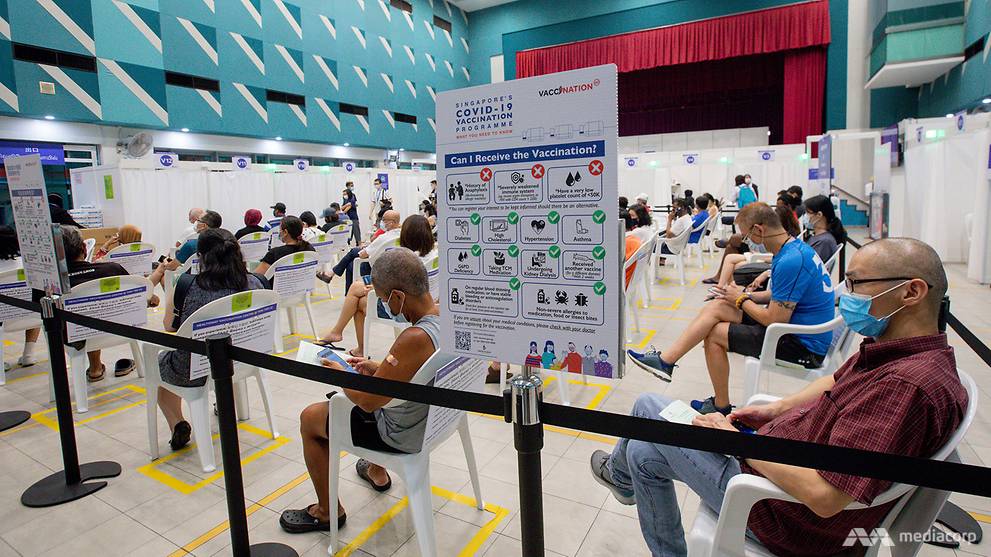
As of Jun 9, Singapore has vaccinated around 44 per cent of its population with at least one dose of the Pfizer-BioNTech or Moderna vaccines. Three in four seniors above 60 have had their jabs or booked an appointment. (File photo: TODAY/Ili Nadhirah Mansor)
On Jun 8, Health Minister Ong Ye Kung acknowledged these issues playing out on social media that had cast doubt on the safety of COVID-19 vaccines, claiming that messenger ribonucleic acid (mRNA) vaccines, such as those by Pfizer and Moderna, do not work.
He was referring to a petition by 12 doctors, who had disagreed with the Government’s decision to roll out mRNA vaccines, and also discouraged parents from vaccinating their children.
Eleven of the doctors later retracted their statement, and the authorities as well as a number of other infectious diseases experts were quick to respond to these vaccine claims.
“In fighting a relatively unknown and mutating virus, we have to steer carefully, constantly learning to navigate better, and improving on our approaches and processes. That, the Multi-Ministry Taskforce is fully committed to doing,” Mr Ong said on Facebook.
While the viral situation is under control in Singapore presently and the vaccination programme is on track, there is no telling what may come in the future when COVID-19 has become endemic, and when repeated booster shots could be needed then.
Dr Shashi Jayakumar, head of S Rajaratnam School of International Studies’ Centre of Excellence for National Security (CENS), warned that the COVID-19 situation could very well turn critical again for Singapore.
And if it does, and if trust in the state and institutions is shaken as a result, malicious rumours, falsehoods, half-truths and misinformation would be back to plague Singapore’s pandemic response once again.
“We are starting from a good position now. But hypothetically, if there is wave after wave of infections, and lockdowns after lockdowns are needed, that would be the fertile ground for malicious misinformation to proliferate,” he said.
Tracing the roots of misinformation to their sources would likely reveal one of several motivations behind its spread: These include political and ideological reasons, commercial profit, mischief, but also cases of genuine misunderstanding, said experts.
QED’s Mr Lim said: “Such false content tends to thrive in an environment with a high degree of anxiety and ambiguity. The successful spread will create a vicious circle that encourages more of such content to be created.”
Such anxiety was the case at the beginning of the pandemic on Jan 23 last year, when Singapore announced its first imported case of the novel coronavirus, which originated in Wuhan, China.
At a time when people were closely watching the developments in China, where several people had died from the new disease, a post by a user in the HardwareZone online forum claimed that a 66-year-old man had died from the virus on Jan 26.
By then, Singapore had counted only its fourth confirmed case of COVID-19.
This false claim by the user named Potato_salad was quickly dismissed by the authorities the next morning, when POFMA was used. The relatively new law had come into force only four months earlier.
A general correction direction was issued to SPH Magazines, which operates the forum, to publish a correction notice to its Singapore users to inform them of the falsehood.
To date, POFMA has been used in 14 separate instances concerning COVID-19-related falsehoods.
But the amount of misinformation being spread during the pandemic is far more numerous than those flagged by the fake news law, which on its own, is insufficient to stop people from believing these claims, said experts.
False content tends to thrive in an environment with a high degree of anxiety and ambiguity. Such anxiety was the case at the beginning of the pandemic on Jan 23 last year, when Singapore announced its first imported case of the novel coronavirus, which originated in Wuhan, China. (File photo: TODAY/Nuria Ling)
Associate Professor Alton Chua from the Wee Kim Wee School of Communication and Information at Nanyang Technological University said that while POFMA is designed to nip the spread of falsehood in the bud, it is no silver bullet when it comes to shaping beliefs.
“Most falsehoods on the COVID-19 virus and vaccines that are swirling around are what is known as dread rumours. Unlike wish rumours which invoke hope and optimism, dread rumours spell doom and gloom,” he said.
People can also suffer from confirmation bias, choosing to interpret information in a way that conforms to their existing beliefs, he said. That means that those who are sceptical about COVID-19 vaccines, for example, tend to exaggerate reports they come across about post-vaccination complications.
“Hence, any dread rumours about COVID-19 vaccination will be uncritically lapped up. The mindset of ‘better be safe than sorry’ is ironically what compels these people to share untruths,” he said.
Citing a recent small-scale research conducted by his graduate student, Assoc Prof Chua said a majority of respondents were averse to sharing misinformation related to COVID-19 because they were able to discern that the messages were of a dubious nature and that it would be unhelpful to share them with people.
When probed further, POFMA did not emerge as a deterrent factor at all among the respondents, he added.
“In the fight against online falsehood during this pandemic, information literacy and education remains an important anchor,” Assoc Prof Chua said.
(Are COVID-19 vaccines still effective against new variants? And could these increase the risk of reinfection? Experts explain why COVID-19 could become a “chronic problem" on CNA's Heart of the Matter podcast.)
FAST-EVOLVING PANDEMIC CONDUCIVE FOR MISINFORMATION
When it comes to COVID-19, however, the scientific nature of the coronavirus and vaccines renders it hard for people to make their own conclusions about the science. Thus, it is key that people can turn to experts with the right credentials and experience to help them sort fact from fiction.
What makes this pandemic a perfect storm for misinformation to be reinforced and spread is because it concerns a new virus, fast-emerging viral strains, and cutting-edge vaccines that will take time to fully understand them.
And with science still playing catch-up with an evolving disease, there is a danger that misinformation can fill in the void and could even foster mistrust of scientific methods.
One common example cited by some conspiracy theorists was Singapore’s insistence at the start of 2020 that face masks should be used only when a person was feeling unwell or showing symptoms.
The guideline later changed to require face masks to be worn at all times, when scientists discovered the possibility of asymptomatic spread of COVID-19 and the World Health Organisation also switched its stance on face masks.
To some, the episode meant that trusting one’s instincts is better than listening to what the authorities say.
People wearing face masks while out marketing at Pasir Ris on June 10, 2020. (Photo: TODAY/Raj Nadarajan)
Zelda said she feels frustrated watching government officials speak about the safety measures needed: “I think they are trying their best. But as a human, do I need to rely on an external party for a decision about my own life? My answer is no.”
Asked about this, Dr Carol Soon and Mr Shawn Goh from the Institute of Policy Studies (IPS) at the Lee Kuan Yew School of Public Policy said that a study they conducted last year had found that false information relating to health and medicine was second out of 11 topics that were most frequently believed by Singaporeans.
Falsehoods about international and foreign affairs came out tops in the study.
In an email interview, they said: “There may be two possible reasons for this. First, health misinformation is perceived to have a direct impact on people’s lives. Negativity bias is also at play as we are evolutionarily hardwired to respond more strongly to survival threats.
“Second, navigating the online space for credible medical information requires not only digital literacy, but also scientific literacy, which many people may not possess sufficiently.”
FALSEHOODS ON VACCINE SAFETY
Dr Soon and Mr Goh warned that they have observed increasingly active forms of “online mobilisation” among people who circulate unverified information or mistruths about COVID-19 vaccine safety and its purported side effects.
Examples include people making allegations that healthy individuals had experienced medical complications or died after receiving their vaccination, and sharing photos of severe rashes and swelling that they claim to be vaccine-induced.
The HSA reported in May that out of the 2.2 million vaccine doses administered until mid-April 2021, there were 95 reports of serious adverse effects such as anaphylaxis, but no deaths have been linked to the vaccines so far.
POFMA was used against opposition member Goh Meng Seng who had published several false statements implying that the vaccines had caused or substantially contributed to death or stroke.
Despite these clarifications from the authorities, the unproven theory that vaccines lead to death continue to pervade the online space in Singapore. The IPS researchers noted that some people who engage in such content have come up with a range of strategies.
“They include setting up Facebook groups to share misinformation, and creating Google forms to solicit stories and cases of vaccine injuries, often without the full context. Mobilisation is also taking place in closed-group platforms such as WhatsApp and Telegram.
“The end-to-end encryption technology that undergirds instant messaging apps hinders timely misinformation detection and debunking,” they said.
Their study had also noted that instant messaging platforms and social networking sites were the top two types of media where people most frequently encountered and believed in false information.
Mr Jake Goh, the private preschool principal who runs one such group on Telegram, claimed that its purpose is to create awareness because “transparency is needed in public health”, so that the public can make an informed decision about vaccines.
“We are filling the gap that the Ministry of Health and all the relevant authorities are not providing or not announcing,” he said.
When asked if he or the other moderators of the platform curate the information shared in the Telegram group, Mr Jake Goh insisted that it is not possible for them to fact-check every post.
“Yes, I am of course concerned if misinformation seeps into the group. So if they mention things like (Donald) Trump or Bill Gates, we will remove the posts. But there is no way the layman can know what is correct or not, so we have to learn from everywhere, and read widely.
“We are just there as a sounding board to surface alternative views,” he said.
He claimed that his vaccine scepticism is backed by his own research, having read through the trial data and reports of existing vaccines, and concluding that the vaccine trials were not thorough enough.
The IPS researchers’ study had noted that instant messaging platforms and social networking sites were the top two types of media where people most frequently encountered and believed in false information. (File photo: TODAY/Ili Nadhirah Mansor)
On this, IPS’ Dr Soon and Mr Shawn Goh said that it is often the case that those who go the extra mile to look up information on vaccine efficacy may end up reinforcing their own beliefs.
“Their false beliefs may be reinforced when they draw invalid conclusions from scientific studies without a full appreciation of their robustness, or if they turn to ‘scientific journals’ that are not actually recognised by the expert community,” they said.
Referring to these online mobilisation efforts as well as the petition against mRNA vaccines by the 12 doctors, Dr Soon and Mr Shawn Goh added: “Without intervention, these online spaces allow anti-vaccine views to fester and gain perceived legitimacy as they grow in size.”
ESTABLISHING LINKS BETWEEN VACCINES AND DEATHS: WHAT PUBLIC NEEDS TO UNDERSTAND
When asked why scientists cannot categorically state that COVID-19 vaccines do not cause death in order to lay these mistruths to rest, experts stressed the importance in trusting the scientific method — that conclusions can only be reached after observations, experiments and measurements are done.
Professor Teo Yik Ying, dean of the Saw Swee Hock School of Public Health, said that there is a clear difference between proof of absence and the absence of proof.
Explaining, he said it is one thing to issue a statement such as “in all the participants in the clinical trials, we have not observed a death event”, as opposed to “this vaccine does not cause death in anyone who takes it”.
“There is a need to systematically review the evidence of any mortality event that is suspected to be linked to the vaccine to understand whether taking the vaccine caused the fatality,” he added.
“This mechanistic link is indeed a challenge to establish properly. This is why regulatory agencies worldwide, not just in Singapore, have been monitoring adverse events that are purportedly linked to the vaccines, so the data and knowledge can be accrued, shared internationally, and reviewed jointly, in order to understand the real-world impact of the vaccines.”
Because proper science takes time, it thus falls to a close partnership among responsible scientists, responsible media and trusted public agencies to be agile in responding to fake news in the meantime, he said.
All three parties are essential to this effort, since no single stakeholder holds all the cards needed to combat fake news.
The media and fact-checking organisations, for example, do not have the complete information needed to deal with complex scientific problems, but they should have access to trusted experts and policymakers to distill the information for the public.
This also means people should be wary of scientists who are not properly informed themselves, as well as irresponsible ones who could have been generating and spreading misinformation, said Prof Teo.
“While (stopping the circulation of fake news) appears to be additional workload to people who may already be busy fighting the pandemic, it is just as important in the overall pandemic control, especially if the fake news will make people act or react in a certain way that causes harm to themselves or others in the community,” he stressed.
When asked why scientists cannot categorically state that COVID-19 vaccines do not cause death in order to lay these mistruths to rest, experts stressed the importance in trusting the scientific method — that conclusions can only be reached after observations, experiments and measurements are done. (File photo: TODAY/Nuria Ling)
ORCHESTRATED DISINFORMATION CAMPAIGNS
Another aspect of misinformation concerns the threat of state-led disinformation campaigns, in the light of efforts by some countries to promote “vaccine diplomacy”.
China, for example, is donating vaccines to regions where its competition with the US for influence is intense, reported Reuters news agency. The US has also announced its plans to donate 500 million doses of vaccines to the developing world, including in Asia.
But could vaccine diplomacy also take on a more aggressive stance, such as by resorting to disinformation campaigns to discredit another country’s vaccine? Are such efforts already underway in Singapore?
It is possible, though drawing a link between a falsehood and a state-originated disinformation campaign is difficult, said Ms Dymples Leong, a senior analyst at CENS.
She noted that there has been misinformation revolving not just around vaccines in general, but also certain vaccines in particular.
“One example (of misinformation) is the claim that mRNA-based vaccines are ineffective against COVID-19 variants, or claims which encourage people to support one vaccine over the other due to reasons such as vaccine nationalism,” said Ms Leong.
On social media in recent weeks, comparisons of efficacy have been made between mRNA-based vaccines which are developed in Western countries, such as Pfizer-BioNTech and Moderna, and the virus vector and inactivated virus vaccines, such as Russia’s Sputnik V and China’s Sinovac and Sinopharm.
Some doctors, including Dr Oon Chong Jin, a private cancer specialist who championed hepatitis B vaccination in Singapore, issued statements that circulated on social media claiming that inactivated virus vaccines such as Sinovac are more effective against COVID-19 variants, whereas mRNA-based vaccines were “useless” against these new strains.
Dr David Lye, the director of infectious disease research at the National Centre for Infectious Diseases, rebutted these statements on Monday, stating that mRNA vaccines were the most effective against the variants and there were hardly any data about this for Sinovac. He also spoke out against doctors who “quote dubious international experts and research potentially misleading the public”.
The expert committee on COVID-19 vaccination under the Ministry of Health has also refuted the online claims. It pointed out that Pfizer-BioNTech and Moderna mRNA vaccines have in various studies “consistently shown to be highly efficacious, at around 90 per cent, especially in protecting against severe COVID-19 disease and hospitalisation”.
These were demonstrated in various trials and actual roll-outs in the United States, United Kingdom and Israel. Emerging data continues to show that the mRNA vaccines are also effective against the B1617 variant. For instance, a study in the UK showed that two doses of the Pfizer-BioNTech mRNA vaccine confer about 88 per cent protection against symptomatic COVID-19 even with the delta or B16172 variant.
The term “vaccine nationalism” was also used by Senior Minister Teo Chee Hean, who is also Coordinating Minister for National Security, in a Facebook post last week.
Vaccine nationalism was the top concern among volunteers at a meet-the-people session, and whether the competition among countries will cloud scientific and medical facts and what to believe amid all the noise that is suddenly being created, wrote SM Teo.
He said in response to a Facebook user comment: “It is not West or East, but science and facts. The question is whether the data provided for evaluation is sufficient for HSA to clear it for general use by Singaporeans, to make sure it is safe for us and our families.”
Asked whether vaccine geopolitics is at play in Singapore, CENS’ Dr Jayakumar said there is no doubt that vaccine diplomacy is now an important “calling card” of national soft power, so there are tensions whenever that soft power is being undermined.
He said that messages of indeterminate origin have been bandied around on social media creating fear about certain vaccine types, though he agreed with Ms Leong that it is not easy to conclude that these are state-led efforts.
Nevertheless, Singapore is also being closely watched for what vaccines it buys and uses for its national vaccination programme, he added.
“Worldwide, we do see certain countries trying to burnish the credentials of certain vaccines. Around the edges of this issue is that Singapore is seen as an index customer, that we are not just any country but a country with acute judgement.
“It is universally recognised that when we choose certain vaccines, questions may be asked as to why we did not choose another one,” said Dr Jayakumar.
The first batch of Pfizer-BioNTech vaccines arrived in Singapore on Dec 21, 2020. (Photo: TODAY/Raj Nadarajan)
GREATER TRANSPARENCY, ENGAGEMENT THE ANTIDOTE?
With such a wide spectrum of motivations behind the spread of misinformation, tackling pandemic falsehoods is a challenging task for any government, said experts.
In the United Kingdom earlier this year, when it was facing a surge in COVID-19 cases caused by a mutant strain, the scourge of misinformation reared its ugly head during the country’s third national lockdown.
Anti-vaccination and anti-lockdown protesters, as well as demonstrators who falsely believed that COVID-19 was a hoax, ended up picketing hospitals and verbally abusing exhausted doctors, teachers and other frontline workers, reported British news outlets.
And in the US, misinformation about the origins of COVID-19 arguably contributed to a rise in hate crimes towards residents of Asian descent, prompting legislators to expedite a COVID-19 Hate Crimes Act aimed at stopping these attacks.
This is why Singapore cannot ignore malicious falsehoods, lest they take hold in society, said those interviewed.
Ms Tin, the MacPherson MP, said: “The Government is faced with the responsibility to contain and control the virus in the fastest time possible to reduce the damage to our people to the minimum possible.
“After all, at the national level, if there are people who are spreading misinformation, discouraging people from receiving the vaccination or from complying with the safety rules, then you can imagine how much it will slow down our pandemic response or even derail it.”
Fortunately, Singapore is not faring too bad when it comes to managing misinformation, said Assoc Prof Chua from the Wee Kim Wee School of Communication and Information.
“When the vaccination programme in Singapore started early this year beginning with senior citizens, there was a palpable sense of apprehension. It didn’t help that there were cases of post-vaccination deaths reported overseas, albeit rare,” he recalled.
But these myths were quickly dispelled through the mainstream media and with the help of infectious diseases experts, said Assoc Prof Chua. Television commercials and public service campaigns, some of which featured Gurmit Singh’s iconic Phua Chu Kang character, drove home the importance of vaccination.
CENS’ Ms Leong pointed to the comic series “The Covid Chronicles”, by the National University of Singapore’s Yong Loo Lin School of Medicine and illustrator Sonny Liew, as a good example of explaining the science of COVID-19 in an engaging format.
IPS’ Dr Soon and Mr Goh said of these efforts: “Effective communication of science is needed to build resilience against vaccine misinformation and foster public trust in science.
“Public messaging should be clear and simple, for example by stating that vaccines are safe and effective, and highlighting scientific consensus on the matter helps inoculate people from being swayed by misinformation that claim otherwise.”
Dr Jeremy Lim, from the Saw Swee Hock School of Public Health, who often comments on public health policy, said he is sympathetic to those with alternative views. But he also noted that disagreements between doctors and professionals can still be cordial, agreeing to disagree.
That said, transparency must also come from scientists, doctors, public health professionals too, considering that the nature of novel diseases means there will be limited data and experience to go by.
“In public communications, it’s important to share views and recognise alternative ways of interpreting data, as well as be clear why one disagrees with certain points made,” said Dr Lim.
While some may argue that alternative views have been shut out of the official narrative, Singapore’s public communications strategies by and large have allowed national vaccination take-up rate to maintain a healthy trajectory, said those interviewed.
After all, the proof is in the pudding, they said.
Demonstrators at an anti-lockdown and anti-vaccine protest in London on May 29, 2021. (Photo: Reuters)
But at the individual level, when confronted with someone with wildly differing views that are based on falsehoods, Ms Tin urged people to not dismiss them and instead listen closely to their concerns.
“Sometimes that can be very difficult to do and it can be an emotional experience,” said Ms Tin. “But we just have to try.”
And sometimes, this endeavour pays off, as the experience of retired tuition teacher Mrs Chia W M, 68, shows.
Speaking in Mandarin, she said that for the longest time, she did not want Western vaccines because YouTube videos had convinced her that they were more dangerous than the “traditional” Chinese vaccines and would alter her DNA.
One message sent from a friend even falsely ventured to say that people who took the vaccine would die within two years.
“I didn’t go look for these videos ... it was my friends who sent them to me,” she said when asked about her news consumption habits.
Her three sons kept bugging her to get jabbed for her own safety, telling her that the videos she watched were not legitimate news sources. She also believed that the Government may restrict the movements of unvaccinated persons.
So in April, she overcame her fear of the mRNA vaccine and headed to the vaccination centre to get the Pfizer jab. Mrs Chia grew worried when she got a high fever after her second dose in May.
The fever subsided quickly the next day and life returned to normal. Mrs Chia still slightly worries about the long-term side effects that the videos have warned her about.
But in the end, her fears about being jabbed were much ado about nothing. “It wasn’t a big deal after all,” she said.