Rabu, 23 September 2020

Anwar Ibrahim says he has 'strong majority' to form a new government in Malaysia - CNA

KUALA LUMPUR: Malaysia’s Opposition Leader Anwar Ibrahim announced on Wednesday (Sep 23) that he has garnered a "strong, formidable, convincing majority" of Members of Parliament (MPs) to form a new government. 

The Parti Keadilan Rakyat (PKR) president said in a press conference that as such, the current government led by Prime Minister Muhyiddin Yassin has fallen. 

READ: As Sabah heads to polls on Sep 26, what's at stake for the main political blocs?

"I was supposed to have an audience with the king on Tuesday 11am but it was postponed because His Majesty was hospitalised," said Mr Anwar, adding that he had spoken with the king on telephone on Tuesday night. 

On Tuesday evening, Istana Negara said Malaysian King Al-Sultan Abdullah Ri'ayatuddin Al-Mustafa Billah Shah had been admitted to the National Heart Institute.
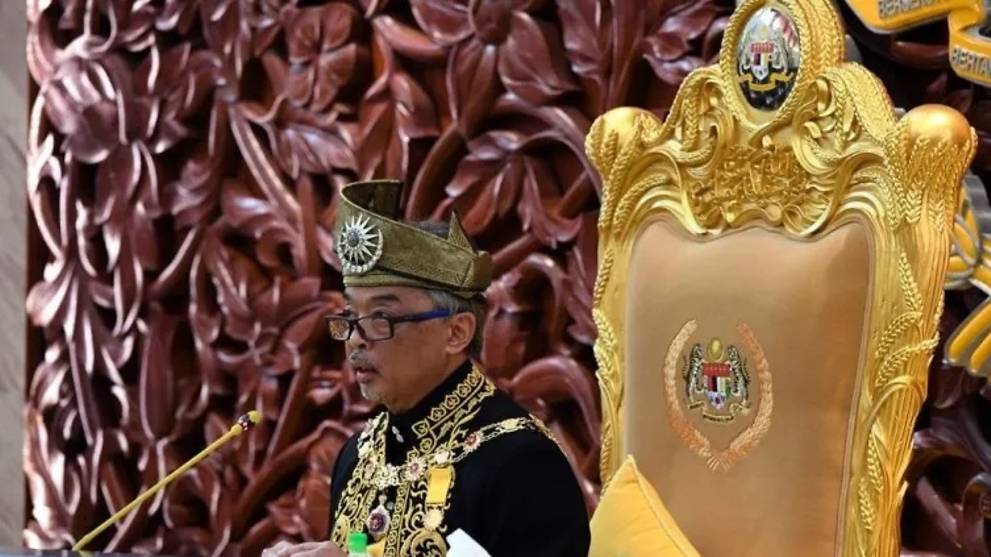
Malaysian king
Malaysian King Al-Sultan Abdullah Ri'ayatuddin Al-Mustafa Billah Shah giving a royal address at parliament on May 18, 2020. (Photo: Bernama) 

When asked to reveal the list of MPs who are with him, Mr Anwar replied that he would only reveal this after the royal audience. 

He claimed that he has close to two-thirds parliamentary majority. "Not four, five or six ... I'm talking about much more than that," he said. 

Those who supported him, he said, would have to respect integrity, good governance, anti-corruption and the rule of law.

"Of course it is a Malay Bumiputera-majority, but a (government) that is inclusive of race and religious denominations in the country. That is a very clear position that I'm not prepared to compromise. I'm glad to say, those with me have decided and have strongly endorsed this position," he noted. 

Previously, Mr Anwar had been tipped to take over from Dr Mahathir, who became the country’s seventh prime minister after Pakatan Harapan (PH) defeated Barisan Nasional (BN) coalition in the 2018 general election.

READ: Commentary - Malaysian politics is going through a midlife crisis

Mr Anwar, who was serving a jail term for sodomy, was granted a royal pardon days after PH’s shock victory.

The transition plan from Dr Mahathir to Mr Anwar had been a significant source of tension in PH as the former had repeatedly declined to give a concrete timetable as to when he would step aside for Mr Anwar to take the reins.
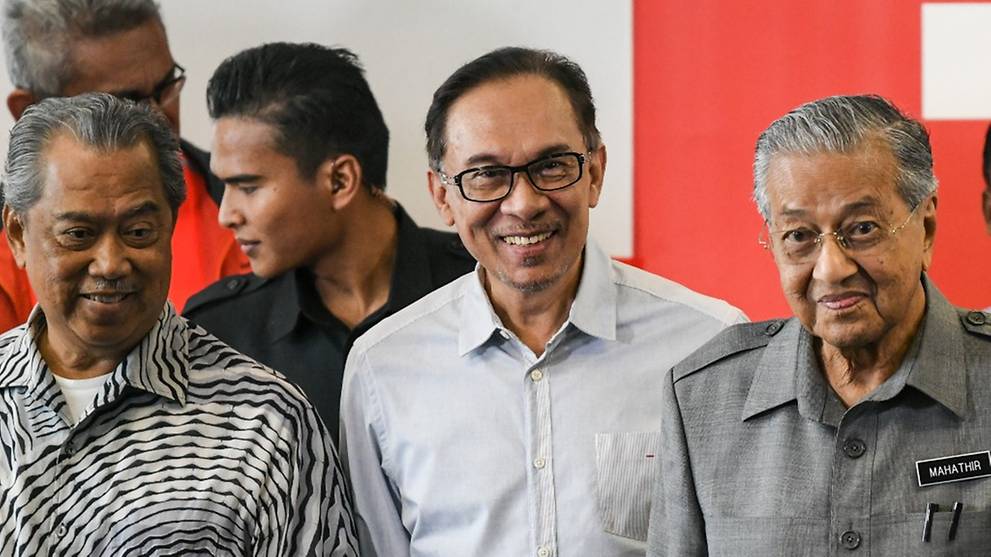
Mahathir Anwar Muhyiddin
Dr Mahathir Mohamad (right), Anwar Ibrahim (centre) and Muhyiddin Yassin leave after a press conference in Kuala Lumpur on Jun 1, 2018. (File photo: Mohd RASFAN / AFP) 

Dr Mahathir abruptly resigned in February and defectors from PH then worked with BN to form the Perikatan Nasional (PN) government. 

Mr Muhyiddin, president of Parti Pribumi Bersatu Malaysia (Bersatu), became the prime minister, after the king met all MPs and found that Mr Muhyiddin likely commanded the support of majority of the lawmakers.

Dr Mahathir and his allies were subsequently removed from Bersatu. They later announced that they would form a new party called Pejuang

PH politicians have cried foul over PN’s political coup to wrest federal power, although the COVID-19 pandemic and government-instituted movement control order to stem the contagion temporarily abated much of the political feud. 

United Malays National Organisation, which has always held the prime minister position before BN’s fall and is now part of the PN government, has repeatedly called for a general election to be held to get rid of the “backdoor government” impression. 

Mr Muhyiddin, when campaigning in the ongoing Sabah state election, said a general election can be called if the state coalition he put together wins the Sabah polls on Sep 26. 

Mr Anwar is currently facing a lawsuit filed to challenge the legality of a royal pardon he received two years ago, with the dates for case management and trial fixed in 2021. 

MUHYIDDIN TO ADDRESS THE NATION IN THE AFTERNOON

In his Wednesday press conference, Mr Anwar revealed that Dr Mahathir's Pejuang was not part of the majority support he has commanded. 

"He may decide later, but now, no," he said. 

Parti Amanah Negara, a PH component party, has pledged its support for Mr Anwar.

"All 11 MPs from Parti Amanah Negara fully support the leadership of Datuk Seri Anwar as PH chairman and place trust in him to form a new government," Amanah president Mohamad Sabu said in a statement that was issued shortly after Mr Anwar's presser. 

Mr Muhyiddin was scheduled to give a live address at 2.30pm on Wednesday.

In an apparent response to Mr Anwar's announcement, Minister for Science and Technology Khairy Jamaluddin tweeted a photo of a Cabinet meeting around noon. "Just finished Cabinet ministers' meeting. Nothing has toppled or fallen," he said. 

Let's block ads! (Why?)


https://news.google.com/__i/rss/rd/articles/CBMibWh0dHBzOi8vd3d3LmNoYW5uZWxuZXdzYXNpYS5jb20vbmV3cy9hc2lhL21hbGF5c2lhLWFud2FyLWlicmFoaW0tc3Ryb25nLW1ham9yaXR5LWZvcm0tbmV3LWdvdmVybm1lbnQtMTMxMzY5MDjSAQA?oc=5

2020-09-23 06:00:00Z
52781078653607

Selasa, 22 September 2020

How can Singapore reopen its borders and keep people safe? - The Straits Times

To stop Covid-19 from entering the country, Singapore shut its doors to travellers. But in the last three months, it has gradually reopened its borders, increasing the risk of infections creeping into the community. To beat the virus while trying to revive the hard-hit travel and aviation industries, the Republic has set up numerous safeguards - to keep cases low, even as numbers surge in some other countries.

A BALANCING ACT

The risk from imported cases is not new, and in fact, border controls have always been a cornerstone of the Republic's defence strategies, experts told The Straits Times.

But the challenge now is to reopen borders in a safe and controlled way amid a pandemic that is still raging in other parts of the world, said Associate Professor Josip Car, director of the Centre for Population Health Sciences at Nanyang Technological University's Lee Kong Chian School of Medicine. The growing knowledge of how to stop the virus spread would help the country reopen its borders smartly, he noted.

But as more countries experience worsening outbreaks, including India and those in Europe, the Middle East and the Americas, it becomes more important to be prudent and cautious when arranging travel green lanes, to protect the fragile local situation that has been brought under control after much effort, said Professor Teo Yik Ying, dean of the National University of Singapore's (NUS) Saw Swee Hock School of Public Health.

For instance, France reported more than 10,000 new cases on Sunday, while Britain reported almost 4,000 cases that same day.

Conversely, said Prof Teo, priority for travel arrangements should be given to countries with a stable local situation and which have similarly put in place strict public health measures.

The biggest benefit, when it comes to aviation and travel, will be through the resumption of mass market tourism, but it comes at a price: It poses the greatest risk to the country.

"Governments worldwide will really need to decide whether regaining the economic activity from tourism justifies the risk to the rest of the local economy," said Prof Teo.

For some countries, this decision is a difficult one as tourism drives a major segment of the local economy, but for many others, shutting down mass market tourism to safeguard the rest of the economy and allow the rest of the community and society to function is a necessary compromise.

Singapore does not expect "no new cases", and there would be a tolerance for a small number of imported cases, said Professor Dale Fisher, a senior consultant in the infectious diseases division at the National University Hospital.

He said it is crucial that visitors entering the country continue to obey the rules on mask wearing and safe distancing, and not having gatherings of more than five in a group.

Asked about the speed at which Singapore is reopening its borders, Prof Fisher suggested that the country could afford to quicken its pace.

"I am sure there is a lot of behind-the-scenes work between governments, health insurers and those in the travel industry to make it happen. Any country that has few cases, does contact tracing quickly and has few unlinked cases should be 'approved'."

If there are additional risks, stricter restrictions such as a week-long stay-home notice and wearing a contact-tracing device can then be added, Prof Fisher said.

FACTORS TO CONSIDER

It is useful to break down the importation risk into three components, said Associate Professor Alex Cook, vice-dean of research at NUS Saw Swee Hock School of Public Health.

First, assessing the level of risk of an arriving passenger being infected from that particular country, which would determine which countries to prioritise having travel arrangements with.

Second, determining how much of this risk of virus spread to the community can be reduced through the nation's "fences", such as having a two-week quarantine compared with a week-long quarantine, or even a rapid test at the airport.

The fence is an approach highlighted by coronavirus analyst Tomas Pueyo in a New York Times article this month. Fences are necessary to control the virus, and are effective if enforced, he said.

Finally, the third component is that should infections creep into the community, how much of this spillover is considered tolerable, Prof Cook said.

"(Having) no spillover infections would be perfect, but of course, we might tolerate one spillover infection, or five, if it helps to reinvigorate the economy. The combination of these three components determines which countries and how many travellers we can accommodate," added Prof Cook.

Prof Car noted that the kinds of tests and the respective thresholds should also be considered. For example, the amount of genetic material that is detected before a test is considered positive and how accurate a test is are different depending on the test used.

Ultimately, Prof Fisher said, one has to look beyond case numbers.

"It is about whether the country knows where its cases are."

Most Malaysian cases were recently from two clusters in Sabah and Kedah, while most Australian cases lately have been in Victoria. Having a handle on where the cases originated and being able to effectively contact trace and quarantine these cases would make the country an unlikely source of infected travellers, Prof Fisher said.

Prof Teo agreed, adding that a well-established and functional surveillance and management protocol, and having the political will to isolate and quarantine whenever necessary, will be enduring aspects in keeping the Covid-19 situation under control.

Another aspect worth noting is whether a country is transparently reporting the local situation, or whether there is a considerable degree of under-reporting due to insufficient testing capacity or incomplete surveillance - for instance, when certain segments in the community are overlooked, such as those living in informal dwellings like slums, and unregistered migrant workers, Prof Teo said.

MANAGING RISK

Given how complex the pandemic has been, risk needs to be managed with multifarious strategies, ranging from the individual (being vigilant and adhering to protocols, for instance) to the government level, said Prof Car.

Government processes such as rigorous protocols for testing, guidance on pre-arrival tests and quarantine would be necessary, and these need to be tailored to balance risk, inconvenience and cost for travellers, Prof Car explained.

What works in one country may also not be transferable to another due to cultural, social, scale or economic factors, he added.

"Individuals also need to be reminded that there is no perfect test and a negative result is not a 100 per cent guarantee that they cannot spread the virus."

Relying on testing to shorten the quarantine period will always result in some leakage and this risk increases if the traveller is coming from a location with a severe outbreak, Prof Teo said.

However, a strict quarantine effectively stops many short trips, Prof Cook said, stressing that testing travellers remains key to reducing risk.

"The question is how and when to test to keep the risk tolerable. For instance, if they are tested before they arrive in Singapore, they could still be infected after the test. I'm inclining towards a rapid test on arrival, followed by a repeat test a few days later to confirm negativity," said Prof Cook.

Ultimately, Singapore's aim has always been to live with the virus, Prof Fisher said, unlike some countries such as New Zealand, China and Vietnam, which aim for eradication.

Related Stories: 

Let's block ads! (Why?)


https://news.google.com/__i/rss/rd/articles/CBMiYGh0dHBzOi8vd3d3LnN0cmFpdHN0aW1lcy5jb20vc2luZ2Fwb3JlL2JhbGFuY2luZy10aGUtbmVlZC10by1yZW9wZW4tY291bnRyeS1hbmQta2VlcC1wZW9wbGUtc2FmZdIBAA?oc=5

2020-09-22 21:00:00Z
CBMiYGh0dHBzOi8vd3d3LnN0cmFpdHN0aW1lcy5jb20vc2luZ2Fwb3JlL2JhbGFuY2luZy10aGUtbmVlZC10by1yZW9wZW4tY291bnRyeS1hbmQta2VlcC1wZW9wbGUtc2FmZdIBAA

China has no intention to fight 'a Cold War or hot one' with any country, says Xi at UN - CNA

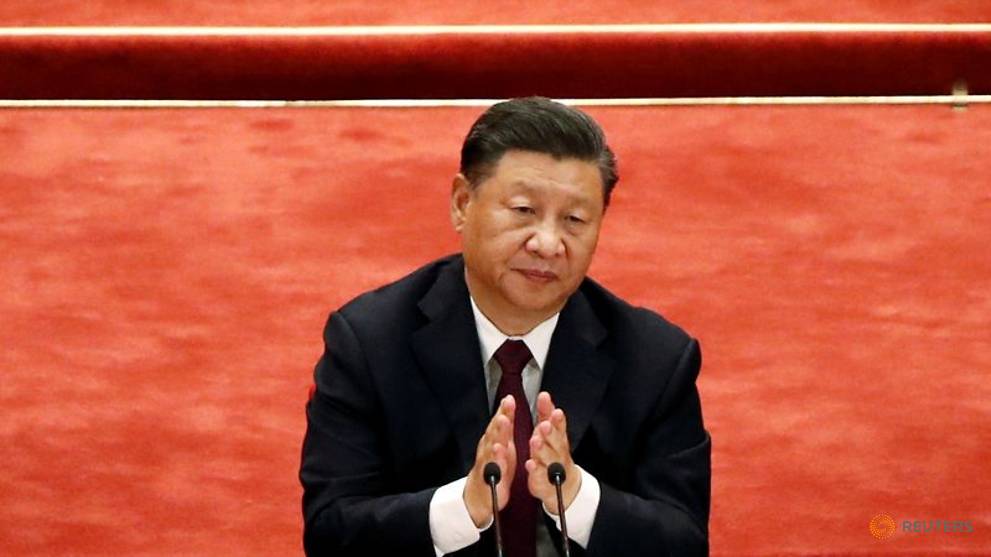
NEW YORK: US President Donald Trump told the United Nations General Assembly on Tuesday (Sep 22) that China must be held accountable for having "unleashed" COVID-19 on the world, prompting Beijing to accuse him of "lies" and abusing the UN platform to provoke confrontation.

China's President Xi Jinping struck a conciliatory tone in his pre-recorded virtual address to the General Assembly, calling for enhanced cooperation over the pandemic and stressing that China had no intention of fighting "either a Cold War or a hot war with any country".

READ: Trump says UN must 'hold China accountable' for COVID-19

But China's UN ambassador Zhang Jun rejected Trump's accusations against China as "baseless" and said "lies repeated a thousand times are still lies".

Trump and Xi, leaders of the world's two largest economies, laid out competing visions at a time when relations have plunged to their worst level in decades, with coronavirus tensions aggravating trade and technology disputes.

Trump, facing a November re-election battle with the United States dealing with the world's highest official number of deaths and infections from the coronavirus, focused his speech on attacking China.

He accused Beijing of allowing people to leave China in the early stages of the outbreak to infect the world while shutting down domestic travel.

"We must hold accountable the nation which unleashed this plague onto the world, China," he said in remarks taped on Monday and delivered remotely to the General Assembly due to the pandemic.

READ: Trump says WHO is China-centric, 'really blew it' on coronavirus

"The Chinese government, and the World Health Organization - which is virtually controlled by China - falsely declared that there was no evidence of human-to-human transmission," he said.

"Later, they falsely said people without symptoms would not spread the disease ... The United Nations must hold China accountable for their actions."

The president promised to distribute a vaccine and said: "We will defeat the virus, and we will end the pandemic."

'GET THROUGH THIS TOGETHER'

Xi's address contained what appeared to be an implicit rebuke to Trump, calling for a global response to the coronavirus and a leading role for the WHO, which the US president has announced plans to leave.

"We should enhance solidarity and get through this together," he said.

"We should follow the guidance of science, give full play to the leading role of the World Health Organization and launch a joint international response ... Any attempt of politicising the issue, or stigmatisation, must be rejected.”

The WHO rejected Trump's remarks.

"No one gov't controls us," its communications director, Gabby Stern tweeted, adding: "On Jan 14 our #COVID19 technical lead told media of the potential for human-to-human transmission. Since February, our experts have publicly discussed transmission by people without symptoms or prior to symptoms."

Russian President Vladimir Putin told the General Assembly the WHO should be strengthened to coordinate the global response to the pandemic and proposed a high-level conference on vaccine cooperation.

China has portrayed itself as the chief cheerleader for multilateralism at a time when Trump's disregard for international cooperation has led him to quit global deals on climate and Iran, as well as the UN Human Rights Council and the WHO.

Xi took an apparent swipe at Trump's "America First" policy in a statement on Monday to a meeting celebrating the UN's 75th anniversary.

"No country has the right to dominate global affairs, control the destiny of others, or keep advantages in development all to itself. Even less should one be allowed to do whatever it likes and be the hegemon, bully or boss of the world. Unilateralism is a dead end," he said.

The US coronavirus death toll surpassed 200,000 on Monday, by far the highest official number of any country.

Trump also attacked China's record on the environment, but levelled no direct criticism at Beijing over human rights.

READ: China calls for global 'green revolution' as Trump goes solo on climate

Trump, a frequent critic of the UN, said that if it was to be effective, it must focus on "the real problems of the world" like "terrorism, the oppression of women, forced labour, drug trafficking, human and sex trafficking, religious persecution, and the ethnic cleansing of religious minorities."

In his UN address, French President Emmanuel Macron called for an international mission under UN auspices to visit China's Xinjiang region to look into concerns about alleged abuses of Muslims there.

China's envoy Zhang Jun issued a statement in response to Trump's remarks, accusing the United States of "abusing the platform of the United Nations to provoke confrontation and create division."

In his speech, Xi announced plans to boost China's Paris climate accord target and called for a green revolution, just minutes after Trump blasted China for "rampant pollution."

UN Secretary-General Antonio Guterres warned that the world was "moving in a very dangerous direction" with US-China tensions.

"We must do everything to avoid a new Cold War," he said. "Our world cannot afford a future where the two largest economies split the globe in a Great Fracture - each with its own trade and financial rules and Internet and artificial intelligence capacities.

"A technological and economic divide risks inevitably turning into a geo-strategic and military divide. We must avoid this at all costs."

Let's block ads! (Why?)


https://news.google.com/__i/rss/rd/articles/CBMiW2h0dHBzOi8vd3d3LmNoYW5uZWxuZXdzYXNpYS5jb20vbmV3cy9hc2lhL2NoaW5hLXVuaXRlZC1uYXRpb25zLXhpLWppbnBpbmctY29sZC13YXItMTMxMzUwMjLSAQA?oc=5

2020-09-22 20:15:00Z
CBMiW2h0dHBzOi8vd3d3LmNoYW5uZWxuZXdzYXNpYS5jb20vbmV3cy9hc2lhL2NoaW5hLXVuaXRlZC1uYXRpb25zLXhpLWppbnBpbmctY29sZC13YXItMTMxMzUwMjLSAQA

UN "must hold China accountable for their actions" on COVID-19: Trump - CNA

[unable to retrieve full-text content]

  1. UN "must hold China accountable for their actions" on COVID-19: Trump  CNA
  2. US vs China: two new world orders on display as the UN turns 75  South China Morning Post
  3. At U.N., Trump demands action against China over virus, Xi urges cooperation  TODAYonline
  4. China calls for global 'green revolution' as Trump goes solo on climate  CNA
  5. At UN, China's Xi Jinping says no intention to fight 'a cold war or hot one' with any country  The Straits Times
  6. View Full coverage on Google News

https://news.google.com/__i/rss/rd/articles/CBMiK2h0dHBzOi8vd3d3LnlvdXR1YmUuY29tL3dhdGNoP3Y9dFlIVjFuU3NQMjjSAQA?oc=5

2020-09-22 15:25:20Z
52781075406448

'Work from home': Johnson starts to shut down Britain again as COVID-19 spreads - CNA

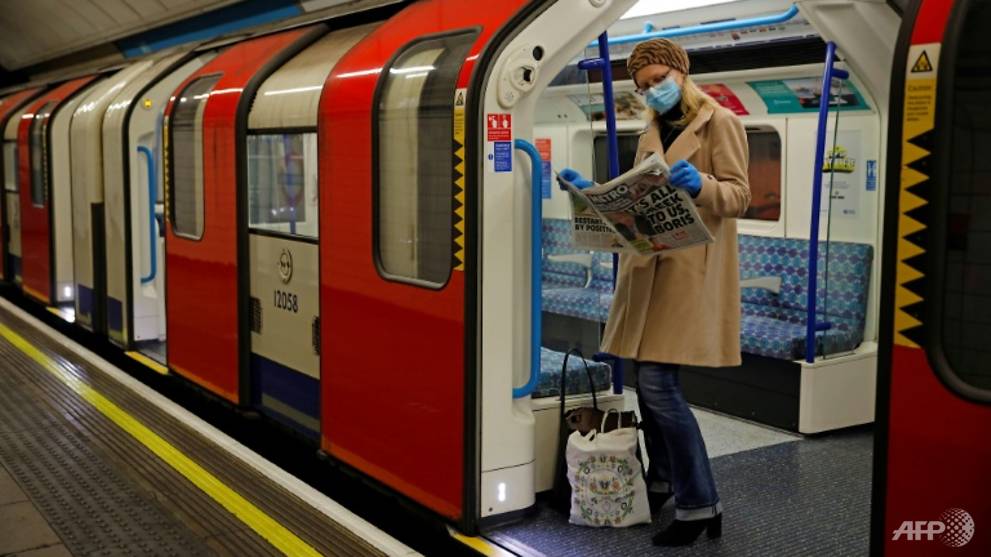
LONDON: British Prime Minister Boris Johnson will tell people on Tuesday (Sep 22) to work from home and will impose new curbs on pubs, bars and restaurants in a bid to tackle the swiftly accelerating second wave of the coronavirus outbreak.

In an address to parliament at 11.30am GMT (7.30pm, Singapore time) and then to the nation at 7pm GMT (3am, Singapore time), Johnson will stop some way short of a full national lockdown of the sort he imposed in March.

"We know this won’t be easy, but we must take further action to control the resurgence in cases of the virus and protect the NHS," Johnson will say, according to excerpts of his remarks distributed by his Downing Street office.

The measures come after senior medics warned on Monday that Britain faced an exponentially growing death rate within weeks unless urgent action was taken.

"We will spare no effort in developing vaccines, treatments, new forms of mass testing, but unless we palpably make progress we should assume that the restrictions I have announced will remain in place for perhaps six months," he told parliament.

READ: UK to outline early pub closing as COVID-19 alert level raised

New COVID-19 cases are rising by at least 6,000 a day in Britain, according to week-old data, hospital admissions are doubling every eight days, and the testing system is buckling.

The new curbs will restrict the hospitality sector to table service only, by law.

Just weeks after urging people to start returning to work, Johnson will advise them to work from home if they can. He will also order all pubs, bars, restaurants and other hospitality sites across England to start closing at 10pm from Thursday.

"One of the things we are going to emphasise is that if it is possible for people to work from home, we are going to encourage them to do so," Michael Gove, the minister for the cabinet office, told Sky News.

"There is going to be a shift in emphasis."

While millions across England, Scotland, Wales and Northern Ireland are already under some form of restriction, Johnson is not expected to announce a fully fledged lockdown of the kind seen in March.

READ: Scotland's Sturgeon says tougher COVID-19 restrictions on the way

LOCKDOWN?

Britain will face an exponentially growing death rate from COVID-19 unless the government moves urgently, Chris Whitty, the government's chief medical officer, and Patrick Vallance, its chief scientific adviser, said.

The United Kingdom already has the biggest official COVID-19 death toll in Europe - and the fifth largest in the world - while it is borrowing record amounts in an attempt to pump emergency money through the damaged economy.

Gove, one of Johnson's most senior ministers, said there were many roles that could not be performed at home, in areas from manufacturing and construction to retail.

"We need to balance, obviously, the need to ensure that people can continue to work, and indeed – critically - continue to go to school and benefit from education, against taking steps to try to reduce the virus, which is why if we can limit, or appropriately restrain, social contact, that is what we are trying to do," he said.

READ: Britain is at COVID-19 tipping point, health minister says

Gove also said that schools should remain open, and employers that need their staff on premises should do so with COVID-19 safety measures in place.

"We're trying to strike a balance. We're trying to say that schools, of course, should remain open. We want workplaces where people have to be in the factory or in the shop in order to do their job to remain open in a COVID-secure way," he said in an interview with the BBC.

"The second shutdown begins", read the front-page headline of the Daily Telegraph while the Daily Mail said: "UK slammed into reverse".

Shares in Britain's listed pubs and restaurant groups fell sharply on Monday in anticipation of the move. While there is no consistent policy nationwide, the move will advance closing time by at least an hour for most areas.

London Mayor Sadiq Khan said he had agreed with local council leaders and public health experts on new COVID-19 restrictions to be put to central government, in an attempt to stem the outbreak in the capital.

BOOKMARK THIS: Our comprehensive coverage of the coronavirus outbreak and its developments

Download our app or subscribe to our Telegram channel for the latest updates on the coronavirus outbreak: https://cna.asia/telegram

Let's block ads! (Why?)


https://news.google.com/__i/rss/rd/articles/CBMiaGh0dHBzOi8vd3d3LmNoYW5uZWxuZXdzYXNpYS5jb20vbmV3cy93b3JsZC9jb3ZpZC0xOS11ay1ib3Jpcy1qb2huc29uLXdvcmstZnJvbS1ob21lLXNlY29uZC13YXZlLTEzMTMzMjA20gEA?oc=5

2020-09-22 11:26:34Z
52781072133712

'We're confident': Russia to share legal risks of COVID-19 vaccine - CNA

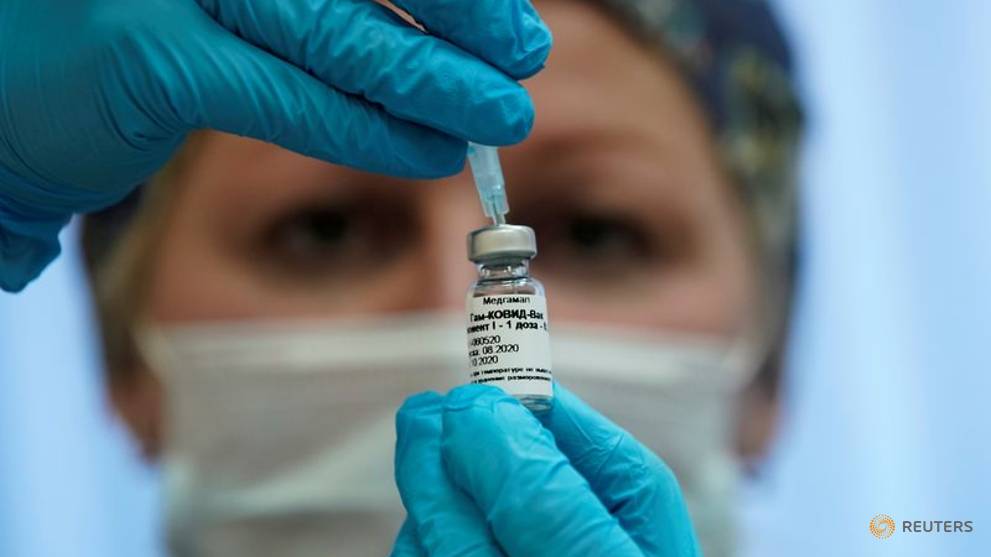
MOSCOW: Russia is so confident in its COVID-19 vaccine that it will shoulder some of the legal liability should anything go wrong, rather than requiring buyers to take on the full risk, the head of the state fund bankrolling the project told Reuters.

The decision leaves the vaccine's state-backed developers open to potentially costly compensation claims should there be any unexpected side-effects. It is something many vaccine-makers have sought to avoid, by asking for full indemnity - complete protection from liability claims - from nations they sell to.

The approach is different from many places in the world. In the United States, for example, liability for COVID-19 vaccines has been shifted fully to the US government. This shields the developers because widespread inoculation against the disease is considered a benefit to society.

With the global vaccine race hotting up, and dozens of candidates being tested on humans, backers of Russia's 'Sputnik-V' shot see liability as a key battleground as they aim to capture market share.

READ: On a fast track like never before - The COVID-19 vaccine effort and 5 vital questions 

"Russia is so confident in its vaccine that it has not asked for full indemnity and this is a major differentiating factor versus any Western vaccine," said Kirill Dmitriev, head of the Russian Direct Investment Fund (RDIF), the state sovereign wealth fund that is backing the vaccine.

"All of them are asking for full indemnity of legal risks."

Dmitriev did not say whether buyers of the Russian vaccine would be asked to take on partial liability, and did not give details about indemnity clauses. His representatives said he had nothing more to add.

However, the health secretary of the Brazilian state of Bahia, which plans to buy 50 million doses of Russia's vaccine, told Reuters the legal risks would be carried by Russian entities.

READ: Widespread COVID-19 vaccinations not expected until mid-2021: WHO

Vaccine developers around the world are compressing years of development into months, raising the possibility of unexpected consequences and making the issue of compensation claims a key point in supply deal negotiations.

For example, British drugmaker AstraZeneca, which has developed a vaccine with Oxford University, has been granted full protection from any future liability claims by many countries with which it has signed supply deals, a senior executive told Reuters in July.

Dmitriev's comments came after some scientists expressed concerns about the safety and efficacy of Sputnik-V, which the Russian government approved for use before completing large-scale human trials.

READ: Commentary: The turning point in global fight against COVID-19 is approaching

BRAZILIAN BUYERS

Sputnik-V was developed by Moscow's Gamaleya Institute, a state research body. The RDIF, which is marketing the vaccine abroad, will shoulder some of the legal risks in supply contracts along with pharmaceutical firms in the fund's portfolio which are producing the shot.

"We are confident in the long-term consequences," Dmitriev said. "We are putting our money where our mouth is by not asking for full indemnity in partnerships we create in different countries."

Thus far, RDIF has announced deals to supply just over 200 million doses, half to Latin America and half to India. The fund says it has orders for as much as 1 billion doses.

FĂ¡bio Vilas-Boas, health secretary of Brazil's Bahia state, which is placing the 50-million-dose order, told Reuters the legal risks would be carried by the Russian pharmaceutical firms producing and supplying the vaccine.

"In the case of any adverse event, nothing will stop people who feel they have been harmed from filing a class action against any of the pharmaceutical companies," said FĂ¡bio Vilas-Boas, who negotiated the testing and letter of intent with RDIF.

Neither Bahia nor ParanĂ¡, a Brazilian state which plans to conduct trials of Sputnik-V on 10,000 volunteers, have actually signed contracts for supply of the vaccine, according to Bahia's Vilas-Boas and the ParanĂ¡ state governor's chief of staff, Guto Silva, who also negotiated with the Russian side.

Thus far, deals have been formalised only in memoranda of understanding, as contracts are awaiting the vaccine's approval by Brazil's health regulators.

READ: Vaccine confidence volatile, vulnerable to misinformation, global study finds

INSURANCE FOR VOLUNTEERS

Russia has staked its scientific reputation on the results after approving the vaccine for domestic use before mass testing had even begun, becoming the first country to licence a COVID-19 vaccine.

Late-stage trials, known as Phase Three, are currently ongoing in Russia, with at least 40,000 volunteers taking part. Initial results are expected in October or November.

Volunteers in its Phase Three trial are unpaid, but their insurance is covered, including a payout of 2 million roubles (US$26,430) in case of death, one volunteer told Reuters.

RDIF also expects to run trials of the vaccine abroad, with plans already in place with Indian pharmaceutical firm Dr Reddy's and with Brazil's ParanĂ¡ state, both pending regulatory approval.

READ: Commentary: Vaccine politics could hamper a COVID-19 recovery

Many people involved in the Sputnik-V's development, including Dmitriev, have tried the jab on themselves in a bid to convince the world of the safety of a Russian-made vaccine.

Dmitriev said he was not concerned about the risk of compensation claims against RDIF.

"We know it will not happen. Because the vaccine has been studied for decades," he said.

"We know we will not have ... billions and billions of liabilities because we have a proven platform and they don't," he said. "Simple."

BOOKMARK THIS: Our comprehensive coverage of the coronavirus outbreak and its developments

Download our app or subscribe to our Telegram channel for the latest updates on the coronavirus outbreak: https://cna.asia/telegram

Let's block ads! (Why?)


https://news.google.com/__i/rss/rd/articles/CBMic2h0dHBzOi8vd3d3LmNoYW5uZWxuZXdzYXNpYS5jb20vbmV3cy93b3JsZC93ZS1yZS1jb25maWRlbnQtcnVzc2lhLXRvLXNoYXJlLWxlZ2FsLXJpc2tzLW9mLWNvdmlkLTE5LXZhY2NpbmUtMTMxMzM0OTbSAQA?oc=5

2020-09-22 10:09:18Z
52781077413400

'Work from home': Johnson starts to shut down Britain again as COVID-19 spreads - CNA

LONDON: British Prime Minister Boris Johnson will tell people on Tuesday (Sep 22) to work from home and will impose new curbs on pubs, bars and restaurants in a bid to tackle the swiftly accelerating second wave of the coronavirus outbreak.

In an address to parliament at 11.30am GMT (7.30pm, Singapore time) and then to the nation at 7pm GMT (3am, Singapore time), Johnson will stop some way short of a full national lockdown of the sort he imposed in March.

"We know this won’t be easy, but we must take further action to control the resurgence in cases of the virus and protect the NHS," Johnson will say, according to excerpts of his remarks distributed by his Downing Street office.

The measures come after senior medics warned on Monday that Britain faced an exponentially growing death rate within weeks unless urgent action was taken.

READ: UK to outline early pub closing as COVID-19 alert level raised

New COVID-19 cases are rising by at least 6,000 a day in Britain, according to week-old data, hospital admissions are doubling every eight days, and the testing system is buckling.

The new curbs will restrict the hospitality sector to table service only, by law.

Just weeks after urging people to start returning to work, Johnson will advise them to work from home if they can. He will also order all pubs, bars, restaurants and other hospitality sites across England to start closing at 10pm from Thursday.

"One of the things we are going to emphasise is that if it is possible for people to work from home, we are going to encourage them to do so," Michael Gove, the minister for the cabinet office, told Sky News.

"There is going to be a shift in emphasis."

While millions across England, Scotland, Wales and Northern Ireland are already under some form of restriction, Johnson is not expected to announce a fully fledged lockdown of the kind seen in March.

READ: Scotland's Sturgeon says tougher COVID-19 restrictions on the way

LOCKDOWN?

Britain will face an exponentially growing death rate from COVID-19 unless the government moves urgently, Chris Whitty, the government's chief medical officer, and Patrick Vallance, its chief scientific adviser, said.

The United Kingdom already has the biggest official COVID-19 death toll in Europe - and the fifth largest in the world - while it is borrowing record amounts in an attempt to pump emergency money through the damaged economy.

Gove, one of Johnson's most senior ministers, said there were many roles that could not be performed at home, in areas from manufacturing and construction to retail.

"We need to balance, obviously, the need to ensure that people can continue to work, and indeed – critically - continue to go to school and benefit from education, against taking steps to try to reduce the virus, which is why if we can limit, or appropriately restrain, social contact, that is what we are trying to do," he said.

READ: Britain is at COVID-19 tipping point, health minister says

Gove also said that schools should remain open, and employers that need their staff on premises should do so with COVID-19 safety measures in place.

"We're trying to strike a balance. We're trying to say that schools, of course, should remain open. We want workplaces where people have to be in the factory or in the shop in order to do their job to remain open in a COVID-secure way," he said in an interview with the BBC.

"The second shutdown begins", read the front-page headline of the Daily Telegraph while the Daily Mail said: "UK slammed into reverse".

Shares in Britain's listed pubs and restaurant groups fell sharply on Monday in anticipation of the move. While there is no consistent policy nationwide, the move will advance closing time by at least an hour for most areas.

London Mayor Sadiq Khan said he had agreed with local council leaders and public health experts on new COVID-19 restrictions to be put to central government, in an attempt to stem the outbreak in the capital.

BOOKMARK THIS: Our comprehensive coverage of the coronavirus outbreak and its developments

Download our app or subscribe to our Telegram channel for the latest updates on the coronavirus outbreak: https://cna.asia/telegram

Let's block ads! (Why?)


https://news.google.com/__i/rss/rd/articles/CBMiaGh0dHBzOi8vd3d3LmNoYW5uZWxuZXdzYXNpYS5jb20vbmV3cy93b3JsZC9jb3ZpZC0xOS11ay1ib3Jpcy1qb2huc29uLXdvcmstZnJvbS1ob21lLXNlY29uZC13YXZlLTEzMTMzMjA20gEA?oc=5

2020-09-22 07:26:28Z
52781072133712