Senin, 07 September 2020

Commentary: That uneasy feeling about Japan's frontrunner for prime minister - CNA

CANBERRA: The outcome of Japan’s Liberal Democratic Party (LDP) leadership election on Sep 14 is a foregone conclusion and an election in name only. 

Chief Cabinet Secretary Yoshihide Suga will almost certainly succeed Shinzo Abe as Japan’s next prime minister on Sep 16.

This is a striking turnaround from just three months ago when his political standing was on much shakier ground.

The LDP’s factions remain the dominant players in party presidential elections. Historically, their principal role has been to elevate their leaders to the prime ministership. 

Becoming LDP president and Japan’s prime minister has traditionally required the support of a coalition of factions that command a majority of LDP Diet members.

READ: Commentary: Will replacing Abe leave Japan in limbo?

READ: Commentary: Japan's longest serving PM has run out of time on unfinished business

NOT A REAL CONTEST

On the math, Suga – while nominally factionless – is a clear winner against this criterion, especially given that the leadership vote will be closed to rank-and-file members owing to contested claims about the difficulty of an all-party vote.

He has the backing of five out of seven LDP factions, plus a dozen or so non-factionally affiliated LDP parliamentarians. This will ensure around 276 votes for Suga representing at least 70 per cent of all LDP Diet members.

These figures suggest that the election will not be a real contest. The poll on Sep 14 will be engineered by the old guard of the LDP, with the party’s Executive Council deliberately disenfranchising rank-and-file party members to produce their preferred outcome.

The just-announced LDP prefectural branch presidential primaries to choose three delegates from each branch to vote in the election are unlikely to alter the predicted outcome.

Japan's Prime Minister Shinzo Abe shouts Banzai as he raises his hands with members of the LDP
Japan's Prime Minister Shinzo Abe cheers with members of the LDP during the annual party convention in Tokyo, Japan March 25, 2018. (Photo: REUTERS/Issei Kato)

The latest polls also show Suga outcompeting candidates from rival factions in public opinion – he has 38 per cent support compared with Shigeru Ishiba’s 25 per cent and Fumio Kishida’s 5 per cent.

Ultimately it comes down to the fact that Kishida and Ishiba’s factions can muster only 66 votes, or 17 per cent of LDP Diet members. They appear resigned to using the election as a trial run to build support for their bids in anticipation of the next party presidential election in September 2021.

From this perspective Suga is seen as only leading a caretaker administration.

READ: In race to replace Japan's Abe, loyalist Suga emerges as strong contender

Other possible contenders for LDP president and prime minister – Defense Minister Taro Kono and Environment Minister Shinjiro Koizumi – have expressed no interest in pursuing what they see as a lost cause.

Deputy Prime Minister Taro Aso and staunch Abe ally has said privately that Taro Kono “still needs more experience to become a good prime minister”. Koizumi has accused the party executive of lying about the reason for excluding the party’s rank and file from the vote.

READ: Commentary: Pulling off 2021 Olympics is a win Japan needs

A DE FACTO ABE ADMINISTRATION?

What are the implications of a Suga victory?

First, from a party-political perspective, it will confirm the continuing importance of LDP factions as key players in party presidential elections.

Second, from a Japanese government and policy perspective, a Suga administration will ensure policy continuity. 

Not only has Suga been an avid supporter and defender of Abe’s policies but he has also made an explicit commitment to continue them, stating, “I will take on the initiatives of Prime Minister Abe and do everything I can to take them forward”.

Suga has declared he will assume responsibility for Abenomics and not upset the government’s existing agreement with the Bank of Japan on monetary easing. Suga is also likely to follow Abe’s foreign policies.

FILE PHOTO: Japan's Prime Minister Abe speaks to Chief Cabinet Secretary Suga at the parliamen
FILE PHOTO: Japan's Prime Minister Shinzo Abe (L) speaks to Chief Cabinet Secretary Yoshihide Suga before Suga answers questions during a lower house budget committee session at the parliament in Tokyo, Japan, February 20, 2014. REUTERS/Yuya Shino

This raises the question whether Japan will end up with what is, in reality, a de facto Abe administration.

The fact that Suga lacks charisma, projects an image of a political functionary and has modest popular appeal also suits the former prime minister. Abe’s legacy is unlikely to be overshadowed or challenged by Suga.

This could be another reason why Abe agreed with LDP Secretary-General Toshihiro Nikai and Deputy Prime Minister Aso that he should switch his long-held support for faction leader Fumio Kishida to succeed him across to Suga.

The reality was Kishida faced certain defeat against Ishiba – Abe’s archrival – who has consistently had solid support from local LDP party members and who also represents a far greater long-term challenge to Abe’s legacy.

READ: Commentary: Japan really needs to get cracking on coronavirus testing

READ: Commentary: Japan’s COVID-19 response is hamstrung by bureaucracy

MANY QUESTIONS REMAIN

Suga is skilled at evading questions about politics and policy and at avoiding accountability as government spokesperson, including stonewalling and defending the indefensible scandals that repeatedly engulfed the Abe administration. This raises the question – will Suga remain Abe’s mouthpiece even after he becomes prime minister?

Abe’s role beyond the LDP presidential election is also unclear. Will he remain in the Diet? Will he run things from behind the scenes?

READ: Japan's Shinzo Abe sought to revive economy, fulfil conservative agenda

A more difficult question to answer is whether Suga’s government, like Abe’s, will be a Kantei-led administration.

Under this system, those recruited to the prime ministerial executive from the political and bureaucratic worlds play a prominent role pursuing policy initiatives on behalf of the prime minister, subordinating both the ruling party and the Kasumigaseki ministries in the policymaking process.

One certainty is that Abe has undoubtedly set the bar higher for the prime ministerial leadership. He will be a hard act to follow.

Aurelia George Mulgan is Professor at the School of Humanities and Social Sciences, the University of New South Wales, Canberra.

Let's block ads! (Why?)


https://news.google.com/__i/rss/rd/articles/CBMieGh0dHBzOi8vd3d3LmNoYW5uZWxuZXdzYXNpYS5jb20vbmV3cy9jb21tZW50YXJ5L3N1Z2EtYWJlLWphcGFuLXBtLWNhYmluZXQtbGRwLWRpZXQtaXNoaWJhLWtpc2hpZGEtcmVzaWduLXBvbGljeS0xMzA4ODcyMNIBAA?oc=5

2020-09-07 22:14:18Z
52781042445714

China's Sinovac COVID-19 vaccine candidate appears safe, slightly weaker in elderly - CNA

BEIJING: Chinese firm Sinovac Biotech Ltd said on Monday (Sep 7) its coronavirus vaccine candidate appeared to be safe for older people, according to preliminary results from an early to mid-stage trial, while the immune responses triggered by the vaccine were slightly weaker than younger adults.

Health officials have been concerned about whether experimental vaccines could safely protect the elderly, whose immune systems usually react less robustly to vaccines, against the virus that has led to nearly 890,000 deaths worldwide.

Sinovac's candidate CoronaVac did not cause severe side effects in a combined Phase 1 and Phase 2 trials launched in May involving 421 participants aged at least 60, Liu Peicheng, Sinovac's media representative, told Reuters. The complete results have not been published and were not made available to Reuters.

READ: China shows off COVID-19 vaccines for first time

Four of the world's eight vaccines that are in the third phase of trials are from China.

For three groups of participants who respectively took two shots of low, medium and high-dose CoronaVac, over 90 per cent of them experienced significant increase in antibody levels, while the levels were slightly lower than those seen in younger subjects but in line with expectation, Liu said in a statement.

CoronaVac, being tested in Brazil and Indonesia in the final-stage human trials to evaluate whether it is effective and safe enough to obtain regulatory approvals for mass use, has already been given to tens of thousands of people, including about 90 per cent of Sinovac employees and their families, as part of China's emergency inoculation scheme to protect people facing high infection risk.

The potential vaccine could remain stable for up to three years in storage, Liu said, which might offer Sinovac some advantage in vaccine distribution to regions where cold-chain storage is not an option.

Such estimation is extrapolated from the fact that vaccines readings stayed within acceptable ranges for 42 days at 25 degrees Celsius, 28 days at 37 degrees Celsius, and five months for 2-8 degrees Celsius, Liu said, without disclosing complete data.

BOOKMARK THIS: Our comprehensive coverage of the coronavirus outbreak and its developments

Download our app or subscribe to our Telegram channel for the latest updates on the coronavirus outbreak: https://cna.asia/telegram

Let's block ads! (Why?)


https://news.google.com/__i/rss/rd/articles/CBMiamh0dHBzOi8vd3d3LmNoYW5uZWxuZXdzYXNpYS5jb20vbmV3cy9hc2lhL2NoaW5hLXMtc2lub3ZhYy1jb3ZpZC0xOS12YWNjaW5lLWNhbmRpZGF0ZS1hcHBlYXJzLXNhZmUtMTMwODk5NzbSAQA?oc=5

2020-09-07 17:45:52Z
52781049819911

No home quarantine for PCA travellers from Singapore heading beyond Johor, KL says - The Straits Times

KUALA LUMPUR - Individuals who travel from Singapore to Malaysia under the Periodic Commuting Arrangement (PCA) will have to be quarantined in centres designated by the Malaysian government if their destination is beyond the southern state of Johor.

This was announced by Malaysia’s Health Minister Adham Baba in a statement on Monday (Sept 7). It came less than a week after a 35-year-old man who had travelled from Singapore tested positive for Covid-19.

Under the new directive, returning Malaysians and Singaporeans are allowed to quarantine at home or at any accommodation arranged by their employer as long as their home or place of employment is in Johor. 

For those whose final destination is beyond Johor, they must be quarantined at government designated centres and this will be at the traveller’s own expense, Dr Adham said. 

The exemption for PCA travellers from undergoing Malaysia’s mandatory 14-day quarantine for international travellers remains. 

“Under this scheme (PCA), travellers are exempted from going through the mandatory 14-day quarantine at government designated centres provided that their Covid-19 PCR test taken within 24 hours of arriving in Malaysia is negative,” Dr Adham said. 

Singapore citizens and permanent residents are required to be in quarantine for seven days but must register another negative result two days before the period ends.

The shorter period was negotiated by the two countries ahead of the reopening of their borders under the Reciprocal Green Lane (RGL) and the PCA arrangements on Aug 17.

Malaysian citizens and permanent residents (PR) are required to be in quarantine until they obtain a negative test result upon returning home. 

Under the PCA, Malaysians and Singaporeans on a long-term social visit pass are allowed to travel across the border for two weeks to a month if they have stayed in the country of their employment for the past three months. 

Under the RGL scheme, those residing in Singapore are allowed to enter Malaysia for a maximum 14-day stay for official or business purposes. RGL arrivals are required to be quarantined at a declared accommodation until a PCR negative test result is obtained. 

Malaysia recorded 62 new Covid-19 cases on Monday, the highest number for a single day since it relaxed its movement restriction order (MCO) in June. 

Most of the cases or 50 of them were linked to a cluster that originated from a district police headquarters in Lahad Datu in Sabah, which is due to hold a state election later this month. 

Let's block ads! (Why?)


https://news.google.com/__i/rss/rd/articles/CBMieWh0dHBzOi8vd3d3LnN0cmFpdHN0aW1lcy5jb20vYXNpYS9zZS1hc2lhL25vLW1vcmUtaG9tZS1xdWFyYW50aW5lLWZvci1wY2EtdHJhdmVsbGVycy1hZnRlci1jb3ZpZC0xOS1jYXNlLW1hbGF5c2lhcy1oZWFsdGjSAQA?oc=5

2020-09-07 13:00:38Z
52781045921801

Hong Kong police slammed over rough arrest of girl, 12, during street protests - The Straits Times

HONG KONG - Hong Kong police on Monday (Sept 7) drew flak over their rough arrest of a 12-year-old girl, who said she was caught in a crowd of protesters while out buying art supplies.

Viral video footage showed riot police rounding up a group of people in Mong Kok, including the girl, who tried to flee but was roughly pushed to the ground and pinned down by officers.

She was among about 300 people arrested on Sunday (Sept 6) amid the city's biggest street protest since July 1, as hundreds demonstrated against the postponement of legislative elections and a new national security law.

The girl, who was bruised in the ordeal, said she had gone out with her elder brother to buy art supplies for school, but they were forced to turn back, as the area had been cordoned off by police.

"When the police suddenly rushed over, I was very scared," the girl told local broadcaster i-Cable News.  “They instructed us to stand there, but I panicked, so I ran.” 

The police force confirmed the incident, but in a statement posted on Facebook defended its officers saying that the girl had acted "suspiciously" and that "minimum necessary force" had been used on her.

The girl's mother told Apple Daily that she would lodge a formal complaint over the matter, adding that both her children were fined under virus-related laws against gatherings.

Pro-democracy legislator Claudia Mo said the incident "showed how unnecessarily jumpy trigger-happy Hong Kong police had become", The Guardian reported.

Sunday's protests marked the day that legislative elections would have been held, had Hong Kong leader Carrie Lam not postponed them for a year due to the danger of fuelling the city's Covid-19 outbreak. She has been accused of using the pandemic to suppress opposition.

At Sunday's demonstrations, protesters also called for the release of 12 Hong Kongers arrested by Chinese coastguards while trying to flee to Taiwan in a speedboat.

The group had been intercepted some 70km south-east of Hong Kong on Aug 23. They were handed over to police in neighbouring Shenzhen and have since disappeared into China's opaque judicial system.

Lawyers representing some of them on Monday said they had been denied access to their clients.

"They said I can't prove that the instructions I have came from family members, even though I have provided my client's birth certificate issued in Hong Kong," said Mr Ren Quanniu, a lawyer who travelled 1,500km from central China to Shenzhen.

Mr Ren said he also visited the police officer in charge of the case, who refused to receive legal documents, including a written request for his client Wong Wai-yin to be handed back to Hong Kong jurisdiction.

Mr Lu Siwei, another lawyer, said he had a similar experience when he tried to visit his client in detention last week.

Both lawyers said Shenzhen police were treating the case as an "illegal border crossing", an offence that carries up to a year in jail.

But Mr Lu said police had informed him that some of the detained may also face the more serious charges of "organising others to cross the border illegally", which carries sentences of up to life in jail.

The prospect of Hong Kongers getting entangled in China's judicial system was the spark that lit seven months of huge and often violent pro-democracy protests last year.

• Additional reporting by AFP

Let's block ads! (Why?)


https://news.google.com/__i/rss/rd/articles/CBMieGh0dHBzOi8vd3d3LnN0cmFpdHN0aW1lcy5jb20vYXNpYS9lYXN0LWFzaWEvaG9uZy1rb25nLXBvbGljZS1zbGFtbWVkLW92ZXItcm91Z2gtYXJyZXN0LW9mLWdpcmwtMTItZHVyaW5nLXN0cmVldC1wcm90ZXN0c9IBAA?oc=5

2020-09-07 11:32:56Z
52781043656805

Wary Hong Kongers shun China-backed mass COVID-19 testing - CNA

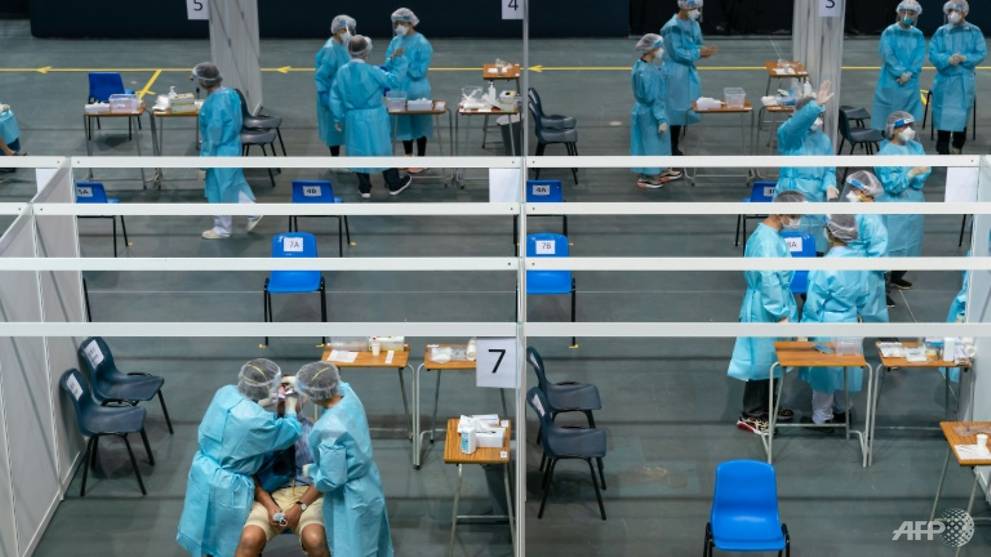
HONG KONG: Hong Kong's plan to test every resident for the coronavirus is being hobbled by limited take-up as a wary public steer clear of the China-backed health scheme.

The free voluntary tests are part of an attempt to stamp out a third wave of infections that began in late June and saw the densely populated city reimpose economically painful social distancing measures.

READ: Commentary: How did Hong Kong get to a third wave of COVID-19 infections?

But the involvement of Chinese testing firms has deterred many in a politically divided city convulsing with resentment towards Beijing's rule.

On Monday (Sep 7) morning, civil service chief Patrick Nip said 1.15 million people had signed up since mass testing began last Tuesday, out of a city population of about 7.5 million.

That figure is well below the 4 million to 5 million leading health experts said would be needed for a mass testing scheme to be effective at finding and stopping hidden transmission chains.

Nip said the tests would be extended for a further seven days to encourage more people to sign up.

"Please take the opportunity to help Hong Kong end the epidemic's third wave so that people's lives and economic activities can gradually return," he wrote on Facebook.

READ: Hong Kong to reopen gyms, massage parlours as COVID-19 cases drop

The tepid enthusiasm is a blow for the city's pro-Beijing leadership, which suffers from low approval ratings.

They had called on residents to embrace the scheme, billing it as a benevolent public health initiative made possible with Chinese help.

But the involvement of teams and labs from the mainland has sent the rumour mills into overdrive and compounded fears of Beijing's surveillance state, which uses biometric data to monitor its citizens.

A group of pro-democracy politicians and lawmakers, as well as a medical union critical of Beijing, called on the public to boycott the test.

Some prominent Hong Kong health experts also questioned the efficacy of a mass testing programme, arguing that more targeted monitoring of at-risk and vulnerable communities would be a better use of resources.

They raised concerns that the act of testing so many people might itself help spread the virus in a city where emergency rules currently forbid more than two people from gathering in public.

On Sunday, police arrested nearly 300 people protesting against the government's decision to suspend local elections for a year because of the virus.

READ: Hong Kong police fire pepper balls at protesters opposed to election delay, new law

Both Beijing and city leader Carrie Lam have accused those opposed to the testing as being politically motivated and "anti-China".

Lam said no DNA or other biometric data would be harvested from the samples, which would not be tested on the mainland.

At the height of the third wave in late July, Hong Kong was recording about 150 new cases a day.

Over the last two weeks, that number has hovered between 10 and 20 a day, even with the mass testing scheme under way.

Since the pandemic began, Hong Kong has registered nearly 4,900 infections and 98 deaths from the coronavirus.

BOOKMARK THIS: Our comprehensive coverage of the coronavirus outbreak and its developments

Download our app or subscribe to our Telegram channel for the latest updates on the coronavirus outbreak: https://cna.asia/telegram

Let's block ads! (Why?)


https://news.google.com/__i/rss/rd/articles/CBMiYmh0dHBzOi8vd3d3LmNoYW5uZWxuZXdzYXNpYS5jb20vbmV3cy9hc2lhL2hvbmcta29uZy1jb3ZpZC0xOS1jaGluYS1tYXNzLXRlc3Rpbmctc2h1bi13YXJ5LTEzMDg4NTIw0gEA?oc=5

2020-09-07 06:57:09Z
52781048582306

Minggu, 06 September 2020

India overtakes Brazil with second-highest COVID-19 cases - CNA

NEW DELHI: India overtook Brazil on Monday (Sep 7) to become the second-worst affected country in terms of coronavirus cases behind the United States, according to an AFP tally.

The South Asian nation has recorded 4.2 million infections since the pandemic began, health ministry data showed, compared with 4.12 million in Brazil and 6.25 million in the US.

India has also recorded 71,642 deaths, fewer than the 126,203 in Brazil and 188,540 in the US.

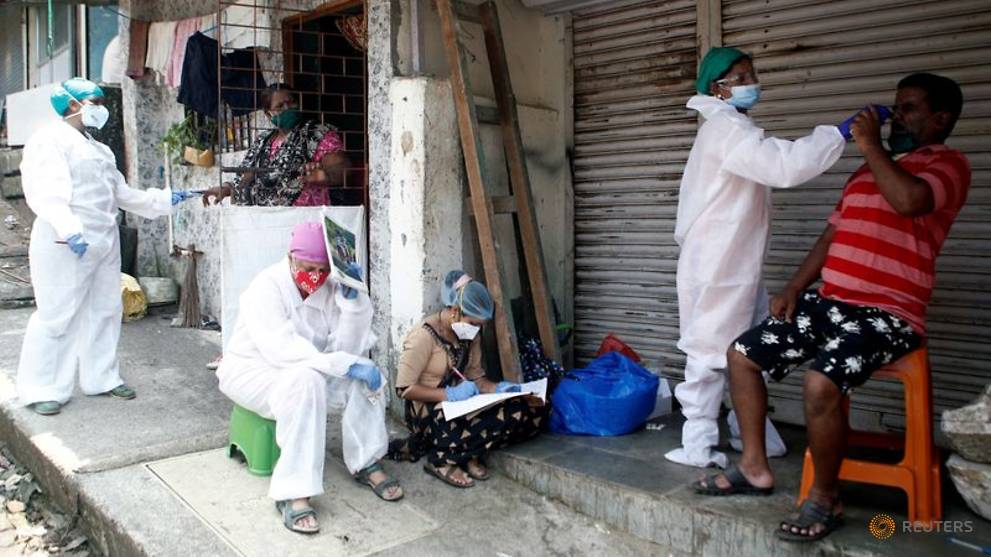
Many experts, however, say it is not testing enough people and not properly recording many deaths, meaning the real numbers may be much higher.

Since August the country of 1.3 billion people, home to some of the world's most densely populated cities, has been reporting the highest single-day rises in the world. On Monday it reported an increase of more than 90,000 cases.

Its caseload moved past 4 million on Saturday, only 13 days after hitting three million.

Virologist Shahid Jameel, who heads the Wellcome Trust/DBT India Alliance, said the key factor to watch is the growth rate in infections, which he called "quite alarming".

"Over the past two weeks, the ... average has moved from about 65,000 cases per day to about 83,000 cases per day, that is about a 27 per cent increase over two weeks or about 2 per cent per day," Jameel told AFP.

India has been testing more than 10 million people per day on average, with plans to ramp it up further.

The Indian Council of Medical Research, the scientific agency leading the government's response, on Friday revised the testing criteria, allowing anyone to undergo a test without a doctor's letter.

Jameel said the move was overdue.

"This will uncover more asymptomatic people, who are the real source of this expansion in India. There should also be more testing in rural districts and villages, since over two-thirds of the cases are coming from there," he said.

READ: Tiny village offers window into India's surging COVID-19 caseload

READ: Indian villagers tire of COVID-19 rules just as rural cases surge

Despite warnings that it could eventually overtake the US to become the world's most-infected country, India has been steadily reopening its pandemic-battered economy.

Economic output contracted a historic 23.9 per cent between April and June.

On Monday, metro trains in major cities, including the capital New Delhi – one of the most badly hit cities along with financial hub Mumbai – reopened after a hiatus of nearly six months.

Early morning images showed masked commuters sitting in nearly empty coaches and flashing victory signs to journalists.

Passengers can only sit on alternate seats, and after undergoing thermal screening.

Delhi, a city teeming with 20 million people, recorded 3,256 new infections on Sunday – its highest single day spike in 73 days. It was also the first time cases crossed the 3,000 mark during this period.

BOOKMARK THIS: Our comprehensive coverage of the coronavirus outbreak and its developments

Download our app or subscribe to our Telegram channel for the latest updates on the coronavirus outbreak: https://cna.asia/telegram

Let's block ads! (Why?)


https://news.google.com/__i/rss/rd/articles/CBMibWh0dHBzOi8vd3d3LmNoYW5uZWxuZXdzYXNpYS5jb20vbmV3cy9hc2lhL2NvdmlkLTE5LWNvcm9uYXZpcnVzLWluZGlhLW5ldy1jYXNlcy1kZWF0aHMtc2Vjb25kLWhpZ2hlc3QtMTMwODgzMDbSAQA?oc=5

2020-09-07 05:03:45Z
52781046345258

No more home quarantine for PCA travellers after Covid-19 case: Malaysia's health minister - The Straits Times

KOTA TINGGI - Travellers coming into Malaysia under the Periodic Commuting Arrangement (PCA) will now be required to undergo quarantine at quarantine centres rather than at home after a Malaysian who had entered the country under the scheme tested positive for Covid-19, Malaysian Health Minister Adham Baba said on Sunday (Sept 6).

The 35-year-old man had travelled from Singapore on Aug 29 and was confirmed to be positive for Covid-19 on Sept 2.

"The patient has since been isolated and given treatment.

"As a result, those travelling under the PCA will no longer be allowed to quarantine at home but would instead have to be kept in quarantine centres," he said at a press conference, as quoted by The Star newspaper.

He also added that those placed at quarantine centres in hotels would have to bear the cost.

Malaysia and Singapore began reopening the land borders between the two countries from Aug 17 for work- and business-related travel under the Reciprocal Green Lane (RGL) and the PCA travel schemes.

The RGL facilitates short-term travel for essential business or official purposes between both sides for up to 14 days, while the PCA allows citizens or permanent residents to travel across the Causeway and stay for a longer period.

Under the current PCA arrangement, travellers would need to serve a seven-day stay-home notice but that might change soon.

Dr Adham also said that since Malaysia and Singapore started the PCA and RGL on Aug 17, more than 3,000 people had entered the country.

"About 815 individuals entered Malaysia under the RGL, while another 2,647 under the PCA.

"So far, there have been no Covid-19 cases reported for those travelling back under the RGL, " he said.

Asked when the third and fourth phases of the reopening of the border with Singapore would be announced, Dr Adham said the matter was still under discussion.

He added that the standard operating procedure for the daily commute of workers between Malaysia and Singapore was also still under negotiation.

"We want to see whether the RGL and PCA could be implemented smoothly between both countries," he said.

Let's block ads! (Why?)


https://news.google.com/__i/rss/rd/articles/CBMieWh0dHBzOi8vd3d3LnN0cmFpdHN0aW1lcy5jb20vYXNpYS9zZS1hc2lhL25vLW1vcmUtaG9tZS1xdWFyYW50aW5lLWZvci1wY2EtdHJhdmVsbGVycy1hZnRlci1jb3ZpZC0xOS1jYXNlLW1hbGF5c2lhcy1oZWFsdGjSAQA?oc=5

2020-09-07 01:04:44Z
52781045921801