MUMBAI: The death of a Tibetan member of an Indian special forces unit in a mine blast near the site of a border flare-up with Chinese troops has offered a rare glimpse into a little-known group of elite, high-altitude warriors.
Tenzin Nyima, 53, was killed and another commando critically wounded in the blast near the shores of the Pangong Tso lake in the western Himalayas, three Indian government officials and two members of his family told Reuters.
Indian and Chinese forces came close to direct confrontation in the area over the weekend over competing territorial claims, their governments have said.
Nyima was part of the Special Frontier Force (SFF), his family and three Indian government officials said.
The force recruits mostly from Tibetan refugees, hundreds of thousands of whom have made India their home since the Dalai Lama fled Tibet following a failed uprising in 1959. Some are Indian citizens.
Few details are publicly known about the covert force set up soon after a war between India and China in 1962. Two officials estimated its strength at more than 3,500 men.
Amitabh Mathur, a former Indian government adviser on Tibetan affairs, said the SFF were "crack troops, especially in the context of mountain climbing and high-altitude warfare.
"If at all they (SFF) were deployed, I am not surprised. It makes sense to deploy them at high altitudes. They are terrific mountain climbers and commandos."
India's defence and home ministries did not respond to a request for comment on the SFF.
China has long considered the presence of a large number of Tibetans in India as a threat to its territorial integrity. They are led by Tibet's spiritual leader, the Dalai Lama, whom Beijing denounces as a dangerous separatist.
He says he only wants genuine autonomy for his remote Himalayan homeland.
Chinese foreign ministry spokeswoman Hua Chunying told a news briefing on Wednesday (Sep 2) she did not know whether Tibetans were fighting for India, but urged caution.
"We are firmly opposed to any country, including India, supporting the secession activities of Tibetan pro-independence forces or providing them with any assistance or physical space," she said.
TIBETANS SEEK RECOGNITION
Within the Tibetan community, grieving has begun over Nyima's death, video footage taken by the family and shared with Reuters shows.
His body was kept in a coffin covered with Indian and Tibetan flags in a refugee colony in Choglamsar village of India's Ladakh region.
Two bereaved relatives and two neighbours of Nyima told Reuters that an Indian government official who delivered the coffin told them that Nyima died "while defending India".
The official requested that the family refrain from speaking about Nyima's 33-year service with the SFF, the relatives said, requesting anonymity as they feared the Indian government might act against them.
The defence ministry and home ministry did not immediately respond to questions about the relatives' account.
Photographs of the coffin and the Tibetan mourning rituals were circulated on WhatsApp groups run by Tibetan refugees in Leh, the main city in Ladakh, and in Dharamshala in northern India, the seat of the self-styled Tibetan government-in-exile.
Some wanted greater recognition for the Tibetans' service to India.
"We respect and love India for giving us shelter but it is time the nation acknowledges the crucial role played by our men in the SFF," Lhagyari Namgyal Dolkar, a 34-year-old lawmaker of the Tibetan parliament-in-exile, told Reuters.
"If an Indian soldier dies, the country declares him as a martyr, government pays rich tribute. Why are Tibetan refugees not bestowed the same respect?" said Dolkar, whose uncle fought alongside Indian soldiers against Pakistan in 1999.
A senior Indian military official said the SFF had played a pivotal role in the 1971 war with Pakistan that led to the creation of Bangladesh as well as a near-war with Pakistan again in 1999 over the Kargil heights.
The prime minister of the Tibetan government-in-exile, Lobsang Sangay, said his "government does not comment on the SFF".
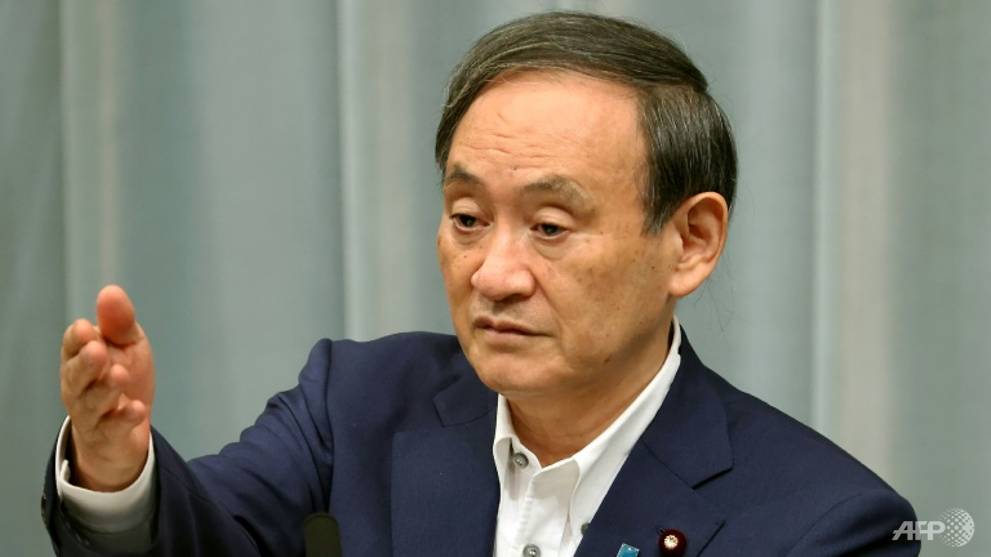
TOKYO: Japan's Chief Cabinet Secretary Yoshihide Suga officially declared on Wednesday (Sep 2) he would run for leadership of the ruling Liberal Democratic Party (LDP), a race he is widely tipped to win to become the next prime minister.
Speaking to a briefing, Suga said he wanted to run to avoid a political vacuum at a time when the world's third-largest economy grapples with the impact of the pandemic.
"I decided to run in the LDP leadership race after some deep thought on what I can do as a politician and a member of Abe's administration," Suga told a briefing.
The party's leader is set to take over as prime minister given the LDP's majority in the lower house of parliament.
He said he would "maintain and push forward" the "Abenomics" stimulus policies pursued by Prime Minister Shinzo Abe if he were to become the next premier.
Suga added he would maintain the kind of relationship the government has had with the Bank of Japan under Abe's administration.
Abe announced his decision to resign last week, citing poor health.
His main competitors for the top job are likely to be a former defence minister, Shigeru Ishiba, and ex-foreign minister Fumio Kishida, but Suga's position looks strong.
He has secured the backing of five of the LDP's seven factions, public broadcaster NHK and others reported.
The party decided on Tuesday to hold a slimmed-down election with just members of parliament and three votes from each of the 47 prefectures - an advantage for Suga. The election will be on Sep 14.
Many party chapters will poll rank-and-file members to decide how to allocate their three votes, but experts say this is unlikely to change the momentum growing for Suga if the members of the five factions back him.
But Ishiba is by far the most popular among the public and has been on a media blitz, appearing on several television programmes over the past few days.
"During Abenomics, stocks rose, the yen was weak and wrought unprecedented profits to companies - that's something to be grateful for," Ishiba said on Fuji TV on Wednesday when asked how he would improve the lives of low-income workers and the unemployed.
"But what do we do with the dark side of that? That's the most important question in the post-Abe era," he said.
Apart from inheriting an economy in the throes of its worst downturn since World War II, Abe's successor will have to try to ensure that next year's Olympics - already delayed for a year by the novel coronavirus - go ahead as planned.
In recent months, Abe had seen his support fall to one of the lowest levels since taking power in December 2012 because of growing discontent among voters with his handling of the coronavirus and scandals among LDP members.
"There are various criticisms of the Abe administration, and we must work on each issue, listening to the voices of the people earnestly so as not to lose public trust," Suga said at one of his twice-daily news conferences as top government spokesperson.
GUWAHATI: India has moved troops to its eastern stretch of border with China since clashes erupted between the nuclear-armed rivals on the western part of their border in the Himalayas in June, a government official said on Wednesday (Sep 2).
The June clash in the Ladakh region, in the western part of their border, was the worst violence between the Asian giants in decades and there has been little sign of a reduction in tension, with more military action in the past week.
The movement of troops to the eastern district of Anjaw, in Arunachal Pradesh state, which China also claims, raises the prospect of a wider face-off though both government and military officials in India ruled out any imminent confrontation.
"The military presence has surely increased, but as far as incursions are concerned, there are no verified reports as such," said Ayushi Sudan, Anjaw's chief civil servant, adding that several Indian army battalions were stationed there.
"There has been an increase in troop deployment since the Galwan incident, and even prior to that we'd started," she told Reuters by telephone, referring to the June clash in which 20 Indian soldiers were killed.
Arunachal Pradesh, which China calls South Tibet, was at the centre of a full-scale border war between India and China in 1962, and security analysts have warned that it could become a flash-point again.
But an Indian military spokesman, Lieutenant Colonel Harsh Wardhan Pande, said there was no cause for concern and the troops arriving in the area were part of regular rotation.
"Basically, it's units changing. That's happening as it happens every time, nothing much," Pande told Reuters from near Guwahati, the largest city in northeastern India.
"As of now, there's nothing to worry about on that front."
But Tapir Gao, a member of parliament from Arunachal, told Reuters that Chinese troops had been regularly crossing into Indian territory.
"It's a regular phenomenon, it's nothing new," he said, identifying the Walong and Chaglagam areas in Anjaw as the most vulnerable.
In the 1962 war, India says its outnumbered forces "blocked the thrust of the invading Chinese" in Walong, and the area of mountains, meadows and fast-flowing rivers is now a government focus for settlement and road-building.
"What we're trying to do is create more possibilities and opportunities for villagers," said Sudan, referring to plans for clusters of villages in the disputed area.
TAIPEI: Fed up with being confused for China amid the coronavirus pandemic and Beijing's stepped-up efforts to assert sovereignty, Taiwan said on Wednesday (Sep 2) it would redesign its passport to give greater prominence to the island's name.
Taiwan has complained during the outbreak that its nationals have encountered problems entering other countries, as Taiwanese passports have the words "Republic of China", its formal name, written in large English font at the top, with "Taiwan" printed at the bottom.
The new passport, expected to come into circulation in January, removes the large English words "Republic of China", though the name in Chinese characters will remain, and enlarges the word "Taiwan" in English.
Taiwan Foreign Minister Joseph Wu unveils the new passport design in Taipei, Taiwan, Sep 2, 2020. (Photo: REUTERS/Ann Wang)
Taiwan Foreign Minister Joseph Wu said new passports were needed to prevent their nationals being mistaken for Chinese citizens, especially with the stepped up entry checks many countries have begun since the pandemic began.
"Since the beginning of the Wuhan pneumonia outbreak this year our people have kept hoping that we can give more prominence to Taiwan's visibility, avoiding people mistakenly thinking they are from China," Wu told reporters.
In Beijing, Chinese Foreign Ministry spokeswoman Hua Chunying said it did not matter what "petty moves" Taiwan made, it could not change the fact that Taiwan was an inseparable part of China.
China claims democratic Taiwan as its sovereign territory, and says only it has the right to speak for the island internationally, a position it has pushed strongly during the pandemic, especially at the World Health Organization.
Taipei says this has confused countries and led them to impose the same restrictions on Taiwanese travellers as on Chinese, and has minimised Taiwan's own successful efforts to control the virus and far lower case number.
Members of the media take photos of paper cut outs of the old and new (right) Taiwan passport displayed in Taipei, Taiwan, Sep 2, 2020. (Photo: REUTERS/Ann Wang)
Taiwan has been debating for years who it is and what exactly its relationship should be with China - including the island's name. But the pandemic has shot the issue back into the spotlight.
The government is also considering a name change - or at least a full redesign - for Taiwan's largest carrier, China Airlines, again to avoid confusion with China.
WASHINGTON: The White House on Tuesday (Sep 1) pushed back on concerns expressed by the World Health Organization after a US health official said a coronavirus vaccine might be approved without completing full trials.
The Washington Post newspaper reported that the administration of President Donald Trump will not join a global effort to develop, manufacture and distribute a coronavirus vaccine because of the involvement of the WHO.
About 172 countries are engaging with the WHO's COVID-19 vaccine plan to ensure equitable access to vaccines, the organisation said recently.
"The United States will continue to engage our international partners to ensure we defeat this virus, but we will not be constrained by multilateral organisations influenced by the corrupt World Health Organization and China," White House spokesman Judd Deere said in a statement.
"This president will spare no expense to ensure that any new vaccine maintains our own FDA's gold standard for safety and efficacy, is thoroughly tested, and saves lives," he said.
The global effort to develop a vaccine against the virus, which has killed more than 851,000 people, has seen recent launches of late-stage trials, but work on treatments has also gone into overdrive.
There is no approved coronavirus vaccine, except one authorised in Russia before large-scale trials.
FDA Commissioner Stephen Hahn told the Financial Times in an interview published on Sunday that his agency was prepared to authorise a coronavirus vaccine before late-stage Phase Three clinical trials were complete, as long as officials are convinced that the benefits outweigh the risks.
On Monday, WHO officials said rushing to make a vaccine widely available could pose risks.
"If you move too quickly to vaccinate ... millions of people, you may miss certain adverse effects," said Mike Ryan, the head of WHO's emergencies program.
WHO chief scientist Soumya Swaminathan said the FDA's approach was "not something that you do very lightly". She said the WHO's preferred approach would be to have a full set of data which could be used for the pre-qualification of vaccines.
Trump has been critical of the WHO's handling of the coronavirus pandemic, accusing it of being too focused on China and issuing bad advice. In May, Trump announced the United States was cutting ties to the organisation.
Phase Three trials, in which randomised patients are treated with a drug or a placebo without participants or doctors knowing which group they were in, are considered the gold standard for clinical trials.
About 82,000 Hong Kong residents were tested for the coronavirus eight hours after the universal testing programme launched on Tuesday, amid calls from activists and some health workers for a boycott.
The effort began at 8am sharp, with workers taking samples from residents at 141 collection centres across all 18 of the city’s districts. By 4pm, about 82,000 people had been tested, according to Patrick Nip Tak-kuen, the secretary for the civil service.
He also said that 650,000 people had registered for the programme, which was expected to run for a week but could be extended for another week. The number is still just a fraction of the city’s population of about 7.5 million.
Get the latest insights and analysis from our Global Impact newsletter on the big stories originating in China.
In an attempt to encourage people to sign up, Hong Kong leader Carrie Lam Cheng Yuet-ngor, her ministers and cabinet members, were among the first to be tested on Tuesday.
“The whole process and experience is safe, simple, convenient and fast,” said Lam, who was tested with colleagues at the government headquarters at Tamar.
Health experts taking the test themselves appealed to the public to respect individual choices over whether to do so – with the scheme becoming highly politicised in recent days – as they called for regular screening for high-risk groups once the universal system ends.
To get tested or not?
At City Hall in Central, there was no line of people waiting to get tested.
Jogger T. Lee said he would not get tested and called the process “meaningless”.
“If I got tested, I would be walking around and would get the results in a few days’ time,” said the 50-year-old who works in the legal sector.
“The only point of this would be if there is a total lockdown where nobody is allowed to leave their homes, and then we test people batch by batch, only letting them out when all the results are known. It’s a complete waste of money.”
He said he did not know why the government decided to spend resources on mass testing after deciding earlier to postpone the Legislative Council elections set for this month over the Covid-19 outbreak.
“They are crowding many people into centres – how is that different to people voting?”
But among those who got tested was Ellen Tsang, chairwoman of the pro-Beijing group the Y. Elites Association.
She said she had encouraged staff at the association, which comprises young professionals, to get tested, but there was a split between younger and older people.
“Young people who have just graduated from university are much more reluctant to get tested,” Tsang said. “It is also related to the social unrest last year. There is still conflict in the community between the government and young people. The key element here is trust.”
‘Important for kids to get tested before school resumes’
At about 2pm, about a dozen people were in line to get tested outside Queen’s College in Causeway Bay, which was used as a polling station during the 2016 Legislative Council election.
A special-education teacher, Lam Suet-po, 55, said she had urged parents and students to take part in the testing scheme.
“To be safe, I think it’s important that families, especially those with kids, get tested, so that we can prevent any possible outbreaks when classes resume,” she said.
Lam hoped more people would participate in the voluntary scheme, as it was found that asymptomatic patients had previously visited nearby malls and restaurants amid the city’s third wave of infections.
But a 20-year-old online shop owner, who was passing by Queen’s College and only gave her name as Wong, said she doubted the accuracy of the test kits.
“I’d wait a week to see how accurate the kits are first before participating,” she said, referring to recent Swedish reports of 3,700 false-positive results returned by kits from BGI Genomics, one of the providers in the Hong Kong scheme.
“I also don’t understand why the government would allow thousands of people to get tested at the exact locations where people would vote,” Wong said. “If we’re allowed to queue up and get tested, why can’t we queue up to vote?”
Queues form before programme begins
Small queues, including at two centres in Hung Hom and Sha Tin, were seen before the programme’s official starting time.
Participants had to go through a temperature check at the entrance before heading into the gymnasium to give a sample. Staff wearing face shields stood at the entrance to ensure people were queuing 1.5 metres apart within the building.
Social distancing, however, was not enforced outdoors. Queues reappeared outside the centre whenever a new batch of participants arrived.
Yuen Mi-ling, a 66-year-old housewife who arrived at the Yuen Wo Road facility at Sha Tin with her husband, said she would stay at home for 14 days after taking the test, a precautionary measure suggested by the Centre for Health Protection.
“I‘m not scared. I haven’t thought much about being infected,” she said. “I hope I can fulfil my responsibility as a citizen. I hope eateries can [fully] reopen.”
View photos
A resident takes the test at Yuen Wo Road Sports Centre in Sha Tin. Photo: Felix Wong
First to be tested
Un Kin-siu, a 64-year-old retiree living in Tsz Ching Estate in Tsz Wan Shan, was among the first to be tested at the area‘s community hall. The Tsz Wan Shan neighbourhood has endured a spate of Covid-19 cases since early July, with at least 160 residents or workers there infected.
Many decided to undergo a second test despite being screened earlier under the system for high-risk groups.
“I live in a high-risk area and have underlying conditions. I think it’s better to do a second test because they will take a nasal and throat swab this time, not just a deep throat saliva sample,” she said.
“I noticed that many elderly people want to get tested but do not know how to register online.”
View photos
Residents gather for the start of screening at Lung Cheung Government Secondary School in Wong Tai Sin. Photo: Winson Wong
A 44-year-old man surnamed Yung, who installs air conditioners in residential areas, said he felt good after taking the test. “Because then I know I won’t infect others if I test negative, especially when I have to come in contact with a lot of people at work,” he said.
Taxi driver Yau Cheong-him, 57, was one of those who decided to take a second test.
“I don‘t know if I am infected. I see new passengers every day,” he said.
Delivery truck driver K.F. Wong, who is in his 50s, was among the first being tested at Lung Cheung Government Secondary School in Wong Tai Sin, an area that also emerged as a virus hotspot.
“I’m taking the test so my family and I can feel more at ease,” he said. “I may have to go to high-risk places for work so it’s better to know if I’m infected or not.”
He added that even if there were social-distancing measures, people would flout the rules.
“You can’t stop all gatherings,” Wong said. “At least we’re getting results out of the scheme, and can find silent carriers through testing.”
Barometer for public opinion
The number of participants in the scheme – due to last at least seven days – is being viewed as a barometer for public opinion on the involvement of about 220 personnel from mainland China in carrying out the tests.
View photos
Professor Gabriel Leung, from the University of Hong Kong, takes the test. Photo: Handout
The government said bookings at 99 centres were full for the first day of the scheme, with participants preregistering online for a half-hour time slot for the tests, after which they received a free pack of masks.
But some people at the two centres in Tsz Wan Shan and Sha Tin were able to take part without having an appointment by filling unallocated time slots.
View photos
Queues formed outside some testing centres in Hong Kong. Photo: Felix Wong
Medical experts take the tests
Two government public health advisers, professors David Hui Shu-cheong and Gabriel Leung, helped each other take the tests before 8am in the Yuen Wo Road centre.
“The process is finished within two minutes, and I did not feel any pain during the process,” Hui said.
“I believe it’s important to participate in order to cut off any hidden transmission in the city.”
Leung said: “People should respect each person’s consideration for doing the tests or not. Apart from considering the patients that I may have contact with, I also feel more comfortable when meeting with friends and relatives after taking a test.”
Leung reported a bottleneck in testing capacity over the past few months. “But if we increase the testing rate greatly, we hope we can save some testing capacity for regularly testing for high risk groups, like the elderly.”
Some disapproved of the choice of testing locations, with district councillor Chu Kong-wai seen alongside residents on Tuesday distributing leaflets and hanging a banner campaigning against the use of the MacPherson Stadium in Mong Kok as a screening centre.
The residents said they were concerned about the contagion risks relating to a sewage pipe shared between the stadium and the accommodation above.
Eight other district councillors, including Roy Tam Hoi-pong of the Neo Democrats party, were also among those arguing the government should be able to hold the Legislative Council elections if the mass testing scheme was not considered an undue risk.
A group of activists led by Joshua Wong Chi-fung and the Hospital Authority Employees Alliance, a union representing frontline staff at public hospitals, had pushed for a boycott of the testing on Sunday. They cited the recent false-positive reports, and questioned the accuracy of citywide testing.
Dr Tony Ko Pat-sing, Hospital Authority’s chief executive, said the authority disagreed with calls from the alliance to boycott the testing scheme.
“Individual workers’ opinions do not represent the Hospital Authority,” he told a radio programme on Tuesday. “We should look at this from a professional and scientific perspective.”
While targeted testing of high-risk groups had managed to catch those infected with the virus, Ko explained there were still about 20 per cent of patients whose source of infections were untraceable and they did not belong to high-risk groups.
The State Council’s Hong Kong and Macau Affairs Office and Beijing’s liaison office have issued separate statements, hitting out at critics who questioned mainland authorities’ help in the fight against the pandemic, calling them “evil” for slandering the cooperation.
The city confirmed 12 cases on Tuesday and nine on Monday, the fewest since the Monday prior, which was the lowest daily number since July 3. The tally now stands at 4,822.
SINGAPORE - Ailing cruise operator Genting Hong Kong has sold the Zouk Group, which operates the popular nightclub, for $14 million as part of efforts to offload non-core assets and generate liquidity for the cash-strapped firm.
Malaysian firm Tulipa is buying the Singapore-based group, according to a filing on the Hong Kong Exchange on Tuesday (Sept 1) night.
Tulipa is owned by Mr Lim Keong Hui, the son of Genting Hong Kong's controlling shareholder.
Mr Lim resigned from the Genting Hong Kong board last week.
The cash sale is expected to result in a gain of about HK$6.7 million (S$1.2 million), which will be used as working capital, the filing said.
The firm said then that cash flow had been impacted by the coronavirus pandemic and funds would have to be channelled to services critical to the company's operations.
Genting Hong Kong owns the Star, Dream and Crystal Cruises brands, operates shipyards and has a stake in Resorts World Manila.
The Tuesday filing said selling the Zouk Group is part of effort to conserve cash and seek additional sources of finance to sustain the business, pending the resumption of cruise operations.
Home-grown nightclub Zouk, ranked among the top clubs in the world, was sold to Genting Hong Kong in 2015. The Zouk Group's other assets include the Five Guys burger joint at Plaza Singapura.
The group made a pre-tax loss of HK$79.6 million for the seven months to July 31 and had an unaudited consolidated net asset value of about HK$72.6 million as of the same date, it said on Tuesday.
While the total consideration for the sale shares is valued at $14 million, the final amount is subject to adjustment based on Zouk's cash level. After the transaction is complete, Zouk Group will cease to be an indirect wholly-owned subsidiary of Genting Hong Kong.
Genting Hong Kong last Friday reported a US$742.6 million (S$1.01 billion) net loss for the first half of the year, due in large part to port closures that have forced cruise lines worldwide to suspend sailings from as early as February.
Revenue for the six months was US$226.2 million, down from US$729.2 million in the same period last year.
The Hong Kong-listed company owed US$3.4 billion as of July 31.
It is implementing a series of measures that will give it a "reasonable prospect" of meeting its financial obligations until June next year, it said last Friday.
These includes cost-cutting, scaling back capital expenditure, deferring loans, undergoing restructuring and seeking additional equity or debt funding from private investors.
It said it has already received interest for investment in one of its cruise brands.
Bloomberg reported last month that Malaysian tycoon Lim Kok Thay, the chairman of the Genting group, pledged almost his entire stake in Genting Hong Kong as collateral for loans after the firm suspended payments to creditors.
Malaysian conglomerate Genting's hospitality and gaming empire has been badly affected by pandemic-related restrictions, which have forced the temporary closure of casinos and put a pause on tourism worldwide.