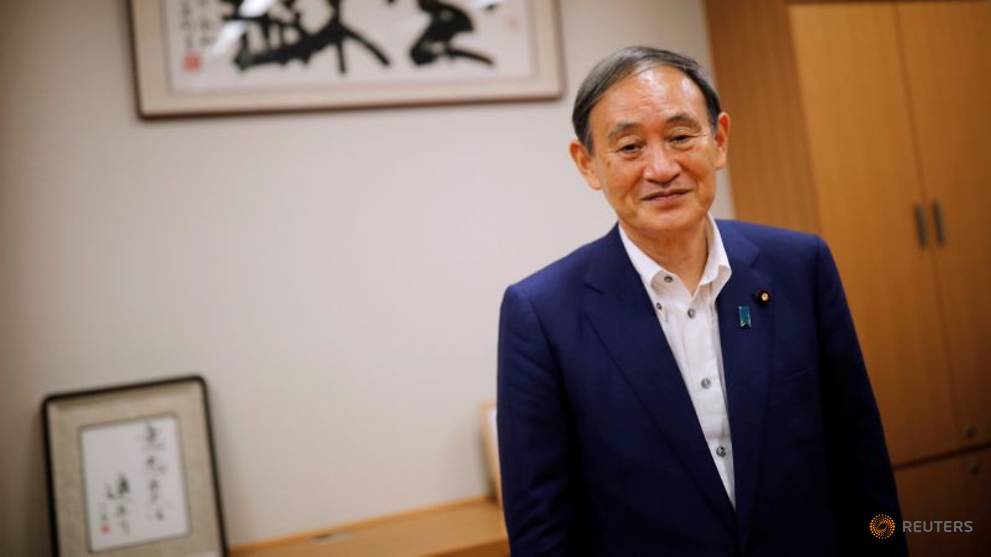
TOKYO: Japan's Chief Cabinet Secretary Yoshihide Suga will join the race to succeed his boss Shinzo Abe as prime minister, local media reported on Sunday (Aug 30), as the competition heats up to succeed Japan's longest-serving leader.
Suga, a longtime lieutenant of Abe's in a key supporting role, has denied interest in the top job but attracted attention with a series of interviews, to Reuters and other news organisations, in the days before Abe's abrupt resignation for health reasons.
A Suga government would extend the fiscal and monetary stimulus that defined Abe's nearly eight years in office.
Abe's announcement on Friday, citing a worsening of a chronic illness, set the stage for a leadership election within his Liberal Democratic Party (LDP). The LDP president is virtually assured of being prime minister because of the party's majority in the lower house of parliament.
Suga decided to join the LDP race judging that he should play a leading role given expectations for his ability to manage crises, such as the COVID-19 pandemic and Japan's deepest postwar economic dive, Kyodo news agency said, citing an unnamed source.
Calls to Suga's parliamentary office seeking comment on Sunday went unanswered.
Suga would join such candidates as former foreign minister Fumio Kishida and former defence minister Shigeru Ishiba.
A self-made politician in a country of political dynasties, Suga was chosen by Abe in 2012 for the pivotal role of Chief Cabinet Secretary, acting as top government spokesman, coordinating policies and riding herd on bureaucrats.
"I'm thinking of running in the LDP leadership race. I'd like you to support me," Suga told LDP secretary-general Toshihiro Nikai in a secret meeting on Saturday, TV Tokyo reported.
It quoted Nikai as replying, "Please do your best," which it said was a sign of his backing for Suga.
"Everyone wants to be on the winning side, so if Nikai is supporting Suga, they will jump on the bandwagon," said Koichi Nakano, political science professor at Sophia University.
LDP heavyweights aim to hold a slimmed-down leadership contest around Sep 13 to 15, public broadcaster NHK said on Sunday.
Nikai and parliamentary affairs chief Hiroshi Moriyama agreed late on Saturday to move quickly to avoid a "political vacuum", NHK said, without citing any sources for the information.
Usually, a leadership vote is held by LDP members of parliament along with grassroots party members in a month-long process. But in the event of a sudden resignation, an extraordinary vote can be called with participants narrowed to MPs and representatives of the LDP local chapters.
The scaled-down version may disadvantage Ishiba, a longtime Abe critic who promotes boosting regional economies in Japan's depopulating hinterlands. He is popular with the public but less so among party MPs.
LDP factions will play a dominant role in the election, Sophia's Nakano said. There might be media criticism that this is not a real contest, which might give Ishiba a bump up, but "not enough to change the momentum", he said.
That was the million-dollar question in Penajam Paser Utara and Kutai Kartanegara last year following President Joko Widodo's announcement that the country’s capital would move from megacity Jakarta to the underdeveloped districts in East Kalimantan province.
The plan to move the capital was deemed necessary as Jakarta, a crowded and polluted city of 10 million people, has for years been battling traffic congestion which costs US$7 billion in economic losses each year.
It is also one of the fastest-sinking cities on Earth with experts predicting that it could be submerged by 2050 if current rates continue.
Penajam Paser Utara and Kutai Kertanegara districts, on the other hand, are at minimal risk of natural disasters, the president said in his announcement and is geographically in the centre of the country where the government already owns about 180,000 hectares of land.
The government's announcement last August led to a spike in demand for land parcels in the new capital site. But with the COVID-19 pandemic and delays in development, the demand appears to have cooled for now.
This being said, those interviewed by CNA noted that land around the capital site remains sought after and are seen as a sound investment for the future.
The COVID-19 pandemic has resulted in the government shifting its priorities, delaying the development of the 466 trillion rupiah (US$32 billion) project.
Now, one year on, the new capital remains a plan on hold with the government asserting several times that it will still be developed when the time is right.
In this regard, land selling is not the talk of the town anymore.
“Nobody is talking about land anymore, unlike last year when many people from out of town dined in my restaurant talking about it,” said Mr Eko, a restaurant owner in Penajam Paser Utara who like many Indonesians goes by one name.
When CNA met Mr Eko at his diner last year, he said that all his customers talked about every day was land prices.
A sign welcoming visitors to the new capital of Indonesia has been put up at Penajam Paser Utara, East Kalimantan, in this photo taken in September 2019. (Photo: Kiki Siregar)
Mr Debi, a resident of oil city Balikapan about 80km east of Penajam Paser Utara, concurred.
He too witnessed a surge in the demand for land in his city last year, but said that the enthusiasm has abated for now.
INVESTORS REMAIN SANGUINE: MINISTER
Although there is currently no construction work in progress, Mr Suharso Monoarfa, the minister overseeing the new capital explained that the master plan is still being worked on.
A highway has been constructed to connect Balikpapan with East Kalimantan provincial capital Samarinda.
The National Development Planning Minister also revealed that investors are still keen in the new capital.
"There are still some investors, including domestic ones, who are still interested. And indeed they keep asking when it can start.
"I think this is also important because, after COVID-19, the economic recovery will (focus on) investment destinations that promise high and fast capitalisation, one of them in Indonesia is the capital city project."
Mr Monoarfa welcomed other countries to invest, especially fellow members of the Association of Southeast Asian Nations (ASEAN).
"In my opinion, because later it (the new capital) will also be a symbol of friendship in ASEAN, why should there be no legacy from ASEAN countries contributing to this capital city?"
Mr Monoarfa is hopeful that the new capital project can resume next year, once COVID-19 has been contained.
STRATEGIC ISLANDS NEAR EAST KALIMANTAN SOUGHT AFTER
A recent case of alleged illegal land sale involving the Malamber islands near the East Kalimantan province, which was reported by local media, suggests that there are still people who are eyeing land in the region despite the uncertainties in the relocation timeline.
The Malamber islands case caught the attention of the authorities after it was reported in June that a man allegedly sold the 6.4 ha island for 2 million rupiah to the regent of Penajam Paser Utara, who is also a businessman.
Inhabited by about five families, Malamber is part of the Balabalakang island chain which technically is in West Sulawesi province, but closer to Balikpapan Bay and the coast of East Kalimantan.
Malamber consists of Big Malamber island and Small Malamber island. (Photo courtesy of Ridwan Alimuddin)
According to the Constitution, island sales and purchases are illegal in Indonesia as they belong to the state.
While the alleged seller has since clarified that he had sold the land on the island and not the island itself, the local police in West Sulawesi are still investigating the case.
The lawyer of Penajam Paser Utara’s regent dismissed claims about his client's involvement and told CNA the regent does not know the alleged seller.
Environmentalists are concerned that the capital's relocation to East Kalimantan will harm the Balikpapan Bay and its coastal communities. (Photo: Kiki Siregar)
Meanwhile, East Kalimantan coordinator of Mining Advocacy Network JATAM Pradarma Rupang, who has studied land ownership in large parts of East Kalimantan believed the Balabalakang island chain would be strategic if the new capital is developed.
“Its location which is near to the new capital makes it an important route, especially for logistics in central and eastern Indonesia, and it would make it also a transit place," Mr Rupang said.
The environmentalist claimed that the practice of buying and selling land, in general, is still prevalent in the area.
“It (the pandemic) did not stop a number of businessmen from outside East Kalimantan to conduct land surveys in a number of villages in the district of Penajam Paser Utara and Balikpapan city,” Mr Rupang said.
LAND OWNERS CONTINUE TO BE APPROACHED
Mr Sikbukdin, head of local tribe Paser Balik in Penajam Pasar Utara concurred.
He said that he still receives calls from people who are interested in buying his land.
“Yes, there are still a lot of people but it is unclear who they are. They (claim to be) speaking on behalf of the National Development Planning Agency,” Mr Sibukdin said.
“I replied saying the new capital is still unclear, it is impossible the National Development Planning Agency is looking for land on its own,” said the 57-year-old who does not want to sell his land.
The exact location of the new capital has yet to be revealed but many are betting on the sub-districts of Sepaku and Samboja, which are at the border of Penajam Paser Utara and Kutai Kartanegara.
The 57-year-old tribe head owns land in Sepaku, Penajam Paser Utara.
The neighbourhood of indigenous Paser Balik tribe in Penajam Paser Utara. (Photo: Kiki Siregar)
Similarly, another Penajam Paser Utara resident also revealed that he still receives many requests from interested land buyers.
Farmer Hamzah, who regularly acts as a middleman between land seller and buyer noted that land price has not decreased despite the pandemic especially in sub-district Sepaku as land availability is scarce.
“People just positively think that the new capital project will start next year,” he added.
Originally, the government planned to begin the construction of the new capital this year on an initial 40,000 ha plot of land and transfer the central administration functions to the new capital site by 2024.
PROPERTY STILL A SOUND INVESTMENT
Over in oil city Balikpapan, Mr Yoga Gunawan, the general manager of superblock Borneo Bay City, which comprises malls, offices, a hotel and apartments, said sales are relatively stable.
When the president announced the relocation of the capital at the end of August last year, Borneo Bay City acted quickly and immediately published a full-page advertisement of its property in a national newspaper the following day.
Property developer Agung Podomoro Land's Borneo Bay City superblock in Balikpapan. (Photo: Kiki Siregar)
Even though there has reportedly been a decrease of 15 per cent in property sales in Balikpapan for the second quarter of 2020, Mr Gunawan is optimistic that the property remains a sound investment.
“According to the latest information, the new capital will still be developed … The people of Balikpapan are still optimistic about the relocation of the new capital,” he told CNA.
Mr Ali Tranghanda, CEO of property consultant and advisor Indonesia Property Watch, added that demand for land and property in the area where the new capital is thought to be has slowed down, but the potential is still there.
“The price of land is still stable with an overall correction of about 1 per cent to 3 per cent,” he told CNA.
TANJUNG MALIM, Perak: Barisan Nasional (BN) has retained the Slim state seat in Perak with a landslide victory in the by-election on Saturday (Aug 29).
BN’s candidate Mohd Zaidi Aziz won 13,060 votes to beat two independent candidates. Lawyer Amir Khusyairi Mohamad Tanusi garnered 2,115 votes, while former teacher S Santharasekaran got only 276 votes.
This means Zaidi won with a 10,945-vote majority.
Santharasekaran lost his deposit for failing to secure at least one-eighth of the total votes received by the candidates.
According to the returning officer, voter turnout was 68.4 per cent. There were 327 spoilt votes.
A total of 22,749 regular voters were eligible to vote in the by-election.
The Slim seat fell vacant after its four-term assemblyman, BN’s Mohd Khusairi Abdul Talib, died from a heart attack on Jul 15.
In Malaysia's 14th general election, Mohd Khusairi won the seat with a 2,183-vote majority, defeating Bersatu's Mohd Amran Ibrahim who was contesting on a PKR ticket, and PAS' Muhammad Zulfadli Zainal.
"It's all thanks to the support and hard work of those involved. This shows the voters have missed us," said UMNO president Ahmad Zahid Hamidi, as quoted by the Star. UMNO is the biggest component party of BN.
"This (result) will be further interpreted if the Sabah state elections or GE15 are held. We continue to gain back the support from the people," he added.
Saturday’s poll is the 12th by-election held after GE14 and the second conducted under amid the COVID-19 pandemic, after the Chini state by-election on Jul 4.
KUALA LUMPUR - Malaysia's largest ruling party Umno scored a thumping victory with 85 per cent of the vote in Saturday's (Aug 29) by-election in Slim, trouncing former prime minister Mahathir Mohamad's weeks-old party Pejuang.
Parti Pejuang Tanah Air, in its electoral debut, failed to make a dent in Umno's stronghold of Slim, garnering less than 14 per cent of the vote for the Perak state assembly seat.
Umno candidate Mohd Zaidi Aziz, who contested under the Barisan Nasional flag, received 13,060 votes, soundly defeating Pejuang’s Amir Khusyairi Mohamad Tanusi who only managed 2,115 votes. Independent candidate Santharasekaran Subramaniam meanwhile received 276 votes.
Safety procedures to curb the spread of the coronavirus were in place at all 12 polling stations, with voters alloted time slots and required to socially distance and have their temperature taken.
Umno had defended the seat in the 2018 general election with 45 per cent of the vote. Saturday's wide margin was thanks in part to the fact that two of its opponents in 2018 are now its allies in the Perikatan Nasional (PN) government.
Umno, Parti Islam SeMalaysia (PAS) and Prime Minister Muhyiddin Yassin's Parti Pribumi Bersatu Malaysia are all part of the federal government as well as the Perak state administration, after the coup in February which deposed Tun Dr Mahathir.
PAS had in 2018 taken 22 per cent of the vote in Slim, while Bersatu was backed by a third of voters.
The 95-year-old Dr Mahathir formed Pejuang earlier this month along with a handful of Bersatu leaders who refused to join hands with Umno. The elder statesman had in the 2018 general election led the Pakatan Harapan (PH) coalition, which then included Bersatu, to a shock win that ended Umno's six-decade rule.
Election Commission chairman Abdul Ghani Salleh (left) reviews the voting process in the Slim by-election. PHOTO: BERNAMA
Umno president Ahmad Zahid Hamidi said the margin of victory showed Umno was gaining back the support of those who had turned their backs on the party at the last polls.
“This shows the voters have missed us,” he told reporters. “This will be further revealed if the Sabah state elections or GE15 are held,” he said, referring to the next general election.
Three-quarters of the voters in Slim are Malay Muslim, who make up the majority in more than half of Malaysia's parliamentary constituencies.
The results show that most of those who had voted for Bersatu in 2018, when Dr Mahathir was still its chairman, did not back his new party on Saturday.
"Pejuang was formed to go up against the three Malay parties in PN but this by-election has shown it will need a miracle to mount a credible challenge at the next general election," risk consultancy BowerGroupAsia's director Adib Zalkapli told The Straits Times.
This was the third by-election since Mr Muhyiddin led Bersatu out of the PH government, and all three have been won by Umno. This was also the only by-election of the three that saw an opposition candidate try to win a Malay majority seat, providing the first real bellwether of the crucial Malay vote.
Just over two-thirds of the 22,749 registered voters in Slim cast their ballots, less than the 81 per cent two years ago, reflecting voter fatigue that was apparent during the two-week campaign.
If the outcome in Slim is indicative of the national sentiment among Malay voters, it would mean that Pejuang, as well as other opposition parties will struggle to galvanise enough support to unseat the current government.
TOKYO: Yoshihide Suga, a longtime lieutenant of Japan's Shinzo Abe, has emerged as a strong contender to succeed him as prime minister, an outcome that would extend the fiscal and monetary stimulus that defined Abe's nearly eight years in office.
Abe, Japan's longest-serving premier, said on Friday (Aug 28) he was stepping down due to a worsening of a chronic illness, setting the stage for a leadership election within the ruling Liberal Democratic Party (LDP).
While some other would-be successors have declared their intention to run, the 71-year-old Suga has said he doesn't want the job. But such comments have been called into question by an aggressive media push in recent days that put him squarely in the public eye.
"They are really going to try to get Suga to replace Abe and continue the Abe government without Abe," said Sophia University political science professor Koichi Nakano.
In an interview with Reuters this week, Suga stressed the need to spur economic growth over tightening restrictions to contain the virus, pointing to the need to promote tourism.
"We need to consider what we can do to prevent the economy from falling off a cliff," Suga said at his parliamentary office, where a large photograph of him standing next to US President Donald Trump was on display.
The interview, in which Suga again denied he wanted the job, was part of the publicity blitz before Abe announced his resignation, in which he gave interviews to at least four major news organisations.
A self-made politician, Suga was chosen by Abe in 2012 for the pivotal role of chief cabinet secretary, acting as top government spokesman, coordinating policies and riding herd on bureaucrats.
The winner of the LDP vote, which domestic media said could be held around Sep 15, is virtually ensured the premiership because of the party's majority in parliament. The victor will serve out Abe's remaining term as LDP chief, which ends in September 2021.
Former defence minister Shigeru Ishiba, 63, a soft-spoken security hawk who aims to revive Japan's regional economies, is also expected to run. A long-time Abe critic, Ishiba is popular with the public but less so among party members of parliament.
Ex-foreign minister Fumio Kishida, 63, long seen as Abe's favoured heir, said on Friday he would run in the party poll, but the dovish lawmaker from Hiroshima has struggled to gain traction with voters.
Dark-horse potential candidates include Defence Minster Taro Kono, 56, who has an image as a maverick but has toed the line on key Abe policies, and Foreign Minister Toshimitsu Motegi, 64, who has a reputation as a tough negotiator.
Environment Minister Shinjiro Koizumi is popular but at 39 seen by many as too young.
What format party executives pick to choose their next leader will have a big impact on the outcome. A decision is expected on Tuesday.
Usually, a leadership vote is held by LDP MPs along with grassroots party members.
In case of a sudden resignation, however, an extraordinary vote can be called with participants narrowed to MPs and representatives of the party's local chapters.
"A regular election gives Ishiba a better chance," said Steven Reed, professor emeritus at Chuo University.
In 2012, Ishiba beat Abe in a first-round party poll that included rank-and-file members but he failed to win a majority and lost in a run-off, when only MPs voted.
Ishiba could also have an edge if LDP lawmakers put priority on a leader who would help the party keep its huge majority in a lower house election that must be held by late October 2021.
Talk of Suga as a contender bubbled up in April 2019 after he unveiled the new imperial era name, "Reiwa", for use on Japanese calendars after the enthronement of the new emperor.
Still, the veteran lawmaker has an image more as a behind-the-scenes operator than a frontline leader.
"The stamp of approval will come through deal-making in smoky backrooms in the LDP, but whoever wins will have to prove themselves by winning the next general election," said Jesper Koll, senior adviser to asset manager Wisdom Tree Investments.
TOKYO: The race to succeed Prime Minister Shinzo Abe kicked off informally on Saturday (Aug 29), with several contenders announcing their plans to stand, a day after Japan's longest-serving leader announced his resignation.
Abe said he was suffering a recurrence of ulcerative colitis, the condition that forced him to cut short his first term in office, but that he would stay on until his successor is decided.
Exactly how the process will unfold was still unclear, with local media reporting on Saturday that several options were being considered.
Abe's ruling Liberal Democratic Party could opt for a more traditional leadership election, involving lawmakers but also members of the party nationwide.
But the urgency of the situation, as well as the constraints imposed by the coronavirus outbreak, could see the party instead opt to poll only its lawmakers and regional representatives - a faster process.
A decision on how the election will be held, and when, is expected early next week, along with more clarity on who will stand for the post.
A few would-be candidates have already thrown their hats into the ring, including party policy chief Fumio Kishida, a mild-mannered former foreign minister considered Abe's personal choice for successor, and ex-defence minister Shigeru Ishiba, who is seen as more popular with voters but commands less party support than some other candidates.
Finance Minister Taro Aso, himself a former prime minister and long considered a likely successor to Abe, has announced he will not stand.
Other possible candidates include powerful chief cabinet secretary Yoshihide Suga, viewed by many as a frontrunner, and current defence minister Taro Kono, a social-media-savvy former foreign minister who is seen as something of a longshot.
One woman is among those expected to stand so far: Seiko Noda, a former cabinet minister whose chances are thought to be slim.
Whoever comes out on top, analysts said, little major shift in policy is expected.
"Key policies - diplomacy and economic measures - won't be changed drastically," Shinichi Nishikawa, a professor of political science at Meiji University in Tokyo, told AFP.
"His successor could be a caretaker," effectively, Nishikawa added, given that the LDP will hold another leadership election in September 2021, with general elections likely the following month.
Yoshinobu Yamamoto, an honorary professor of international politics at the University of Tokyo, said Abe's successor would not produce any surprises but would face "big challenges".
Most immediate will be the ongoing response to the coronavirus pandemic, with heavy criticism of Abe's government so far for policies viewed as contradictory and slow.
But there are also diplomatic challenges on the horizon, including on relations with China.
Ties had been warming, but with rising tensions between Beijing and Washington and concerns domestically about issues including the coronavirus outbreak and the situation in Hong Kong, the next prime minister faces a balancing act.
Abe is also leaving office with the issue of the Tokyo 2020 Olympics still unresolved. The Games were postponed by a year over the pandemic and are now scheduled to open in July 2021, but questions remain about whether the event can be held safely.
And the next prime minister will inherit an economy that had swung into recession even before the coronavirus crisis hit and may face further hits if additional waves of infection force business shutdowns again this winter.
Tokyo markets slumped on Friday on news of Abe's resignation but recovered slightly before the end of trade, and economists said disruption would be minimal because economic policy was not likely to change.
"We believe the current monetary easing policies and expansionary fiscal policies will continue for the duration of the COVID-19 pandemic," wrote Naoya Oshikubo, senior economist at SuMi TRUST.
"Thus the impact on the market should be limited in the mid-to-long term."
BETING, West Java: With a watchful eye, Sanusi scanned the water in front of him as he drove his wooden boat along an unnamed narrow offshoot of West Java’s Citarum River.
The tide is low, revealing mangrove tree roots jutting out of the water, binding themselves to the loose and slowly eroding mud along the riverbank.
Sanusi slowed his boat as he neared his village Beting, not wanting the propellers attached to his boat to catch the many tree trunks and garbage in the water.
As the boat crawled further downstream, houses in various stages of decay started to reveal themselves.
Although some have remained occupied, the majority of the houses were abandoned, with their walls infested by mold and fungi while their wooden doors rotted away. Some stood lopsided while others were reduced to rubble.
All of the houses were surrounded by pools of mud and water left behind by a recent tidal flood which completely inundated Sanusi’s Beting village in the northern coast of Java, some 40km northeast of Jakarta.
Sanusi, 50, driving his boat down a river which cuts through his village, Beting, Bekasi regency, West Java. (Photo: Nivell Rayda)
The tidal flood hits Beting twice a month, at full and new moons. During those periods, the sea swells because of the gravitational force of the moon and drowns the entire village in water up to 1m deep.
The water, Sanusi said, sometimes linger for seven days.
“I fear that one day this village will become one with the sea,” the 50-year-old fisherman told CNA.
It has not always been like this, Sanusi said. The village was once a productive fish farming area and home to 600 families.
But for the past 11 years, the sea has encroached more than 6,000ha of fish ponds and residential areas in Beting and climate change, which resulted in rising sea level, stronger winds and bigger waves, has exacerbated the problem. Waves lapping on the shores carry away with them soils along the coast.
Today, only 100 families remain in Beting village, battling the fortnightly tidal floods which also inundate schools, mosques and the potholed road which serves as the village’s only land access to the outside world.
A girl walks past an inundated school, drowned by the frequent tidal floods which hit Beting village, West Java. (Photo: Wisnu Agung Prasetyo)
The erosion has become so severe that tidal floods have reached houses which sit as far away as 4km from where the coastline used to be.
And the habitable area is confined to a strip of land along a small river, sandwiched by eroding fish ponds on either sides.
DOLLAR VILLAGE NO MORE
Sukara, who also has one name, said his family used to employ 10 people to work on their 7ha fish farm, producing tonnes of milkfish and prawns every three months.
The fish farms in Beting village were so productive that farmers there became the main suppliers of fishes sold in North Jakarta, a one-and-a-half hour boat ride away.
Buyers and brokers with their 8 tonne capacity boats would come to Beting at least three times a day to haul in their fishes. The farmers could easily earn US$10,000 every three to four months during harvest seasons.
Sukara, 37, went from a fish farm owner to a struggling fisherman almost overnight when the sea devastated his properties in Beting village, West Java. (Photo: Wisnu Agung Prasetyo)
“The economy here thrived so much that they nicknamed this village the ‘dollar kampung’. People flocked here looking to work at fish farms or start their own,” the 37-year-old told CNA.
But that all changed in 2008 when the sea started to creep in and flooded the fish farms.
“It happened so quickly. Every lunar tide there would be one or two more fish farms which became one with the sea,” Sukara said, adding that the sea finally devastated his own pond in 2010.
Sukara lost hundreds of millions of rupiah in fish harvest and property damage when the erosion hit his fish farm, but more worryingly, the erosion had cost him his livelihood.
“Now, we don’t have a steady income. We’d be lucky if we can put food on our table,” he bemoaned.
Satellite images showing the alarming abrasion rate in Beting village, West Java. Images were taken in April 2001 (left), August 2010 (middle) and May 2019 (right). (Images: Google Earth Pro)
Like so many in Beting village, Sukara went from being a wealthy fish farm owner to a poor fisherman who makes 40,000 (US$2.79) to 100,000 rupiah a day catching fishes, clams and squids from the Java Sea.
To make matters worse, the sea is heavily polluted by trash and chemical waste from nearby Jakarta and the neighbouring industrial town of Bekasi.
Another former fish farm owner, Ahmad Payumi said life has become very hard for residents of Beting after the abrasion.
“People have been farming fish in Beting since the 1960s. Farming fish is our only source of income and for many people it’s the only thing they know how to do,” the 49-year-old told CNA.
A woman walks past an abandoned home in Beting village, West Java. The number of households in the village has been reduced to 100, down from the original 600 since coastal abrasion began in 2008. (Photo: Wisnu Agung Prasetyo)
Payumi said the only options for people of Beting are to become a fisherman or work as a labourer somewhere else. Some people have even decided to be trash pickers at a landfill 70km south of the village.
“We don’t have degrees and diplomas. We can’t land a more decent job,” he said, adding that he stayed in Beting and become a fisherman because he has no choice.
“I wish I could cut my losses, sell my properties and move elsewhere to start another fish farm, but no one wants to buy a piece of land which is eroding,” he said.
AGGRAVATED BY CLIMATE CHANGE
The erosion which occurred in Beting is not unique.
In Central Java’s Demak regency, coastal abrasion has turned 3,200ha of residential and farming areas into a wasteland for the last 20 years, displacing thousands of people and leaving at least three villages under water.
In fact, throughout the northern coast of Java, there are numerous areas with alarming coastal abrasion rates dotting the 1,100 km coastline, although none are as bad as Demak and Beting.
A house in Beting village, West Java surrounded by a pool of mud and water caused by the constant tidal floods hitting the area. When the flood hits, the house is drowned in water up to 1m deep. (Photo: Wisnu Agung Prasetyo)
Scientists said the northern coast of Java is more prone to erosion than other areas in Indonesia.
The land there is low lying and made up of mostly compacted mud formed through millenniums of sediment pile up, scientists told CNA, making it more susceptible to erosion.
The coastline also sits directly in the path of the west monsoon winds, which travels from mainland Asia to Australia between November and March, bringing with it big and strong waves as it enters the shallow Java Sea.
While coastal abrasion is a natural phenomenon which has been going on for millions of years in Java, today the process is aggravated because of climate change.
“Because of climate change, the weather pattern is changing. Winds which were normally moderate are becoming extreme and in turn, waves are becoming stronger,” Ratna Sari Dewi, a researcher at the government’s Geospatial Information Agency told CNA.
Aerial photo of the devastated fish farms in Beting village, West Java. The sea began to breach the fish farms in 2008 and since then at least 6,000ha have been affected. (Photo: Wisnu Agung Prasetyo)
But while erosion is happening throughout Java, Beting and Demak are seeing exceptionally massive erosion rate due to the fact that they are located near two of Indonesia’s most populated cities: Jakarta and Semarang respectively.
The two cities are battling land subsidence due to the overuse of groundwater and in a bid to save their coastal areas from sinking, the cities have erected dikes, embankments and seawalls.
“These structures change the sea current patterns,” Adi Purwandani, an oceanography expert from the Indonesian Institute of Sciences told CNA.
“Jakarta sits in a bay which decelerates the current. If Jakarta erects a seawall, the sea current flowing to (Beting) will be stronger and the coastal abrasion rate there will be even faster.”
BATTLE TO SAVE THE VILLAGE
Despite the threat it would pose to villages like Beting, the Ministry of Public Works is pressing ahead with plans to erect a 32km giant seawall to protect Jakarta and its 9.6 million inhabitants.
Jakarta has a subsidence rate of 1.15cm a year, with some parts of the city sinking as much as 25cm annually and experts predicted that 95 per cent of Jakarta’s coastal areas could be entirely submerged below sea level by 2050.
The entire project is scheduled to be completed by 2030.
With Jakarta bent on saving itself from sinking by erecting a giant seawall, Dewi said the odds are against small fishing communities like Beting.
“The most vulnerable places are not cities like Jakarta, but villages like (Beting). They don’t have the money to erect dikes and they cannot afford to move,” she said.
A woman and a child stands on the porch of their inundated home, drowned by the frequent tidal floods which hit Beting village, West Java. (Photo: Wisnu Agung Prasetyo)
Muslim, the secretary of Muara Gembong district, where Beting is located, told CNA that the district government lacks the money to build dikes and has repeatedly asked the central government for help.
“The central government has not responded to our request,” Muslim, who also goes with one name, told CNA.
But villager Sonhaji, who only has one name as well, said some residents are not giving up.
“We don’t want to leave so easily. This is our community. This is our home,” the 35-year-old said.
Sonhaji said residents have tried to save their homes and everything inside by erecting perimeter walls and raising their floors. Some had even built wooden houses on bamboo stilts next to the skeletons of their original homes.
Villagers in Beting also referred to the lunar calendar which they find more useful to predict the tidal floods. “By adopting the lunar calendar, we know when to be ready,” he said.
But Sonhaji felt that these efforts are band-aid solutions and believed more should be done to solve the underlying problem of coastal abrasion.
In 2013, Sonhaji and a number of residents began searching for mangrove seeds. “It was hard to find the seeds, because all of the mangrove trees in Beting had been cut down to make way for the fish farms,” he said.
“We talked to other communities who still have mangrove trees. We learned how to plant them and we learned how to cultivate them.”
Sonhaji, 35, has been trying to plant mangrove trees to save his community in Beting village, West Java from the ongoing coastal abrasion. (Photo: Wisnu Agung Prasetyo)
Sonhaji even reached out to corporate donors and individual philanthropists to finance the buying and planting of mangrove seeds.
But Sonhaji is struggling to get the whole village involved. “All the villagers care about is whether these mangroves can bring back the fishes. It might not be the case just yet, but if we built an ecosystem of mangrove trees they might,” he said.
Seven years since Sonhaji’s efforts began, more than 300,000 mangrove trees have been planted.
“Thanks to the mangroves, waves from the sea don’t directly hit our home. The mangroves slow down the erosion rate although they cannot stop it completely,” he said.
The planted trees only covered around one eighth of the affected areas and Sonhaji estimated that the village would need millions more to completely stop the abrasion.
And with climate change and the building of a giant seawall in nearby Jakarta it has become a race against time.
“I believe we can still save our village,” he said.