HONG KONG: Hong Kong on Monday (Jul 27) announced further restrictions to curb a surge in COVID-19 cases, including a ban on gatherings of more than two people, a total bar on restaurant dining and mandatory face masks in all public places, including outdoors.
Local authorities reported 145 new cases of coronavirus on Monday, of which 142 were locally transmitted, setting a new daily high just hours after the city announced its toughest measures yet to curb a community outbreak.
The measures, which will take effect from Wednesday, are the first time the city has completely banned dining in restaurants.It builds on measures introduced last week to contain the spread of COVID-19.
Restaurants will still be allowed to serve takeaway meals.
"The situation is very worrying," said Chief Secretary Matthew Cheung, adding that the current outbreak is the most severe the city has experienced.
The measures will be in place for seven days, he said.
Last week's measures saw a ban on dining in restaurants after 6pm and the continued closure of 12 types of venues - including gyms and entertainment centres - until Jul 28.
The announcement also mandated face masks in all public indoor areas, including malls and markets, for two weeks from Jul 22.
A spike in recent cases was mostly due to people not wearing masks, Health Secretary Sophia Chan said when announcing last week's measures.
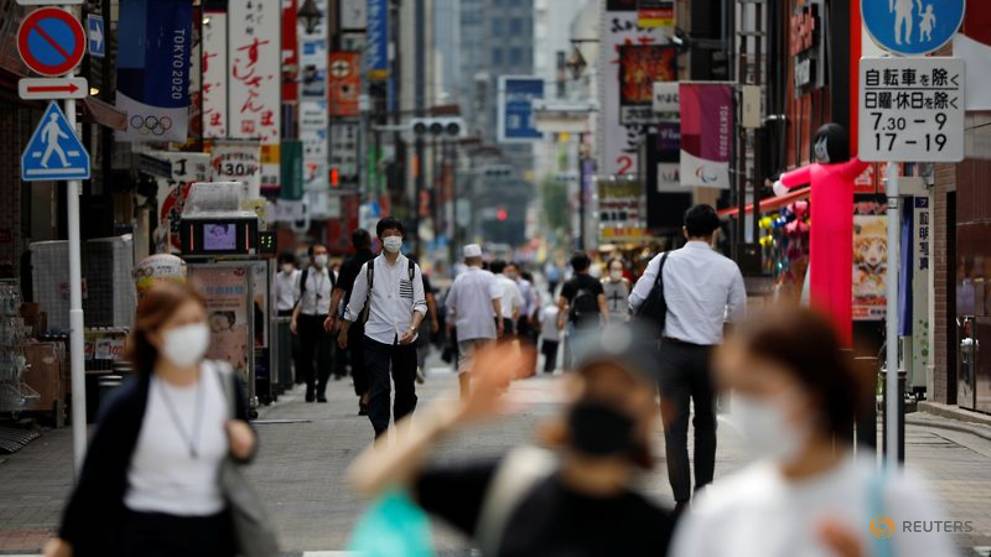
Hong Kongers were early adopters of widespread mask wearing, but now the government has made it compulsory even when outdoors, and limited gatherings to two people. (Photo: AFP/Anthony Wallace)
"This is the most critical time for Hong Kong. We ask citizens to be patient and stay at home as much as possible," she added.
Since late January, more than 2,600 people have been infected in Hong Kong, 20 of whom have died.
After seemingly ending local transmissions for weeks, new infections in Hong Kong have hit triple figures on a daily basis, sparking fears that the new outbreak is spreading out of control.
More than 1,000 infections have been confirmed since early July - more than 40 per cent of the total since the virus first hit the city in late January.
Authorities have warned that citizens have become too lax about wearing masks and social distancing.
People wearing protective face masks walk at Mid-Levels Central in Hong Kong, China, Jul 22, 2020. (Photo: Reuters/Tyrone Siu)
Over the weekend they stepped up controls, sealing off popular beaches and introduced new rules to limit movements of ship and flight crews which stop in the city.
Hong Kong's Hospital Authority has said new cases are being found faster than public hospitals can take them in, according to public broadcaster RTHK.
China's liaison office in Hong Kong said on Sunday that the central government had made clear it would boost the city's capacity in coronavirus tests and help set up hospitals especially for infected patients.
Local authorities had previously announced plans to convert a large exhibition centre near the city's airport into a temporary field hospital.
Cheung on Monday said Beijing had agreed to help build the 2,000-bed facility, similar to those used in the central Chinese city of Wuhan where the deadly virus first emerged.
"These hospitals were built with marvellous speed in mainland China," Cheung said.
HONG KONG: Hong Kong on Monday (Jul 27) announced further restrictions to curb a surge in COVID-19 cases, including a ban on gatherings of more than two people, a total bar on restaurant dining and mandatory face masks in all public places, including outdoors.
The measures, which will take effect from Wednesday, are the first time the city has completely banned dining in restaurants.It builds on measures introduced last week to contain the spread of COVID-19.
Restaurants will still be allowed to serve takeaway meals.
"The situation is very worrying," said Chief Secretary Matthew Cheung, adding that the current outbreak is the most severe the city has experienced.
The measures will be in place for seven days, he said.
Last week's measures saw a ban on dining in restaurants after 6pm and the continued closure of 12 types of venues - including gyms and entertainment centres - until Jul 28.
The announcement also mandated face masks in all public indoor areas, including malls and markets, for two weeks from Jul 22.
A spike in recent cases was mostly due to people not wearing masks, Health Secretary Sophia Chan said when announcing last week's measures.
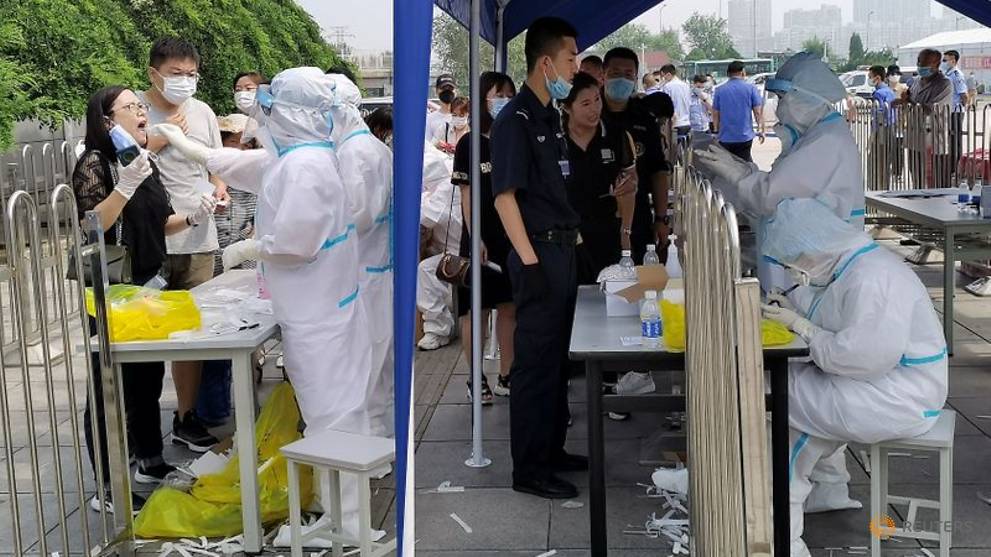
A medical worker in protective suit collects a swab from a man to test for COVID-19 at a specimen collection point for taxi drivers inside a car park in Hong Kong. (Photo: Reuters/Lam Yik)
"This is the most critical time for Hong Kong. We ask citizens to be patient and stay at home as much as possible," she added.
Since late January, more than 2,600 people have been infected in Hong Kong, 20 of whom have died.
After seemingly ending local transmissions for weeks, new infections in Hong Kong have hit triple figures on a daily basis, sparking fears that the new outbreak is spreading out of control.
More than 1,000 infections have been confirmed since early July - more than 40 per cent of the total since the virus first hit the city in late January.
Authorities have warned that citizens have become too lax about wearing masks and social distancing.
People wearing protective face masks walk at Mid-Levels Central in Hong Kong, China, Jul 22, 2020. (Photo: Reuters/Tyrone Siu)
Over the weekend they stepped up controls, sealing off popular beaches and introduced new rules to limit movements of ship and flight crews which stop in the city.
Hong Kong's Hospital Authority has said new cases are being found faster than public hospitals can take them in, according to public broadcaster RTHK.
China's liaison office in Hong Kong said on Sunday that the central government had made clear it would boost the city's capacity in coronavirus tests and help set up hospitals especially for infected patients.
SINGAPORE: South Korean authorities have informed New Zealand that they suspect a traveller who tested positive for COVID-19 "was infected during the transit in Singapore airport", New Zealand’s Ministry of Health said on Monday (Jul 27).
The traveller left New Zealand on Jul 21 and arrived in South Korea the next day after transiting through Singapore. The person showed no symptoms but tested positive for the coronavirus upon arrival in South Korea.
“South Korean authorities have informed us that based on their initial investigations they suspect the traveller was infected during the transit in Singapore airport,” the New Zealand health ministry said on Monday.
“However other causes, including infection in New Zealand, can’t be ruled out at this stage so the ministry is in close contact with South Korea and is expecting further information from the authorities later today New Zealand time.”
Passengers flying through Changi Airport will be directed to new transit holding areas in Terminals 1 and 3 to provide a “safe environment for all passengers and airport workers”, said Changi Airport Group (CAG) on Jun 11.
Singapore Airlines (SIA) also announced on that day that SIA and SilkAir passengers flying from Auckland and Christchurch in New Zealand will be allowed to transit through Changi Airport.
CAG said the holding areas will be disinfected regularly and temperature taking will be conducted at the entrances. Transit passengers with a high temperature or who appear or feel unwell will be given medical attention.
The new Terminal 1 transit holding area. (Photo: Changi Airport Group)
All passengers must wear a face mask and adhere to the safe distancing markers.
Airport staff members in transit holding areas are required to wear face masks, face shields and gloves, and will also have their temperatures taken before entering the area.
Contactless hand sanitisers, automatic water taps and doors equipped with sensors in restrooms are available in the transit holding areas, CAG had said.
All restrooms, seats and chairs are regularly cleaned and disinfected.
“Frequently touched surfaces such as charging stations, tables and playgrounds have been sprayed with a long-lasting anti-microbial disinfectant coating that reduces the risk of virus transmission,” said CAG.
CNA has contacted CAAS and the Ministry of Health for more information.
CAG said it has no comment, in response to CNA's queries.
Seats in the transit holding area are vacuumed and wiped regularly with disinfectant. (Photo: Changi Airport Group)
There have been 1,206 COVID-19 cases in New Zealand, the health ministry said.
"It has now been 87 days since the last case of COVID-19 was acquired locally from an unknown source," the media release said.
"There are no new recovered cases today, which means the total number of active cases in New Zealand's managed isolation and quarantine facilities remains at 21. There is no one in New Zealand receiving hospital-level care for COVID-19."
TOKYO: Japan's economy minister says the government will urge businesses to aim for 70 per cent telecommuting and enhance other social distancing measures amid a rise in coronavirus cases among workers, some infected during after-work socialising.
Though Japan has largely avoided the mass infections that have killed tens of thousands overseas, a record surge in cases during the past week in Tokyo and other major urban areas has experts worried the country will face a second wave.
Economy Minister Yasutoshi Nishimura on Monday said in a video meeting with Japanese governors that business leaders will be asked to ramp up anti-virus measures such as encouraging the level of telecommuting achieved during Japan's state of emergency this year, when it hit 70 per cent to 80 per cent. It has since fallen to about 30 per cent, he added.
He also called on companies to encourage staggered shifts and avoid large after-work gatherings for drinks or meals.
Tokyo last week reported a daily record of 366 cases, with 239 on Sunday. The southern city of Fukuoka reported a record 90 cases on Sunday, along with rising numbers in Osaka.
Despite the rise in cases, the government does not plan to call another state of emergency, Chief Cabinet Secretary Yoshihide Suga told a news conference.
"The situation compared to April is very different," he said, citing the small number of serious cases as well as fewer cases among the elderly.
Nishimura said last week that concern was rising about clusters, specifically those involving host and hostess bars as well as others connected to workplaces and after-work socialising.
Though the number of serious cases remains relatively small, the government is also concerned about a rise in infections among people in their 40s and 50s.
The rate of telecommuting has lagged in Japan because of a paper-driven culture and technological shortcomings, experts say.
The central government remains determined to restart economic activity and last week launched a domestic travel campaign in the face of widespread criticism.
But Tokyo was omitted from the plan and Tokyo governor Yuriko Koike called on the city's residents to stay home during a four-day weekend starting Thursday.
On Monday, 131 new cases were confirmed in the capital, Koike said, but noted that testing had fallen to about 20 per cent of normal over the extended holiday weekend. She added that serious cases rose by one, to 19.
More than 30,000 people in Japan have been infected and nearly 1,000 have died.
BEIJING: China recorded 61 new COVID-19 cases on Sunday (Jul 26) - the highest daily figure since April - propelled by clusters in three separate regions that have sparked fears of a fresh wave.
Of the new infections, 41 were in the far western region of Xinjiang, where a sudden outbreak in the regional capital of Urumqi occurred in mid-July.
Fourteen domestic cases were also recorded in the northeastern province of Liaoning where a fresh cluster broke out in the city of Dalian last week.
Two more local cases were found in the neighbouring province of Jilin near the North Korean border - the first since late May.
The remaining four were imported cases, according to a statement by the National Health Commission on Monday.
Sunday's COVID-19 figure is the highest daily tally of new cases since Apr 14, when 89 cases, mostly imported, were recorded.
China also reported 44 new asymptomatic patients, down from 68 a day earlier.
Chinese authorities have rolled out mass testing for hundreds of thousands of people in the port city of Dalian.
A second wave of mass testing was also launched in Xinjiang's Urumqi on Sunday to detect residents who had previously tested false negative, reported the state-run Global Times, following a mass testing effort earlier this month.
SINGAPORE: A National University of Singapore (NUS) PhD student who went to Beijing to give a presentation on politics was recruited by Chinese intelligence operatives and went on to work for them, collecting sensitive information about the US military and government.
Singaporean Yeo Jun Wei Dickson pleaded guilty on Friday (Jul 24) to using a fake consultancy business in the United States as a front to collect sensitive US information for Chinese intelligence. He entered his plea in federal court in Washington to one charge of operating illegally as a foreign agent.
In his plea, Yeo admitted to working between 2015 and 2019 for Chinese intelligence, spotting and assessing Americans with access to “valuable non-public information”.
This included information from a civilian working with the US Air Force on the F-35B aircraft programme, another from a US officer working in the Pentagon about the withdrawal of troops from Afghanistan, and a report about a person in the State Department about a US Cabinet member.
He recruited these people on social media under orders from the Chinese intelligence service, meeting operatives on more than 20 occasions.
RECRUITED WHILE DOING DOCTORATE IN NUS
Yeo’s work with Chinese intelligence operatives began as early as 2015, when he travelled to Beijing to give a presentation on the political situation in Southeast Asia, court documents show.
At the time, he was studying to receive his Doctorate of Philosophy in Public Policy from NUS.
After his presentation, he was recruited by individuals who claimed to be China-based think tanks. They offered Yeo money in exchange for political reports.
“Yeo came to understand that at least four of these individuals were intelligence operatives for the PRC (People’s Republic of China) government. One of the intelligence operatives later asked Yeo to sign a contract with the PRC People’s Liberation Army (PLA). Yeo refused to sign the contract but continued to work for this and other (Chinese intelligence service) operatives,” a signed statement of facts said.
The operatives tasked him with providing them information about international political, economic and diplomatic relations. They said they wanted “non-public information” – information that they referred to as “scuttlebutt”.
Scuttlebutt is a slang for rumours or gossip.
Tensions are rising between the US and China as they battle for global supremacy. (Photo: AFP/Jason Lee)
“At first, the taskings were focused on Southeast Asia. Over time, the taskings became focused on the United States,” court documents read.
“Although these (Chinese intelligence service) operatives used pseudonyms in their interactions with Yeo, they were open about their affiliation with the PRC government. One of the operatives told Yeo that he and his boss worked for the PRC’s main intelligence unit.”
During one of Yeo’s trips to China, he met this operative and two others in a hotel room. During the meeting, the operative instructed Yeo with obtaining non-public information about the US Department of Commerce, artificial intelligence, and the trade war between China and the US.
He met operatives in various locations across China, and met with one Chinese intelligence contact about “19 to 20 times”. He met another operative about 25 times.
Whenever Yeo travelled to China for the meetings, he would be taken out of the customs line and brought to a separate office for admission into China.
He raised this issue with an operative, but they told Yeo they wanted to “conceal his identity” when he travelled into China.
USING SOCIAL MEDIA TO CONNECT WITH TARGETS
Yeo used social media to find and recruit US citizens who could provide him information. In 2018, a Chinese intelligence operative instructed him to create a fake consulting company and post job listings for the company on an online job-search website.
He used the same name as a prominent US consulting firm that conducts public and government relations. More than 400 resumes were sent in, with 90 per cent of them from US military and government personnel with security clearances.
Yeo would send the resumes to Chinese intelligence service operatives if he believed they would find the person’s resume interesting.
A “professional networking website” that was focused on career and employment was used by Yeo to find individuals with resumes and job descriptions that suggested they were likely to have access to valuable “non-public” information.
After he contacted potential targets online, the website began suggesting additional potential contacts.
“According to Yeo, the website’s algorithm was relentless,” court documents said.
“Yeo checked the professional networking website almost every day to review the new batch of potential contacts suggested to him by the site’s algorithm.
“Later, Yeo told US law enforcement that it felt almost like an addiction.”
File photo of a man making a call.
FINDING TROUBLED TARGETS
After he identified his potential targets, he worked to recruit them to provide information and write reports.
He received guidance from Chinese intelligence contacts on how to recruit potential targets, including asking whether the targets were dissatisfied with work, were having financial troubles, had children to support, and whether they had a good rapport with Yeo.
The court was told of three people he managed to recruit to provide him with information.
In and around 2015, he spotted a civilian working with the US Air Force on the F-35B military aircraft programme. The person has high-level security clearance, and confided in Yeo that he was having financial trouble.
Yeo recruited him to write a report, and the civilian also provided information about the geopolitical implications of the Japanese purchasing F-35 aircraft from the US. Yeo drafted a report and sent it to his contacts in Chinese intelligence.
Between 2018 and 2019, Yeo spotted another person on the professional networking website. This person was employed at the US Department of State at the time, and told Yeo he was feeling dissatisfied at work and was having financial trouble.
He said he was worried about his upcoming retirement.
At Yeo’s direction, the man wrote a report about a then-serving member of the US Cabinet.
The man said he feared that if State Department officials discovered he had provided information to Yeo, it would jeopardise his retirement pension. Yeo paid him S$1,000 or S$2,000 for the report.
Another person was recruited via a social networking app, an US Army officer who was assigned to the Pentagon.
Yeo met the officer on multiple occasions, building up a “good rapport” with him. The officer confided in Yeo that he was traumatised by his military tours in Afghanistan.
File photo of a man using a laptop. (Photo: AFP/Frederic J Brown)
Yeo asked the officer to write reports for clients in Korea and other Asian countries, but did not say it would be given to a foreign government.
The officer wrote a report on how the withdrawal of US military forces from Afghanistan would impact China, and was paid S$2,000 or more for the report. The money was transferred to the officer’s wife’s bank account.
Yeo was told to recruit the US officer to provide more classified information, and was offered more money if the officer could become a “permanent conduit of information”.
After Yeo returned to the US in November 2019, he planned to ask the officer for the classified information and wanted to reveal who he was working for.
However, when he landed at the airport, he was stopped by law enforcement and arrested before he could ask for more information from the officer, court documents said.
COMMUNICATING FROM THE US
The statement of facts shows Yeo lived in Washington from about January 2019 to July 2019. Besides recruiting people online, he attended multiple events and speaking engagements at DC-area think tanks, making contact with several individuals from lobbying firms to defence contracting firms.
Yeo was told not to communicate with Chinese intelligence operatives when he travelled to the US over concerns their communications would be intercepted.
He was instructed to email operatives from a local coffee shop, if he needed to do so. Another told him not to take his phone and notebooks while travelling to the US.
WeChat logo. (File photo: AFP/Martin BUREAU)
Yeo was also given a bank card to pay his American contacts for the information they provided. When Yeo was outside the US, he communicated with a Chinese intelligence operative through WeChat.
He was asked to use multiple phones and to change his WeChat account every time he contacted the Chinese intelligence service operatives.
“Yeo failed to notify the US Attorney General that he would be acting in the United States as an agent of a foreign government or foreign government official,” the court documents said.
Yeo faces a maximum of 10 years imprisonment and will be sentenced on Oct 9.