SINGAPORE: South Korean authorities have informed New Zealand that they suspect a traveller who tested positive for COVID-19 "was infected during the transit in Singapore airport", New Zealand’s Ministry of Health said on Monday (Jul 27).
The traveller left New Zealand on Jul 21 and arrived in South Korea the next day after transiting through Singapore. The person showed no symptoms but tested positive for the coronavirus upon arrival in South Korea.
“South Korean authorities have informed us that based on their initial investigations they suspect the traveller was infected during the transit in Singapore airport,” the New Zealand health ministry said on Monday.
“However other causes, including infection in New Zealand, can’t be ruled out at this stage so the ministry is in close contact with South Korea and is expecting further information from the authorities later today New Zealand time.”
Passengers flying through Changi Airport will be directed to new transit holding areas in Terminals 1 and 3 to provide a “safe environment for all passengers and airport workers”, said Changi Airport Group (CAG) on Jun 11.
Singapore Airlines (SIA) also announced on that day that SIA and SilkAir passengers flying from Auckland and Christchurch in New Zealand will be allowed to transit through Changi Airport.
CAG said the holding areas will be disinfected regularly and temperature taking will be conducted at the entrances. Transit passengers with a high temperature or who appear or feel unwell will be given medical attention.
The new Terminal 1 transit holding area. (Photo: Changi Airport Group)
All passengers must wear a face mask and adhere to the safe distancing markers.
Airport staff members in transit holding areas are required to wear face masks, face shields and gloves, and will also have their temperatures taken before entering the area.
Contactless hand sanitisers, automatic water taps and doors equipped with sensors in restrooms are available in the transit holding areas, CAG had said.
All restrooms, seats and chairs are regularly cleaned and disinfected.
“Frequently touched surfaces such as charging stations, tables and playgrounds have been sprayed with a long-lasting anti-microbial disinfectant coating that reduces the risk of virus transmission,” said CAG.
CNA has contacted CAAS and the Ministry of Health for more information.
CAG said it has no comment, in response to CNA's queries.
Seats in the transit holding area are vacuumed and wiped regularly with disinfectant. (Photo: Changi Airport Group)
There have been 1,206 COVID-19 cases in New Zealand, the health ministry said.
"It has now been 87 days since the last case of COVID-19 was acquired locally from an unknown source," the media release said.
"There are no new recovered cases today, which means the total number of active cases in New Zealand's managed isolation and quarantine facilities remains at 21. There is no one in New Zealand receiving hospital-level care for COVID-19."
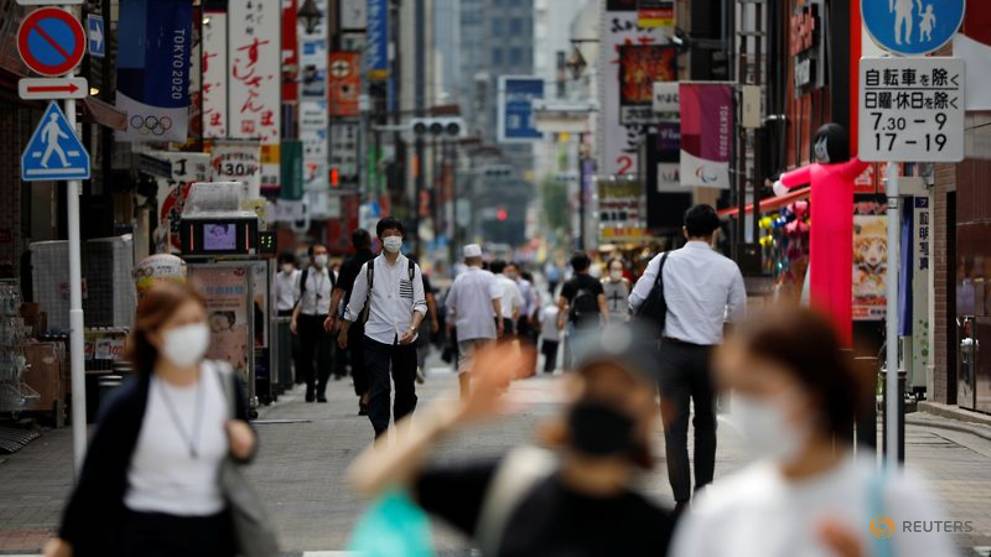
TOKYO: Japan's economy minister says the government will urge businesses to aim for 70 per cent telecommuting and enhance other social distancing measures amid a rise in coronavirus cases among workers, some infected during after-work socialising.
Though Japan has largely avoided the mass infections that have killed tens of thousands overseas, a record surge in cases during the past week in Tokyo and other major urban areas has experts worried the country will face a second wave.
Economy Minister Yasutoshi Nishimura on Monday said in a video meeting with Japanese governors that business leaders will be asked to ramp up anti-virus measures such as encouraging the level of telecommuting achieved during Japan's state of emergency this year, when it hit 70 per cent to 80 per cent. It has since fallen to about 30 per cent, he added.
He also called on companies to encourage staggered shifts and avoid large after-work gatherings for drinks or meals.
Tokyo last week reported a daily record of 366 cases, with 239 on Sunday. The southern city of Fukuoka reported a record 90 cases on Sunday, along with rising numbers in Osaka.
Despite the rise in cases, the government does not plan to call another state of emergency, Chief Cabinet Secretary Yoshihide Suga told a news conference.
"The situation compared to April is very different," he said, citing the small number of serious cases as well as fewer cases among the elderly.
Nishimura said last week that concern was rising about clusters, specifically those involving host and hostess bars as well as others connected to workplaces and after-work socialising.
Though the number of serious cases remains relatively small, the government is also concerned about a rise in infections among people in their 40s and 50s.
The rate of telecommuting has lagged in Japan because of a paper-driven culture and technological shortcomings, experts say.
The central government remains determined to restart economic activity and last week launched a domestic travel campaign in the face of widespread criticism.
But Tokyo was omitted from the plan and Tokyo governor Yuriko Koike called on the city's residents to stay home during a four-day weekend starting Thursday.
On Monday, 131 new cases were confirmed in the capital, Koike said, but noted that testing had fallen to about 20 per cent of normal over the extended holiday weekend. She added that serious cases rose by one, to 19.
More than 30,000 people in Japan have been infected and nearly 1,000 have died.
BEIJING: China recorded 61 new COVID-19 cases on Sunday (Jul 26) - the highest daily figure since April - propelled by clusters in three separate regions that have sparked fears of a fresh wave.
Of the new infections, 41 were in the far western region of Xinjiang, where a sudden outbreak in the regional capital of Urumqi occurred in mid-July.
Fourteen domestic cases were also recorded in the northeastern province of Liaoning where a fresh cluster broke out in the city of Dalian last week.
Two more local cases were found in the neighbouring province of Jilin near the North Korean border - the first since late May.
The remaining four were imported cases, according to a statement by the National Health Commission on Monday.
Sunday's COVID-19 figure is the highest daily tally of new cases since Apr 14, when 89 cases, mostly imported, were recorded.
China also reported 44 new asymptomatic patients, down from 68 a day earlier.
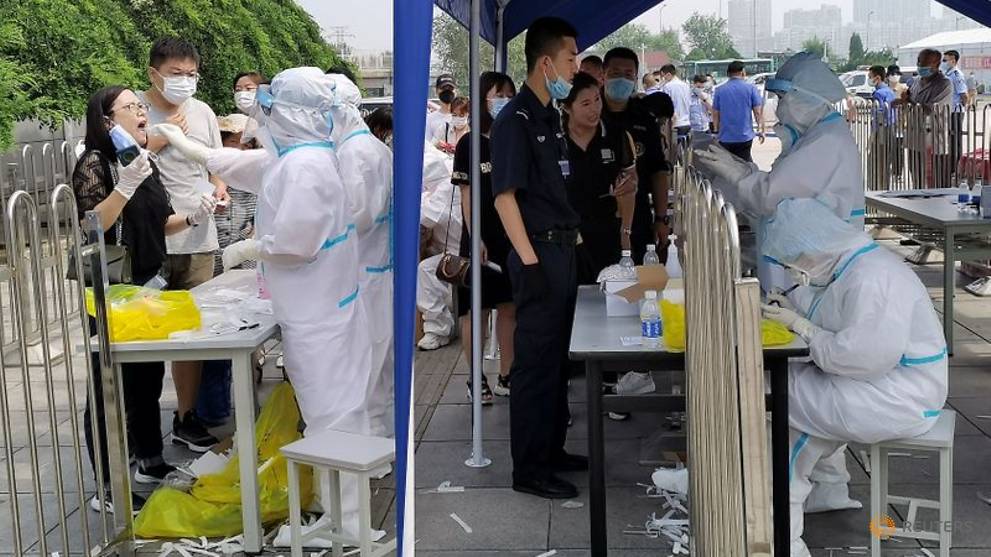
Chinese authorities have rolled out mass testing for hundreds of thousands of people in the port city of Dalian.
A second wave of mass testing was also launched in Xinjiang's Urumqi on Sunday to detect residents who had previously tested false negative, reported the state-run Global Times, following a mass testing effort earlier this month.
SINGAPORE: A National University of Singapore (NUS) PhD student who went to Beijing to give a presentation on politics was recruited by Chinese intelligence operatives and went on to work for them, collecting sensitive information about the US military and government.
Singaporean Yeo Jun Wei Dickson pleaded guilty on Friday (Jul 24) to using a fake consultancy business in the United States as a front to collect sensitive US information for Chinese intelligence. He entered his plea in federal court in Washington to one charge of operating illegally as a foreign agent.
In his plea, Yeo admitted to working between 2015 and 2019 for Chinese intelligence, spotting and assessing Americans with access to “valuable non-public information”.
This included information from a civilian working with the US Air Force on the F-35B aircraft programme, another from a US officer working in the Pentagon about the withdrawal of troops from Afghanistan, and a report about a person in the State Department about a US Cabinet member.
He recruited these people on social media under orders from the Chinese intelligence service, meeting operatives on more than 20 occasions.
RECRUITED WHILE DOING DOCTORATE IN NUS
Yeo’s work with Chinese intelligence operatives began as early as 2015, when he travelled to Beijing to give a presentation on the political situation in Southeast Asia, court documents show.
At the time, he was studying to receive his Doctorate of Philosophy in Public Policy from NUS.
After his presentation, he was recruited by individuals who claimed to be China-based think tanks. They offered Yeo money in exchange for political reports.
“Yeo came to understand that at least four of these individuals were intelligence operatives for the PRC (People’s Republic of China) government. One of the intelligence operatives later asked Yeo to sign a contract with the PRC People’s Liberation Army (PLA). Yeo refused to sign the contract but continued to work for this and other (Chinese intelligence service) operatives,” a signed statement of facts said.
The operatives tasked him with providing them information about international political, economic and diplomatic relations. They said they wanted “non-public information” – information that they referred to as “scuttlebutt”.
Scuttlebutt is a slang for rumours or gossip.
Tensions are rising between the US and China as they battle for global supremacy. (Photo: AFP/Jason Lee)
“At first, the taskings were focused on Southeast Asia. Over time, the taskings became focused on the United States,” court documents read.
“Although these (Chinese intelligence service) operatives used pseudonyms in their interactions with Yeo, they were open about their affiliation with the PRC government. One of the operatives told Yeo that he and his boss worked for the PRC’s main intelligence unit.”
During one of Yeo’s trips to China, he met this operative and two others in a hotel room. During the meeting, the operative instructed Yeo with obtaining non-public information about the US Department of Commerce, artificial intelligence, and the trade war between China and the US.
He met operatives in various locations across China, and met with one Chinese intelligence contact about “19 to 20 times”. He met another operative about 25 times.
Whenever Yeo travelled to China for the meetings, he would be taken out of the customs line and brought to a separate office for admission into China.
He raised this issue with an operative, but they told Yeo they wanted to “conceal his identity” when he travelled into China.
USING SOCIAL MEDIA TO CONNECT WITH TARGETS
Yeo used social media to find and recruit US citizens who could provide him information. In 2018, a Chinese intelligence operative instructed him to create a fake consulting company and post job listings for the company on an online job-search website.
He used the same name as a prominent US consulting firm that conducts public and government relations. More than 400 resumes were sent in, with 90 per cent of them from US military and government personnel with security clearances.
Yeo would send the resumes to Chinese intelligence service operatives if he believed they would find the person’s resume interesting.
A “professional networking website” that was focused on career and employment was used by Yeo to find individuals with resumes and job descriptions that suggested they were likely to have access to valuable “non-public” information.
After he contacted potential targets online, the website began suggesting additional potential contacts.
“According to Yeo, the website’s algorithm was relentless,” court documents said.
“Yeo checked the professional networking website almost every day to review the new batch of potential contacts suggested to him by the site’s algorithm.
“Later, Yeo told US law enforcement that it felt almost like an addiction.”
File photo of a man making a call.
FINDING TROUBLED TARGETS
After he identified his potential targets, he worked to recruit them to provide information and write reports.
He received guidance from Chinese intelligence contacts on how to recruit potential targets, including asking whether the targets were dissatisfied with work, were having financial troubles, had children to support, and whether they had a good rapport with Yeo.
The court was told of three people he managed to recruit to provide him with information.
In and around 2015, he spotted a civilian working with the US Air Force on the F-35B military aircraft programme. The person has high-level security clearance, and confided in Yeo that he was having financial trouble.
Yeo recruited him to write a report, and the civilian also provided information about the geopolitical implications of the Japanese purchasing F-35 aircraft from the US. Yeo drafted a report and sent it to his contacts in Chinese intelligence.
Between 2018 and 2019, Yeo spotted another person on the professional networking website. This person was employed at the US Department of State at the time, and told Yeo he was feeling dissatisfied at work and was having financial trouble.
He said he was worried about his upcoming retirement.
At Yeo’s direction, the man wrote a report about a then-serving member of the US Cabinet.
The man said he feared that if State Department officials discovered he had provided information to Yeo, it would jeopardise his retirement pension. Yeo paid him S$1,000 or S$2,000 for the report.
Another person was recruited via a social networking app, an US Army officer who was assigned to the Pentagon.
Yeo met the officer on multiple occasions, building up a “good rapport” with him. The officer confided in Yeo that he was traumatised by his military tours in Afghanistan.
File photo of a man using a laptop. (Photo: AFP/Frederic J Brown)
Yeo asked the officer to write reports for clients in Korea and other Asian countries, but did not say it would be given to a foreign government.
The officer wrote a report on how the withdrawal of US military forces from Afghanistan would impact China, and was paid S$2,000 or more for the report. The money was transferred to the officer’s wife’s bank account.
Yeo was told to recruit the US officer to provide more classified information, and was offered more money if the officer could become a “permanent conduit of information”.
After Yeo returned to the US in November 2019, he planned to ask the officer for the classified information and wanted to reveal who he was working for.
However, when he landed at the airport, he was stopped by law enforcement and arrested before he could ask for more information from the officer, court documents said.
COMMUNICATING FROM THE US
The statement of facts shows Yeo lived in Washington from about January 2019 to July 2019. Besides recruiting people online, he attended multiple events and speaking engagements at DC-area think tanks, making contact with several individuals from lobbying firms to defence contracting firms.
Yeo was told not to communicate with Chinese intelligence operatives when he travelled to the US over concerns their communications would be intercepted.
He was instructed to email operatives from a local coffee shop, if he needed to do so. Another told him not to take his phone and notebooks while travelling to the US.
WeChat logo. (File photo: AFP/Martin BUREAU)
Yeo was also given a bank card to pay his American contacts for the information they provided. When Yeo was outside the US, he communicated with a Chinese intelligence operative through WeChat.
He was asked to use multiple phones and to change his WeChat account every time he contacted the Chinese intelligence service operatives.
“Yeo failed to notify the US Attorney General that he would be acting in the United States as an agent of a foreign government or foreign government official,” the court documents said.
Yeo faces a maximum of 10 years imprisonment and will be sentenced on Oct 9.
SINGAPORE: The National University of Singapore's Lee Kuan Yew School of Public Policy (LKYSPP) has terminated the PhD candidature of Dickson Yeo Jun Wei with immediate effect, a spokesperson for the school said on Sunday (Jul 26).
Responding to CNA's queries, the spokesperson said in a statement that this move comes after information released by the US Department of Justice. The statement noted that Yeo has pleaded guilty in the US to one count of acting within the US as an illegal agent of a foreign power.
Yeo enrolled as a PhD student in LKYSPP's Public Policy programme in 2015. In 2019, he applied for, and was granted, a leave of absence, the spokesperson said.
Screengrab of Dickson Yeo's profile, which was up on LKYSPP's website until Jul 25, 2020.
Checks by CNA showed that while he was a student at LKYSPP, Yeo researched and wrote papers on China’s treatment of small states. He proposed a thesis titled "How does China treat small states of Strategic Value?" According to Yeo’s profile on the Academia website, his thesis proposal was approved in principle by LKYSPP in August 2017.
The 29 papers and presentations uploaded online revealed that he was also a visiting researcher at Peking University for International Relations and Public Policy.
On his profile, Yeo also published a “brief note” on US President Barack Obama’s foreign policy. In the paper, he said Mr Obama’s “main goal” was to “re-establish American economic leadership” while “persecuting the war on terror by not alienating America’s friends”.
In another paper studying US intervention in Afghanistan, Yeo had concluded that the intervention was “primarily dependent” on “obtaining international support for domestic legitimisation of action” following the 9/11 attacks.
“This arbitrary definition of legitimacy, once obtained, ignored the principles of self determination and non-intervention,” he wrote.
FORMER TOP DIPLOMAT LINKS YEO WITH EXPELLED PROFESSOR
In a Facebook post on Saturday, former top Singapore diplomat Bilahari Kausikan said that Yeo’s PhD supervisor at LKYSPP was former LKYSPP Professor Huang Jing. Mr Kausikan did not indicate the source of the information.
Prof Huang was identified in 2017 as an “agent of influence for a foreign country” by the Ministry of Home Affairs (MHA). Without naming the country, MHA said that Prof Huang "knowingly interacted with intelligence organisations and agents of the foreign country, and cooperated with them to influence the Singapore Government’s foreign policy and public opinion in Singapore".
Prof Huang gave what he claimed was “privileged information” about the foreign country to prominent and influential Singaporeans, including to a senior member of LKYSPP, with the aim of influencing their opinions in favour of that country, MHA said.
RECRUITED BY CHINESE AGENTS
Yeo pleaded guilty on Friday (Jul 24) to using a fake consultancy business in the United States as a front to collect sensitive US information for Chinese intelligence. He entered his plea in federal court in Washington to one charge of operating illegally as a foreign agent.
In his plea, Yeo admitted to working between 2015 and 2019 for Chinese intelligence, spotting and assessing Americans with access to “valuable non-public information”.
He was recruited by Chinese intelligence operatives and went on to work for them after he went to Beijing to give a presentation on politics.
Yeo was arrested after he returned to the US in November 2019; upon his return, he had planned to ask an informant for classified information and also reveal whom he was working for, according to court documents. However, he was stopped by US law enforcement agents and arrested after he landed at the airport.
LAST FACEBOOK POST IN NOVEMBER 2019
According to information from his Facebook page, Yeo was born on Feb 22, 1981.
On Nov 6, 2019, Yeo posted on Facebook that he was “flying yet again”, and later posted a photo of a boarding counter at a Japanese airport that showed details for an 11.05am flight to John F Kennedy International Airport in New York.
This was followed by Yeo’s last posts on Facebook on Nov 7, 2019. There were two - first, a post that said “Stressful Day”, and then he shared an inspirational quote from another page.
Four weeks after his last posts, a friend commented on his “Stressful Day” post: “Dickson, where are you?”
Screengrabs of Yeo’s last Facebook posts in early November 2019. He was arrested that month in the US by law enforcement agents.
FAKE CONSULTANCY BUSINESS
In court documents, it is said that Yeo was directed by Chinese intelligence to open up a fake consultancy and offer jobs in the US.
The fake business bore the same name as a prominent US consulting firm that conducts public and government relations.
The website of one such company - which has since been taken down - bears Yeo’s name, and what appears to be his email address and Singapore phone number. It was further claimed that the company was “formed as a result of a brain-storm between multiple parties in Singapore and Shanghai”.
The company also claimed to serve as a “consulting bridge” between “multiple parties” and to offer “in-depth analysis on the risk and market entry issues centered on the Eurasian Region”.
According to court documents, Yeo received more than 400 resumes, 90 per cent of which were from US military or government personnel with security clearances, and gave his Chinese handlers the resumes that he thought they would find interesting.
Before becoming a PhD candidate at LKYSPP, Yeo was also an energy analyst at the NUS Energy Studies Institute in 2011.
MADRID: British tourists flying home on Sunday (Jul 26) after a holiday in Spain angrily reacted to an abrupt decision by their government to make everyone arriving from the Mediterranean country spend 14 days in quarantine.
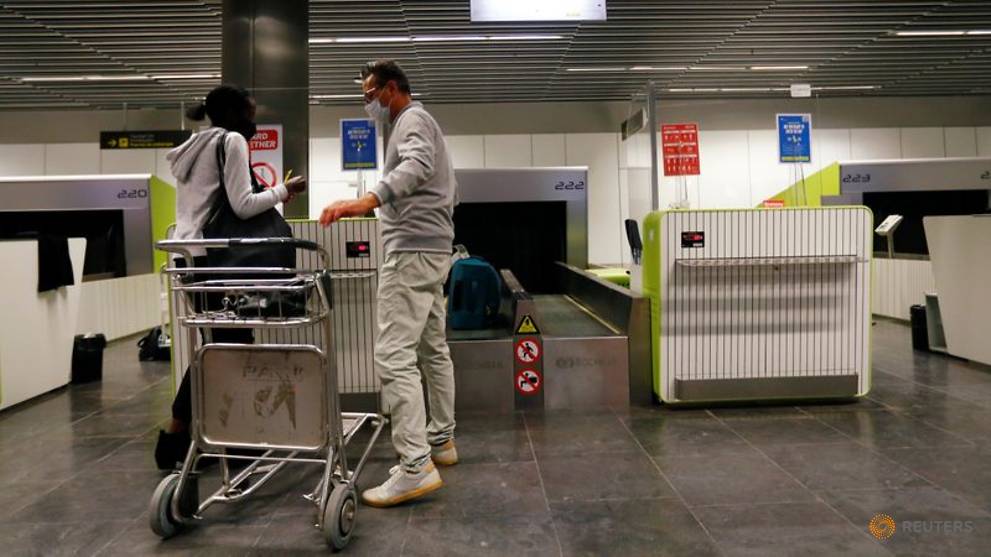
Britain's decision late on Saturday to take Spain off a safe-travel list over a rise in COVID-19 cases took effect from midnight local time, leaving travellers with no time to dodge it, and with major concerns about their returns, tourists at Madrid's Barajas airport said.
"It's really bad because it's just come all of a sudden, it's not given very much time to prepare so everyone is now panicking," said Emily Harrison, from Essex, who was taking a flight to London and faced the prospect of having to self-isolate for two weeks.
"It ruins plans for everybody," Harrison said. "We had a wedding to go to and we had plans to visit friends and family who we haven't seen in a very long time and now we are going to have to cancel all those plans, so it's really quiet upsetting."
Spain was one of the worst hit countries in Europe by the coronavirus pandemic, with more than 290,000 cases and over 28,000 deaths. It imposed very strict lockdown measures to contain the spread, gradually easing them earlier in the summer.
Spain had been on a list of countries that the British government had said were safe for travellers to visit - meaning tourists returning home would not have to go into quarantine.
But it has seen a surge of cases in the last few weeks, forcing lockdowns to be reimposed in some areas.
The British decision follows steps by Norway on Friday to re-impose a 10-day quarantine requirement for people arriving from Spain, while France advised people not to travel to Spain's northeastern region of Catalonia.
But a collapse of tourism from Britain would have far more of an impact on Spain's economy.
Britons made up more than 20 per cent of foreign visitors to Spain last year, the largest group by nationality, a key source of income for a country that depends on tourism for about 12 per cent of its economy.
Some British tourists pointed out that Spain's mask-wearing rules are much stricter than those in Britain.
"We're quite frustrated by it to be honest, because it actually feels safer in Spain," British tourist Carolyne Lansell said of the quarantine decision.
Lansell was flying to Ibiza from Madrid for a 10-day holiday before going home.
Antonio Perez, the mayor of Benidorm, a resort on Spain's Costa Blanca that is hugely dependent on British tourists, said the British quarantine rule was a "tough blow".
"We've suffered a lot this year and then this happened. We thought that the British were going to come back but this makes things harder for now," he said.