HONG KONG: On Jul 14, US President Donald Trump signed the “Hong Kong Autonomy Act” and issued an executive order on Hong Kong Normalisation.
It states that “Hong Kong is no longer sufficiently autonomous to justify differential treatment in relation to the People’s Republic of China”.
This decision was taken by the Trump administration after “the National People’s Congress of China announced its intention to unilaterally and arbitrarily impose national security legislation on Hong Kong”.
If there is no differential trade treatment for Hong Kong, the city will be treated by external countries such like the US as the same as other cities in China in many aspects, including passport control and trade status.
Perhaps the only differences that remain between Hong Kong and other Chinese cities are the free flow of money, information, people and an independent judicial system.
Although there is no obvious capital exodus from Hong Kong yet, the US sanctions can be quite detrimental.
In 2019, according to the Hong Kong Trade Development Council, about 11.2 per cent of China’s exports were handled via Hong Kong. Imports and exports contributed 17.2 per cent of Hong Kong’s GDP, generating 376,600 jobs.
The total trade value between Hong Kong and the US was HK$517 billion (US$67 billion) with imports at HK$213 billion, domestic exports at HK$3.7 billion and re-exports, routed through Hong Kong, at HK$300.3 billion.
According to the President Trump’s Order, the US will revoke license exceptions for exports from Hong Kong, re-exports from Hong Kong, and transfers within Hong Kong of items subject to the Export Administration Regulations.
FILE PHOTO: A Star Ferry boat crosses Victoria Harbour in front of a skyline of buildings during sunset, as a meeting on national security legislation takes place in Hong Kong, China June 29, 2020. REUTERS/Tyrone Siu/File Photo
If there is no preferential treatment, these re-exports may no longer pass through Hong Kong. The impact to Hong Kong’s economy could be substantial, including specific sectors.
IMPACT TO THE FINANCIAL SECTOR
The Hong Kong Autonomy Act, targets the financial sector.
First is the identification of “persons” who are described as “materially contributing to, has materially contributed to, or attempts to materially contribute to the failure of the Government of China to meet its obligations under the Joint Declaration or the Basic Law”.
Second, the identification of “any foreign financial institution that knowingly conducts a significant transaction with a foreign person.”
The president can levy sanctions on these persons and foreign financial institutions.
Section 7(b) of the Hong Kong Autonomy Act states the potential sanctions such as prohibition from acting as a primary dealer in US debt, participating in foreign-exchange transactions that are subject to US jurisdiction, on the export of commodities or software to the financial institution, on any US person from investing in equity or debt of the financial institution.
It is obvious that foreign institutions would try to stay away from such foreign persons or otherwise as these institutions would be sanctioned by the US government. These financial institutions will not only suffer from sanctions in certain transactions but also suffer reputation loss.
If the US government sanctions a particular financial institution, its operation would definitely be seriously jeopardised.
According to global financial messaging service SWIFT, in May 2020, about 40 per cent of global payments were made in US dollars, 33 per cent in euros and only 1.79 per cent were in renminbi. The Hong Kong dollar accounted for only 1.41 per cent of global payments.
The US dollar is still the widest used currency in the world. Thus, any restrictions in foreign exchange transactions that are subject to the US jurisdiction and sanctions will undermine Hong Kong as an international financial centre in the region.
The US economy is also the biggest in the world, and the New York Stock Exchange (NYSE) and the NASDAQ are the two biggest stock markets globally with total market capitalisation of US$35 trillion.
Therefore, global financial institutions, which typically have shareholders from the US, cannot ignore American investors.
Hong Kong has been plunged into crisis over the past year, threatening its status as a reliable world-class business centre. (Photo: AFP/Anthony WALLACE)
For example, dealers in US debt or foreign exchange transactions are subject to the US jurisdiction. Financial institutions may still be able to deal with US debt in an alternative way or have foreign exchange transactions not subject to the US jurisdiction, but the scale of such opportunities would be limited.
STOCK MARKET BENEFITS FROM CHINESE COMPANIES
Also, if other countries take a leaf from the US’ book to issue similar sanctions, then these financial institutions will not be able to provide full-scale global operations to their customers.
Already, Australia, the UK and New Zealand have all announced a review of policies that regarded Hong Kong as separate from China. The UK, for instance, suspended its extradition treaty with Hong Kong and extend its arms embargo with China to the island.
Will the stock market in Hong Kong collapse? It may not.
About 54 per cent of the weight of the Hang Seng Index stocks are mainland or mainland-related companies. As long as the economy of China performs well, international investors can still use Hong Kong to invest in these companies.
International investors can also invest directly in the Chinese markets through the Shanghai-Hong Kong Stock Connect and the Shenzhen-Hong Kong Stock Connect but these are subject to a daily northbound quota for each market at 52 billion renminbi.
The utilisation of the north bound quotas is on average at a 40 per cent rate and it indicates that investors prefer to invest in mainland companies through Hong Kong instead of through the stock connect.
Financial services contributed to 19.8 per cent of GDP in 2018 and professional services such as accounting, legal and auditing, contributed another 1.4 per cent. Many of these activities are related to services for the listed companies and wealth management.
If President Trump sanctions the export of commodities or software to financial institutions, these companies may eventually not be able to receive the necessary information to perform some transactions.
Already, the disappearance of preferential treatment was seen even before the President’s Order.
In April, the Federal Communications Commission approved Alphabet Inc unit Google’s request to use part of a US-Asia undersea telecommunications cable. Google agreed to operate a portion of the Pacific Light Cable Network system between the US and Taiwan, but not Hong Kong as the US regulators had blocked its use.
This incident has revealed that even before the security law was passed, the US regulators were subjecting Hong Kong to the same wary treatment as China.
WILL INVESTORS STILL PAY PROPERTY MARKET PREMIUMS?
The Hong Kong property market has been relatively stable after the implementation of the national security law and Trump’s latest announcement.
As of Jul 17, the Centa-City Leading Index, which reflects Hong Kong's property price index, is at around 180.81 – which is 1.04 per cent higher than the previous week and 9.2 per cent lower than its historical high of 190 last July. The demand for housing is always strong in Hong Kong. Unless the core values of Hong Kong change, otherwise, the demand remains.
Commercial and residential property prices in Hong Kong have been fuelled by an influx of money from wealthy mainland Chinese investors and developers. (Photo: AFP/Anthony Wallace)
As the differences between Hong Kong and Chinese cities converge, foreign investors may start thinking it better to invest directly in other mainland cities rather than paying a premium cost to keep their operations in Hong Kong.
Investors have been willing to incur premium charges for office rentals and residential costs in Hong Kong because the city offered access to China while also retaining core values that they would be more comfortable with.
With a new national security law that came into effect on Jun 30, investors may feel that some of these core values may have changed or even disappeared, bringing into question if they would still feel the need to pay a premium to be in Hong Kong.
If Hong Kong’s role as an international financial centre and re-export hub between China and the US diminishes, the island stands to lose many business opportunities. The demand for housing may drop and level of premium paid by users will reduce.
If Hong Kong is treated as just another mainland city, salaries and house prices would be equalised eventually. It all depends on how the Hong Kong Autonomy Act is implemented and if President Trump wants it to be a symbolic gesture or if he is going to push for more sanctions.
Hong Kong has long occupied a crucial intermediary role for China's economic development. That should now count for more if the rest of the world is going to reduce economic ties with Hong Kong.
Simon Lee is Senior Lecturer at the School of Accountancy and Co-Director of the International Business and Chinese Enterprise Programme at the Chinese University of Hong Kong Business School.
WASHINGTON (REUTERS) - US President Donald Trump, in a shift in rhetoric on facial coverings, encouraged Americans on Tuesday (July 21) to wear a mask if they cannot maintain social distance from people around them in an effort to curb the spread of the coronavirus.
In his first briefing focused on the pandemic in months, Trump told reporters at the White House that the virus will probably get worse before it gets better.
Trump has been reluctant to wear a mask himself in public.
He wore one for the first time in public during a recent visit to a military hospital but has otherwise eschewed putting one on in front of the press.
As cases rises in states around the country, including in politically important states such as Florida, Texas and Arizona, Trump is shifting his tone to try to get the number of cases under control.
"We're asking everybody that when you are not able to socially distance, wear a mask, get a mask. Whether you like the mask or not, they have an impact, they'll have an effect and we need everything we can get," he said.
Trump said he was getting used to masks and would wear one himself in groups or when on an elevator.
"I will use it, gladly," he said.
"Anything that potentially can help... is a good thing."
The president also urged young Americans to avoid crowded bars where the virus could spread.
HONG KONG: Riot police fanned out across a Hong Kong town on Tuesday (Jul 21) to stamp out rallies marking the one-year anniversary of an attack against protesters by government supporters which sent anti-Beijing sentiment soaring.
Officers used pepper spray to disperse small groups of protesters and reporters inside a mall in the town of Yuen Long, near the border with China.
Hundreds were detained and searched throughout the night, and police said at least five arrests made, as officers used loudhailers to warn people against "unlawful assembly".
At one point a police banner was raised saying crowds were in breach of a new security law Beijing imposed on the city after a man waved his own sign with the popular protest slogan: "Liberate Hong Kong. Revolution of our times."
Police said they issued 79 spot fines under emergency anti-coronavirus measures banning groups of more than four people. Activists and reporters wearing yellow press jackets were among those given tickets, AFP journalists saw.
The attack inside Yuen Long station was a pivotal moment in last year's huge protests, compounding already swirling animosity towards the police and heralding a dramatic increase in political violence.
At least 40 people were injured when a group of stick-wielding men set upon protesters returning from a rally in the city.
Riot police enter a shopping mall in Yuen Long to dispere an attempt by anti-government protesters to rally. (Photo: AFP/Dale de la Rey)
Videos of bloody beatings went viral, sparking accusations that police were too slow to respond and had allowed the attackers to gather and depart unmolested.
The force denies allegations of collusion and says 37 people have been arrested over the attack - some with links to "triad" organised crime gangs.
In a statement on Tuesday, the police said they "understand the public's concern" and said the investigation had "high priority".
'UGLY SIDE'
More than 9,000 people have been arrested during protests over the last year, with some 1,500 charged.
Hong Kong police turned out in force to stamp out any attempt at protests in Yeung Long. (Photo: AFP/Dale de la Rey)
Local lawmaker Lam Cheuk-ting was one of those beaten in last year's attack.
He was among those fined on Tuesday while trying to hold a small rally outside the station.
"I believe the police cannot face their own dark and ugly side in the Jul 21 attack, so they prevent us legislators from speaking out for the people," he told reporters afterwards.
"But all Hong Kongers have seen it (the attack) clearly last year," he added.
Protesters attend a rally at a shopping mall in Hong Kong on Jul 21, 2020. (Photo: AFP/Dale de la Rey)
Yuen Long is a blue-collar town in Hong Kong's rural New Territories bordering mainland China. It is a stronghold of staunchly pro-Beijing groups, as well as triad gangs.
The attack sparked huge protests by residents and left the community deeply divided.
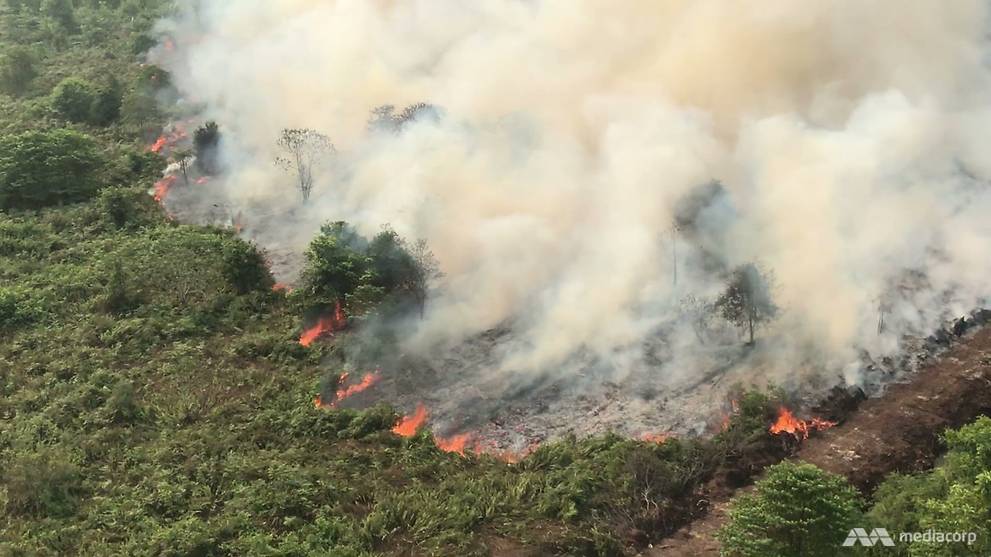
JAKARTA: The head of Indonesia’s Peatland Restoration Agency (BRG) Nazir Foead said that he is "very optimistic" there will be no fires this year in the peatlands under his supervision.
Speaking to CNA in an exclusive interview on Monday (Jul 20), he said that the agency has improved the methods for preventing fires from happening this time round.
He said that BRG has set up about 150 sensors in non-concession peatlands that can measure the water and moisture level every hour.
These readings would indicate how susceptible the peatlands are to fires. They will also give an indication if someone has purposely drained the peatland with the aim of setting fires to clear the land.
The BRG would send this information to relevant authorities, including law enforcers.
When asked how optimistic he is that no fires will happen this year, Mr Foead replied: "Very optimistic because we are working very hard.”
The meteorological, climatological, and geophysical agency (BMKG) has predicted a wetter dry season this year, which would also lower the chances of forest and land fires happening.
Despite this, the other government agencies have warned the BRG to remain vigilant, especially amid COVID-19, said Mr Foead.
The pandemic has brought economic hardship as a result of social restrictions put in place to curb the disease and now millions in Indonesia are out of jobs.
“They warned us. They said that those capitalists (brokers) who want to use this opportunity to clear land using fires will find it cheaper to pay people to burn land,” he said.
“(Because) people need more money.”
This picture taken on Sep 19, 2019 shows firefighters battling a forest fire near Pekanbaru, Riau. Indonesia is battling forest fires causing toxic haze across southeast Asia with aircraft, artificial rain and even prayer, President Joko Widodo said during a visit to a hard-hit area. (Photo: AFP/Wahyudi)
Authorities have long said that forest and land fires are man-made to clear land, worsened by dry weather.
“So they (authorities) warned us: ‘Be prudent, be prepared, you need to have a stronger intelligence, stronger patrols … The bad capitalists out there are trying to gain an advantage in the situation.
"There’s always those kinds of people and this year they can find easier and cheaper troops to do that,” Mr Foead said.
“So the danger is still high.”
After Indonesia experienced huge forest and land fires in 2015, which resulted in deaths, economic loss and transboundary haze, President Joko Widodo set up the BRG in Jan 2016 to prevent similar incidents.
89% OF NON-CONCESSION PEATLAND HAS BEEN RESTORED
When the agency was first set up, Mr Foead said his team spent the first year planning how to restore peatlands which includes rewetting, revegetating, and revitalising economic livelihood in seven provinces where peatlands are mainly found.
Peatland is an accumulation of multiple layers of organic material such as mosses and plants.
Thus, when it gets burned, the fires would be harder to extinguish than fires on mineral soil as the flames would continue to smoulder beneath the surface.
In the provinces of Riau, Jambi, South Sumatra, West Kalimantan, Central Kalimantan, South Kalimantan and Papua, the BRG is continuously educating people about the importance of peatland restoration, he said.
There are about 2.6 million ha of peatland in the seven provinces, about 1.7 million ha of them are on concession lands which are the responsibility of companies.
The companies are mainly dealing with palm oil, pulp and paper as well as timber.
The environment and forestry ministry is responsible for overseeing peatland on concession lands, while the BRG is responsible for about 900,000 ha of peatland on non-concession lands which are community lands.
Mr Foead said that 89 per cent of the peatland on non-concession land has been restored as of the end of 2019. The target set by the government is to achieve 100 per cent by the end of this year.
Mr Foead noted how local farmers have taken ownership of the peatlands and have even planted pineapples, vegetables and coffee on the lands.
Fire raging in Jambi, Indonesia on Sep 25, 2019. (Photo: Kiki Siregar)
Commenting on the remaining target, he said: “We are confident when it comes to the non-concession lands.”
However, he noted that forest and land fires are not only dependent on the moisture level of peatland. Tough law enforcement is also crucial to ensure people would not deliberately set fires anymore.
PEATLAND RESTORATION "CANNOT BE DONE QUICKLY"
Mr Foead told CNA that peatland restoration should be a long term effort, as the land cannot be rehabilitated in a short period of time.
He explained that if peatland has been drained since 1999, for example, it would need 10 or even 20 years to be restored.
“Based on cases abroad, there are even instances which take up to 30 years. Even those have not restored completely,” Mr Foead said.
“So ecosystem restoration takes time. It cannot be done quickly.”
Peatland that has been razed by fire. (Photo: Kiki Siregar)
The BRG chief, who used to work for the World Wildlife Fund also said that his agency is trying new methods of peatland mapping, which combines coring with three-dimensional satellite images.
With an improved methodology, the agency will have access to land categorisation data. It can then take samples according to every category, which is a quicker and cheaper way of mapping.
Considering the new technologies and methods the BRG now has, backed up by civil society, communities, and governments as well as policies, Mr Foead is hopeful that Indonesia can be a champion in peatland restoration.
“I would really like to see that we will prove this is the most effective way in protecting, maintaining and restoring peatlands.
“We have a lot to share with the world, mostly tropical countries that have huge peatlands. Or maybe any rehabilitation programme in any biome, not only peatlands but also wetland habitats, we can share a lot.”
SINGAPORE - A secretary was aware that her Singapore-based firm and related companies were unlawfully supplying luxury items to North Korea, but she failed to alert the authorities as she feared losing her job .
Singaporean Lam Hon Lan, 40, was fined $6,000 on Tuesday (July 21) after pleading guilty to three charges under the United Nations Act involving perfumes and cosmetics worth more than $82,000.
The court considered 40 other similar charges involving goods worth nearly $500,000 during sentencing.
United Nations sanctions prohibit people in Singapore or Singaporeans outside the country from selling or supplying certain luxury items to anyone in North Korea.
Anyone with information about such transactions must alert the authorities.
Police said in an earlier statement that Lam, who was working for SCN Singapore at the time of the offences, also handled administrative matters for two other firms - Sindok Trading and Laurich International.
The court heard on Tuesday that these companies unlawfully supplied luxury items to four North Korean organisations from December 2010 to November 2016.
One of them, the Korean Bugsae Shop, was owned by North Korean Li Ik.
Li Ik's son, Li Hyon, had studied in Singapore before helping his father with the luxury goods business here.
Deputy Public Prosecutor Thiam Jia Min said the bulk of the luxury items were supplied by SCN Singapore directly to the shop.
They were shipped to North Korea by air through Beijing or via freight vessels via Dalian in China, as well as by hand through airport check-ins.
Lam's job included sourcing the luxury items and issuing export documents, as well as arranging for shipments to the North Korean organisations.
The offences came to light after Singapore's Commercial Affairs Department received information that SCN Singapore had "significant sales" to more than one entity in North Korea.
Li Hyon, 32, was jailed for four weeks last month after pleading guilty to four counts of engaging in a conspiracy with other people and two companies - including SCN Singapore - to deliver luxury goods such as cosmetics and spirits to North Korea.
The cases involving SCN Singapore,Sindok Trading and Laurich International are pending.
Committing offences under the Act before March 10, 2014, can bring jail terms of up to five years and fines. Offences committed after March 10, 2014, can result in jail sentences of up to 10 years and fines.