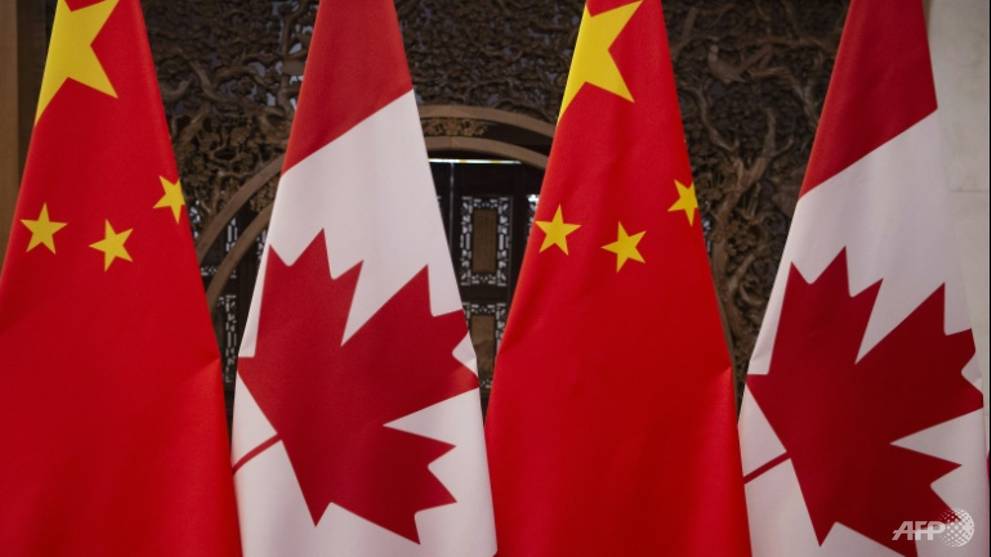
BEIJING: China warned Canada on Monday (Jul 6) that it would retaliate over Ottawa's response to a new national security law in Hong Kong, threatening to sink their troubled diplomatic relations to new lows.
Canada last week suspended its extradition treaty with Hong Kong and halted exports of sensitive military gear to the financial hub as Western nations voiced concern about the legislation's impact on the city's special rights.
"China strongly condemns this and reserves the right to make further response. All consequences arising therefrom will be borne by Canada," foreign ministry spokesman Zhao Lijian said at a regular briefing.
"Any attempt to put pressure on China will never succeed," Zhao said.
"China urges Canada to immediately correct its mistakes and stop interfering in Hong Kong affairs and China's internal affairs in any way, so as to avoid further damage to China-Canada relations."
Relations between Beijing and Ottawa have deteriorated since Canadian authorities arrested top Huawei executive Meng Wanzhou in December 2018, and China later detained two Canadians, including a former diplomat.
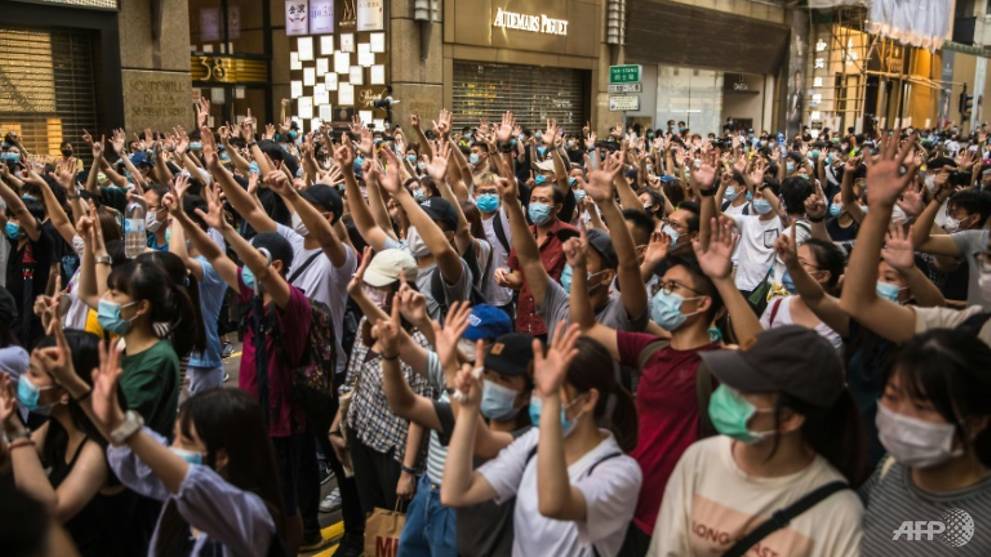
HONG KONG: A Hong Kong court denied bail on Monday (Jul 6) to the first person charged with inciting separatism and terrorism under the city's new national security law after he carried a sign saying "Liberate Hong Kong" and drove his motorbike into police.
Tong Ying-kit, 23, was arrested after a video posted online showed him knocking over several officers at a demonstration last Wednesday, less than 24 hours after Beijing imposed sweeping national security legislation on the city.
The city's government has said the protest slogan "Liberate Hong Kong, revolution of our times", connotes separatism or subversion under the new law, stoking concern over freedom of expression in the former British colony.
Tong, who was unable to appear in court on Friday as he was being treated in hospital for injuries sustained in the incident, appeared in court in a wheelchair.
In rejecting bail, Chief Magistrate So Wai-tak referred to Article 42 of the new law, which states that bail will not be granted if the judge has sufficient grounds to believe the defendant will continue to endanger national security.
The case was adjourned until Oct 6 and Tong was remanded in custody.
Critics say the law - which punishes crimes of secession, subversion, terrorism and collusion with foreign forces with up to life in prison - is aimed at crushing dissent and a long-running campaign for greater democracy.
Authorities in Beijing and Hong Kong have repeatedly said it is aimed at a few "troublemakers" and will not affect the rights and freedoms that underpin the city's role as a financial hub.
Also on Monday, prominent democracy activist Joshua Wong pleaded not guilty to inciting others to participate in an unlawful assembly during anti-government protests last year.
Fellow activist Agnes Chow pleaded guilty to a similar charge. Their case has been adjourned to Aug 5.
Wong and Chow, who were both granted bail last year, led a pro-democracy group called Demosisto that they dissolved hours after Beijing passed the national security law.
The United States, Britain and others have denounced the new legislation, which critics say is the biggest step China has taken to tighten its grip over the city, despite a "one country, two systems" formula meant to preserve its freedoms.
KUALA LUMPUR: Parti Keadilan Rakyat (PKR) president Anwar Ibrahim is back as Pakatan Harapan's (PH) choice of candidate for the prime minister post, as talk of a snap poll heats up in Malaysia.
In a joint statement on Monday (Jul 6), the opposition coalition said it is committed to its original stance that Mr Anwar should take over the top post if it recaptures Putrajaya.
"The presidential council is in the opinion that efforts needed to be made in order to restore the people's mandate, and this requires support from all parties.
"As such, the council gives full mandate to Anwar Ibrahim to continue discussions with all parties, including Shafie Apdal, towards that end," the statement read.
Mr Shafie is Sabah's chief minister and Parti Warisan Sabah's president. The statement is jointly issued by Mr Anwar, Parti Amanah Negara president Mohamad Sabu and Democratic Action Party secretary-general Lim Guan Eng.
Sabah Chief Minister Mohd Shafie Apdal. (Photo: Bernama)
Currently, PH is in opposition, having been replaced by the Perikatan Nasional (PN) in late February when Parti Pribumi Bersatu Malaysia (Bersatu) and several PKR Members of Parliament shifted their allegiance and joined forces with the formerly ousted Barisan Nasional.
Bersatu president Muhyiddin Yassin was sworn in as the country's eighth prime minister.
As PH prepared to reclaim federal power, it was plagued by disagreement over its choice of prime minister candidate among the top leadership, particularly between Mr Anwar and former prime minister Dr Mahathir Mohamad.
Dr Mahathir had offered to be prime minister again before handing over the position to Mr Anwar, but PKR was not in favour of the proposal.
Following that, Dr Mahathir had named Mr Shafie as PH's prime minister of choice. Under this proposal, Mr Anwar and Dr Mahathir's son Mr Mukhriz Mahathir would serve as deputy prime ministers.
PH's Monday statement has officially put this proposal to rest.
GROWING CALLS FOR SNAP POLL
In its statement, PH also called on both federal and state governments to focus on post-pandemic assistance for the citizens.
As such, it said the PH state governments - Penang and Selangor - would not be dissolved if a snap election were to be called. The next general election is due by 2023.
Last week, United Malays National Organisation and Parti Islam Se-Malaysia said they have agreed to continue supporting Mr Muhyiddin as prime minister in the next general election.
Malaysia's Minister of International Trade and Industry Azmin Ali reacts during a news conference in Putrajaya, Malaysia March 11, 2020. REUTERS/Lim Huey Teng
On Jul 5, Senior Minister Azmin Ali, who was formerly with PKR, was reported as saying that the Muhyiddin government might call for snap polls as early as this year or 2021.
The PN government led by Mr Muhyiddin had overcome political, economic and public health crises brought about by the COVID-19 pandemic, he added.
MELBOURNE: Australia will effectively seal off the state of Victoria from the rest of the country, authorities said Monday (Jul 6), announcing unprecedented measures to tackle a worrying surge in coronavirus cases.
For the first time since the pandemic began, the border between Australia's two most populous states - Victoria and New South Wales - will be closed from 11.59pm local time on Tuesday, officials from both states said.
Victoria - home to more than 6.6 million people - announced a record 127 new cases Monday, as the virus spread through Melbourne, including a cluster in several densely populated apartment blocks.
Victorian Premier Daniel Andrews described the decision to close off the state as "the smart call, the right call at this time, given the significant challenges we face in containing this virus".
Plans to reopen Victoria's border with South Australia have already been put on ice.
After weeks of easing virus restrictions, Melbourne has seen a huge spike in community transmission, leading health officials to effectively shut off some neighbourhoods to the rest of the city until the end of this month.
Sixteen of the new cases were detected in nine high-rise public housing towers, where 3,000 residents were locked in their homes on Saturday in Australia's strictest COVID-19 response to date.
So far, just 53 cases have been recorded in the buildings - which are home to a large number of vulnerable migrants - but there are concerns the virus could spread rapidly, with one health official likening the crowded conditions inside to "vertical cruise ships".
Cruise ships emerged as early coronavirus hotspots, with passengers and crew at high risk of infection - often packed in small cabins.
Community leaders have raised concerns about the targeted nature of the "hard lockdown", which saw hundreds of police officers deployed with almost no warning that reportedly left some residents unable to stock up on essentials.
Andrews said food and toys had been delivered to families while mental health and other medical support was being provided as officials sought to test every resident over the coming days.
"This is a massive task and the message to everybody in the towers... (is) those staff -- thousands of them -- are doing the very, very best they can and they will continue to do everything they can to support those who are impacted by this lockdown," he said.
Australia has recorded more than 8,500 cases of COVID-19 and 105 deaths from the virus.
The bulk of new daily cases are now being detected in Melbourne, while most other regions are enjoying relaxed restrictions after largely curbing the virus spread.
NEW DELHI: Indian soldiers who died in close combat with Chinese troops last month were unarmed and surrounded by a larger force on a steep ridge, Indian government sources, two soldiers deployed in the area and families of the fallen men said.
One of the Indian soldiers had his throat slit with metal nails in the darkness, his father told Reuters, saying he had been told by a fellow soldier who was there.
Others fell to their deaths in the freezing waters of the Galwan river in the western Himalayas, relatives have learned from witnesses.
Twenty Indian soldiers died in the Jun 15 clash on the de facto border separating the two armies. The soldiers all belonged to the 16th Bihar Regiment deployed in the Galwan region.
No shots were fired, but it was the biggest loss of life in combat between the nuclear-armed neighbours since 1967, when the simmering border dispute flared into deadly battles.
Reuters spoke to relatives of 13 of the men who were killed, and in five cases they produced death certificates listing horrific injuries suffered during the six-hour night-time clash at 4,267m amid remote, barren mountains.
Reuters contacted the military hospital in India's Ladakh region where the bodies were brought. The hospital declined to comment on the cause of death and said that the bodies were sent to the families along with the death certificates.
Reuters also spoke to two soldiers of the Bihar Regiment deployed in the area, who were among those who accompanied the bodies of fallen colleagues to their homes in the area. They were not directly involved in the melee.
Indian Army vehicles drive on a road near Chang La high mountain pass in northern India's Ladakh region of Jammu and Kashmir state near the border with China on Jun 17, 2020. (Photo: STR/AFP)
The soldiers cannot be named because of military rules and all the families asked for anonymity because they said they were not supposed to speak about military matters.
The Indian defence ministry did not respond to a request for comment on the fighting on Jun 15.
In response to a Reuters query, a China foreign ministry spokesperson repeated previous statements blaming the Indian side for crossing the de facto border and provoking the Chinese.
"When Chinese officers and soldiers went there to negotiate, they were suddenly and violently attacked by the Indian troops," the spokesperson said. "The rights and wrongs of the incident are very clear. The responsibility absolutely does not lie with the Chinese."
China has not provided evidence of Indian aggression. China's defence ministry did not respond to a request for comment.
"ARTERIES RUPTURED"
Three of the dead men had their "arteries ruptured in the neck" and two sustained head injuries caused by "sharp or pointed objects", the death certificates seen by Reuters said.
There were visible marks on the neck and forehead, all five documents said.
"It was a free-for-all, they fought with whatever they could lay their hands on – rods, sticks, and even with their bare hands," said a government official in Delhi briefed on the clash.
The Indian government has said that the People's Liberation Army (PLA) acted in a premeditated manner, but it has not provided a full account of the clash that stunned the country and stoked popular anger against China.
China has dismissed an Indian government minister's claim that China had lost 40 soldiers from the PLA's western theatre command deployed in Galwan.
Its envoy to Delhi suggested in remarks to local media and posted on the embassy website that there had been losses on both sides.
"The Indian army suddenly and violently attacked the Chinese officers and soldiers who went for negotiation, causing fierce physical conflicts and casualties between the two sides," Sun Weidong said.
Indian government officials have told Reuters that the conflict began when the commanding officer of the Bihar regiment led a small party to Patrol Point 14 to verify whether the Chinese had made good their promise to withdraw from the disputed site and dismantle structures they had built there.
But instead they came under attack by Chinese soldiers using iron rods and wooden clubs with nails studded in them on a narrow ledge barely 4m wide overlooking the Galwan river.
BODIES FOUND IN RIVER
In recent weeks the world's two most populous countries have mobilised more forces along the 3,488km Line of Actual Control, and the renewed hostilities have triggered a diplomatic and commercial spat that threatens to escalate, experts including former Indian military officers say.
FILE PHOTO: Demonstrators shout slogans as they burn an effigy depicting Chinese President Xi Jinping during a protest against China, in Kolkata, India. REUTERS/Rupak De Chowdhuri
The possibility that unarmed Indian soldiers were overrun by a larger force could further fuel resentment against China and raise questions about why Indian soldiers were sent to a tense frontline without being armed.
"How dare China kill our unarmed soldiers. Why were our soldiers sent unarmed to martyrdom?" Rahul Gandhi, leader of the main opposition Congress party wrote in a tweet, demanding the government provide a full account.
A relative of one of the soldiers who accompanied Colonel Santosh Babu, the commanding officer, to the site of two tents erected by the Chinese troops told Reuters that members of the Indian patrol were unarmed.
They were confronted by a small group of Chinese soldiers and an argument ensued over the tents and a small observation tower the relative said, on the basis of conversations with two other soldiers who were present.
Reuters was unable to establish all of the details of what happened, but government officials in New Delhi briefed on the incident said that at some point Indian troops took down the observation post and the tents because they were on India's side of the Line of Actual Control.
Soon after the Indian side came under attack from a large Chinese force that pelted them with stones and attacked them with sharp-edged weapons, according to the families of three dead Indian soldiers, based on conversations they had with survivors.
Some soldiers retreated to safety on the ridge line in the darkness, but when they could not find the commanding officer, they re-emerged and came under fresh attack, four family members said.
Babu was among those killed in the fighting, the Indian government said. One of the soldiers deployed in the area that Reuters spoke to said the Indian patrol was outnumbered by the PLA.
"The Chinese side overwhelmed our people by sheer numbers," said the soldier, who overheard radio messages seeking reinforcements being sent to regional headquarters in Ladakh.
Three of the Indian families said they had been told by soldiers who were commissioned to bring the bodies back to them that some combatants pushed each other into the fast-flowing Galwan river.
The government official in Delhi also said bodies of some soldiers were fished out of the river the next morning. Some had succumbed to hypothermia, the official added.