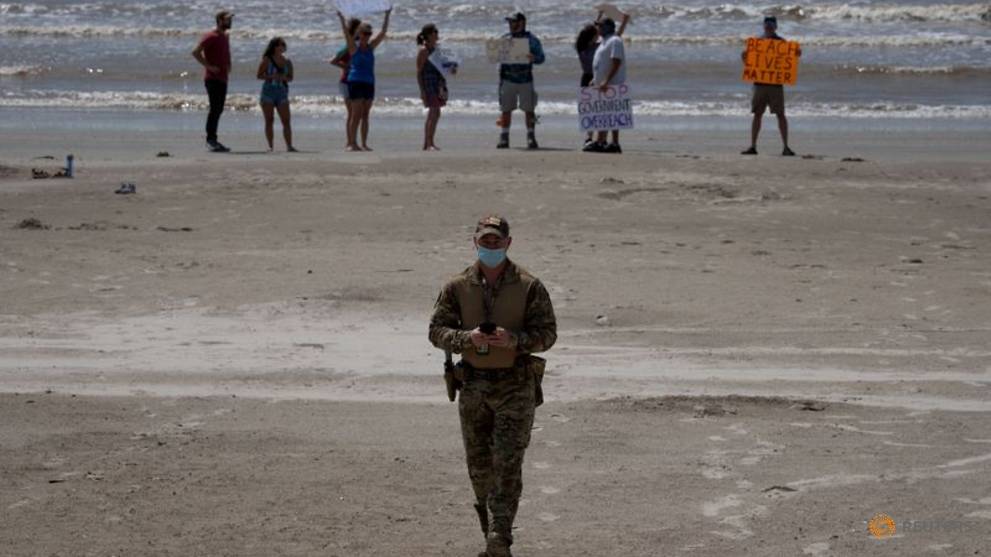
WASHINGTON: Rising coronavirus cases in 39 US states cast a shadow over the nation's Jul 4 celebrations as health experts worried that holiday parties will cause a further spike in infections that could overwhelm hospitals.
After towns and cities across the country cancelled annual fireworks displays to avoid large crowds gathering, many Americans launched bottle rockets and roman candles from streets and suburban backyards to commemorate Independence Day.
In the first four days of July alone, 15 states have reported record increases in new cases of COVID-19, which has infected nearly 3 million Americans and killed about 130,000, according to a Reuters tally.
Florida's cases have risen by over 10,000 for three out of the last four days, including climbing by 10,059 on Sunday (Jul 5), surpassing the highest daily tally reported by any European country during the height of the coronavirus outbreak there.
Cases are also soaring in Arizona, California and Texas and trending upwards in Midwest states that once had infections declining such as Iowa, Ohio and Michigan, according to a Reuters analysis of how much cases rose in the past two weeks compared with the prior two weeks.
In Phoenix, Arizona, people gathered on Saturday without masks or social distancing to listen to a speaker at a rally against restrictions to prevent the spread of the virus. Many in the crowd wore red, white and blue, and some held signs saying, "Capitalism makes sense. Socialism doesn't. Go Trump 2020."
"We opened way too early in Arizona," Phoenix Mayor Kate Gallego said on ABC. She said the city was in a "crisis related to testing," with people waiting in eight-hour lines in their cars to find out if they were infected.
During an Independence Day speech at the White House on Saturday, US President Donald Trump claimed without evidence that 99 per cent of coronavirus cases in the United States were "totally harmless."
In Texas alone, the number of COVID-19 patients currently hospitalised rose to a record 7,890 on Saturday compared with 3,247 just two weeks ago. The Democratic mayor of Austin, Texas, warned during an interview with CNN that his city's hospitals could reach capacity in two weeks and run out of intensive care unit (ICU) beds in 10 days. In Arizona, about 90 per cent of ICU beds are full.
"NO ROOM TO EXPERIMENT"
Trump, a Republican, has refused to wear a mask in public and has been reluctant to encourage Americans to do so, saying it was a personal choice. A Jul 4 celebration he attended at Mount Rushmore in South Dakota was "mask-optional" and had no social distancing.
Mixed messaging from governments has been a major factor in people not following coronavirus mitigation recommendations in Miami Beach, said its Democratic mayor, Dan Gelber.
Miami Beach's coronavirus hospitalisations have doubled in the last 14 days and hospitals now have 158 people on ventilators, up from 64 two weeks ago, he told CNN.
"We're spreading it because of this incredible activity, and too many people obviously are not taking seriously all of these admonishments to socially distance to wear masks," he said.
In addition to rising cases, an alarming percentage of tests are coming back positive. The World Health Organization considers a positivity rate above 5 per cent to be cause for concern because it suggests there are more cases in the community that have yet to be uncovered.
Ten states averaged double-digit positivity rates over the past week: Arizona (26 per cent), Florida (18 per cent), South Carolina (17 per cent), Nevada (14 per cent), Alabama (14 per cent), Texas (14 per cent), Mississippi (13 per cent), Georgia (13 per cent), Idaho (11 per cent) and Kansas (10 per cent), according to The COVID Tracking Project.
Judge Lina Hidalgo of Harris County, a hard-hit county in Texas that includes Houston, said officials must be proactive in getting ahead of the virus and advocated a stay-at-home order. "We don't have room to experiment. We don't have room for incrementalism when we're seeing these kinds of numbers," she told ABC.
Per capita, Japan has more elderly than any other country in the world
Why haven't more people in Japan died from Covid-19? It is a macabre question that has spawned dozens of theories, from Japanese manners to claims that the Japanese have superior immunity.
Japan does not have the lowest death rate for Covid-19 - in the region, South Korea, Taiwan, Hong Kong and Vietnam can all boast lower mortality.
But in the early part of 2020, Japan saw fewer deaths than average. This is despite the fact that in April, Tokyo saw about 1,000 "excess deaths' - perhaps due to Covid. Yet, for the year as a whole, it is possible that overall deaths will be down on 2019.
This is particularly striking because Japan has many of the conditions that make it vulnerable to Covid-19, but it never adopted the energetic approach to tackling the virus that some of its neighbours did.
Deaths
What happened in Japan?
At the height of the outbreak in Wuhan in February, when the city's hospitals were overwhelmed and the world put up walls to Chinese travellers, Japan kept borders open.
As the virus spread, it quickly became clear that Covid is a disease that primarily kills the elderly and is massively amplified by crowds or prolonged close contact. Per capita, Japan has more elderly than any other country. Japan's population is also densely packed into huge cities.
Greater Tokyo has a mind-boggling 37 million people and for most of them, the only way to get around is on the city's notoriously packed trains.
Then there is Japan's refusal to heed the advice of the World Health Organization (WHO) to "test, test, test". Even now, total PCR tests stand at just 348,000, or 0.27% of Japan's population.
Nor has Japan had a lockdown on the scale or severity of Europe. In early April, the government ordered a state of emergency. But the stay-at-home request was voluntary. Non-essential businesses were asked to close, but there was no legal penalty for refusing.
Many paragons of Covid strategy, such as New Zealand and Vietnam, used tough measures including closing borders, tight lockdowns, large-scale testing and strict quarantines - but Japan did none of that.
Yet, five months after the first Covid case was reported here, Japan has fewer than 20,000 confirmed cases and fewer than 1,000 deaths. The state of emergency has been lifted, and life is rapidly returning to normal.
Japan has had a relatively low testing rate compared to places like South Korea
There is also growing scientific evidence that Japan really has contained the spread of the disease - so far.
Telecom giant Softbank carried out antibody testing on 40,000 employees, which showed that just 0.24% had been exposed to the virus. Randomised testing of 8,000 people in Tokyo and two other prefectures has shown even lower levels of exposure. In Tokyo just 0.1% came back positive.
As he announced the lifting of the state of emergency late last month, Prime Minister Shinzo Abe spoke proudly of the "Japan Model", intimating that other countries should learn from Japan.
Is there something special about Japan?
If you were to listen to Deputy Prime Minister Taro Aso, it is down to the "superior quality" of Japanese people. In a now notorious comment, Mr Aso said he had been asked by leaders of other countries to explain Japan's success.
"I told these people: 'Between your country and our country, mindo (the level of people) is different.' And that made them speechless and quiet."
Excess deaths
Literally translated, mindo means "people's level", although some have translated it as meaning "cultural level".
It is a concept dating back to Japan's imperial era and denotes a sense of racial superiority and cultural chauvinism. Mr Aso has been roundly condemned for using it.
But there is no doubt that many Japanese, and some scientists, think there is something about Japan that is different - a so called "Factor X" that is protecting the population from Covid-19.
It is possibly relevant that some aspects of Japanese mores - few hugs and kisses on greeting - have in-built social distancing, but nobody thinks that is the answer.
Does Japan have special immunity?
Tokyo University professor Tatsuhiko Kodama - who studies how Japanese patients react to the virus - believes Japan may have had Covid before. Not Covid-19, but something similar that could have left behind "historical immunity".
This is how he explains it: When a virus enters the human body, the immune system produces antibodies that attack the invading pathogen.
There are two types of antibody - IGM and IGG. How they respond can show whether someone has been exposed to the virus before, or something similar.
"In a primary (novel) viral infection the IGM response usually comes first," he tells me. "Then the IGG response appears later. But in secondary cases (previous exposure) the lymphocyte already has memory, and so only the IGG response increases rapidly."
So, what happened with his patients?
"When we looked at the tests we were astonished... in all patients the IGG response came quickly, and the IGM response was later and weak. It looked like they had been previously exposed to a very similar virus."
He thinks it is possible a Sars-like virus has circulated in the region before, which may account for the low death rate, not just in Japan, but in much of China, South Korea, Taiwan, Hong Kong and South East Asia.
Activities like karaoke - which have been branded high-risk - were popular in Japan
This has been met with some scepticism.
"I am not sure how such a virus could be restricted to Asia," says Professor Kenji Shibuya, director of Public Health at Kings College, London and a former senior adviser to the government.
Professor Shibuya does not discount the possibility of regional differences in immunity or genetic susceptibility to Covid. But he is suspicious of the idea of a "Factor X" that explains the mortality differences.
He thinks countries that have done well in the fight against Covid, have done so for the same reason - they succeeded in dramatically reducing transmission.
Japanese people began wearing face masks more than 100 years ago during the 1919 flu pandemic and they've never really stopped. If you get a cough or a cold here it is expected that you will don a mask to protect those around you.
"I think it (a mask) acts as a physical barrier. But it also serves as a reminder to everybody to be mindful. That we still have to be careful around each other," says Keiji Fukuda, an influenza specialist and director of the School of Public Health at Hong Kong University.
Japan's track and trace system also goes back to the 1950s when it battled a wave of tuberculosis. The government set up a nationwide network of public health centres to identify new infections and report them to the health ministry.
If community transmission is suspected, a specialist team is dispatched to track the infections, relying on meticulous human contact tracing and isolation.
Japan discovered the Three Cs early
Japan also discovered two significant patterns early in the pandemic.
Dr Kazuaki Jindai, a medical researcher at Kyoto university and member of the cluster-suppression taskforce, said data showed over a third of infections originated in very similar places.
"Our figures... showed many infected people had visited music venues where there is screaming and singing... we knew that those were the places people needed to avoid."
The team identified "heavy breathing in close proximity" including "singing at karaoke parlours, parties, cheering at clubs, conversations in bars and exercising in gyms" as the highest-risk activities.
Second, the team found that the infection's spread was down to a small percentage of those carrying the virus.
An early study found around 80% of those with Sars-CoV-2 did not infect others - while 20% were highly infectious.
The state of emergency did not make staying home compulsory, but rather encouraged
These discoveries led to the government launching a nationwide campaign warning people to avoid the "Three Cs".
Enclosed spaces with poor ventilation
Crowded places with many people
Close contact settings such as face-to-face conversations.
"I think that probably worked better than just telling people to stay at home," Dr Jindai says.
Although workplaces were left off the list, it was hoped the "Three Cs" campaign would slow the spread enough to avoid lockdown - and fewer infections means fewer deaths.
For a while it did - but then in mid-March infections in Tokyo jumped and the city looked like it was on the path to exponential growth, like Milan, London and New York.
At this point Japan either got smart or got lucky. The jury is still out on which.
Timing, timing
Professor Kenji Shibuya thinks the lessons from Japan are not so different from elsewhere: "To me, it was a timing lesson."
Prime Minister Shinzo Abe ordered a - non-enforceable - state of emergency on 7 April, asking people to stay at home "if possible".
"If such measures were delayed, we might have experienced a similar situation like New York or London. The death rate (in Japan) is low.
"But a recent study by Columbia University suggests that if New York had implemented lockdown measure two weeks earlier, it would have prevented tens of thousands of deaths," Prof Shibuya notes.
A recent report by the United States Centers for Disease Control and Prevention found people with underlying medical conditions such as heart disease, obesity and diabetes are six times more likely to be hospitalised if they get Covid-19 and 12 times more likely to die.
Japan has the lowest rates of coronary heart disease and obesity in the developed world. Still, scientists insist such vital signs do not explain everything.
"Those kinds of physical differences may have some effect but I think the other areas are more important. We've learned from Covid that there is no simple explanation for any of the phenomena that we're seeing. It's a lot of factors contributing to the final outcome," says Prof Fukuda.
The government asked, people listened
To go back to Prime Minister Shinzo Abe's boast of the "Japan Model" - is there a lesson to be learned?
Does the fact that Japan has, so far, succeeded in keeping infections and deaths low, without shutting down or ordering people to stay at home, show a way forward? The answer is yes and no.
There is no "Factor X" - like everywhere else it has depended on the same thing - breaking the chain of transmission. In Japan, though, the government can count on the public to comply.
Despite not ordering people to stay at home, on the whole, they did.
"It was lucky but also surprising," Prof Shibuya says. "Japan's mild lockdowns seems to have had a real lockdown effect. Japanese people complied despite the lack of draconian measures."
Much of Japan has now re-opened
"How do you reduce contact between infected and uninfected people...? You need a certain kind of response from the public, which I don't think is going to be so easily replicated in other countries," adds Prof Fukuda.
Japan asked people to take care, stay away from crowded places, wear masks and wash their hands - and by and large, that is exactly what most people have done.
SINGAPORE: The National Solidarity Party's (NSP) secretary-general Spencer Ng has questioned how many of the 100,000 jobs the Government is creating as part of COVID-19 recovery measures are "quality" jobs.
Speaking to CNA after his party's walkabout in Sembawang GRC on Sunday morning (Jul 5), Mr Ng said that it is unclear if the 100,000 new jobs will result in a net gain or a net loss of positions in the job market.
"They did not specify what kind of jobs and how many jobs were lost when you compare with how many jobs have been created," he said.
Mr Ng leads the NSP's Sembawang team which comprises Mr Ivan Yeo Tiong Boon, Mr Sebastian Teo, Mr Yadzeth Hairis and Mr Sathin Ravindran.
The National Solidarity Party's (NSP) Sembawang GRC team at a walkabout at Sembawang Mart on Jul 5, 2020. (Photo: Try Sutrisno Foo)
Mr Ng noted that the ruling People's Action Party (PAP) is also facing pressure from the opposition.
"When quality opposition keeps coming up with proposals on these issues Singaporeans are very concerned with, they work harder and they get ideas from us - from the opposition parties," he said.
The NSP team is up against Education Minister Ong Ye Kung, Mr Lim Wee Kiak, Mr Vikram Nair, Ms Poh Li San and Ms Mariam Jaafar from the PAP.
On the topic of getting people in the workforce to acquire new skills, Mr Ng acknowledged that no system is perfect.
However, he voiced concern for middle-aged Singaporeans who are reskilling in order to move on to new jobs. "Is the next job going to let them earn enough to maintain their current lifestyle? That is very important," Mr Ng said.
This is especially when they have to contend with big-ticket financial items such as housing loans.
"By the time we are middle-aged, we have commitments like children and insurance. When we get our second job, will that be enough to maintain?
"Or we may have to downgrade to a small home, downgrade our quality of life," said Mr Ng.
Mr Ng also said the PAP promised over the past 30 years that "we are supposed to have a Swiss standard of living" yet the people "are paying a Swiss standard cost of living".
NSP, he added, is focused on giving Singaporeans a "quality life".
The National Solidarity Party's Sembawang GRC candidate Spencer Ng (left) and Ivan Yeo speaking to residents at Woodlands Mart on Jul 5, 2020. (Photo: Try Sutrisno Foo)
LACK OF INFRASTRUCTURE TO DIGITALISE EDUCATION
Moving on to the topic of education, Mr Ng said the COVID-19 pandemic has shown that Singapore does not have the infrastructure ready to accelerate the digitalisation of our education system.
Referring to the announcement made by Mr Ong to bring forward the plan for all secondary school students to have personal laptops or tablets for learning by 2021, Mr Ng asked: "Is the infrastructure ready? Are the teachers ready? Or are you forcing this down the throat of the teachers?"
The National Solidarity Party's Sembawang GRC candidate Spencer Ng giving out flyers and masks to residents at Sembawang Mart on Jul 5, 2020. (Photo: Try Sutrisno Foo)
Mr Ng said the system for home-based learning during the circuit breaker period was "not there, and (teachers) had to fine-tune here and there".
He added that credit has to be given to teachers "who have been left to their own devices to come up with creative methods to engage with students" during this period.
RECOGNISE SKILLS INSTEAD OF PAPER QUALIFICATIONS
Mr Ng also mentioned that "it is a pretty sad fact that Singaporeans choose to ignore, refuse to take action, or acknowledge that we are built on the backs of cheap labour".
"This is macroeconomics at play and this is something that the PAP has formulated," adding that the ruling party "got us addicted to cheap labour".
Mr Ng then compared the situation in Singapore to South Korea, Taiwan and Japan where skilled labour he said, are "done by skilled local workers".
He said there is a need to shift the focus away from cheap labour and recognise skills instead of just paper qualifications.
The National Solidarity Party's Sembawang GRC team at their walkabout at Woodlands Mart on Jul 5, 2020. (Photo: Try Sutrisno Foo)
Mr Ng added: "The PAP government had kicked the can down the road to this stage whereby they need to get cheap labour in to perform all these jobs.
"If we have been focusing on developing people with skills and couple it with technology, we can achieve higher productivity and at the same time give these jobs to locals with decent pay and a level of respect."
WASHINGTON (REUTERS, BLOOMBERG) - American rapper Kanye West, a vocal supporter of US President Donald Trump, announced on Saturday (July 4) that he would run for president in 2020 in an apparent challenge to Mr Trump and his presumptive Democratic rival, former vice-president Joe Biden.
"We must now realise the promise of America by trusting God, unifying our vision and building our future. I am running for president of the United States," West wrote in a Twitter post, adding an American flag emoji and the hashtag "#2020VISION".
West's Saturday night post instantly went viral, with more than 100,000 retweets within the first hour. West has 29.3 million followers on Twitter.
'Kanye' quickly became the number one trending term on Twitter in the US.
It was not immediately clear if West was serious about vying for the presidency four months before the Nov 3 election or if he had filed any official paperwork to appear on state election ballots.
The deadline to add independent candidates to the ballot has not yet passed in many states.
But if West is serious, there is a long list of hurdles towards running that would be nearly insurmountable for most candidates, including starting a campaign from scratch in July of an election year.
He would need to qualify for ballot access across 50 states and the District of Columbia, as well as build a presidential-grade political organisation from scratch without the support of a party infrastructure.
At the moment, West doesn't appear to have filed forms with the Federal Election Commission to run for office, according to a Bloomberg review of FEC data.
We must now realize the promise of America by trusting God, unifying our vision and building our future. I am running for president of the United States 🇺🇸! #2020VISION
West and his equally famous wife, Kim Kardashian West, have visited Mr Trump in the White House.
At one meeting in October 2018, West donned a red "Make America Great Again" hat. He also delivered a rambling, profanity-laden speech in which he discussed alternative universes and his diagnosis of bipolar disorder, which he said was actually sleep deprivation.
Mr Elon Musk, the chief executive of electric-car maker Tesla and another celebrity known for eccentric outbursts, endorsed West's Twitter post: "You have my full support!" he wrote.
US President Donald Trump and first lady Melania Trump host the 2020 "Salute to America" on the South Lawn of the White House on July 4, 2020
The United States marked an unusually somber Independence Day on Saturday, with President Donald Trump bashing domestic opponents and China -- but praising the country's coronavirus response, despite a record surge in cases.
Across the country, virus fears dampened or nixed Main Street parades, backyard barbecues and family reunions on a day when Americans typically celebrate their 1776 declaration of independence from Britain.
Instead of adopting a unifying tone, Trump -- facing a tough re-election and eager to mobilize his political base -- railed against protesters demanding racial justice after unarmed African American George Floyd was killed by a white police officer.
"We are now in the process of defeating the radical left, the Marxists, the anarchists, the agitators, the looters," Trump said.
Anti-racism protesters who have marched in cities across America are "not interested in justice or healing. Their goal is demolition," he said.
Speaking from the White House lawn, Trump addressed a crowd that included frontline health workers battling COVID-19, which has killed nearly 130,000 Americans.
He accused China -- where the outbreak originated -- of a cover-up that allowed the illness to race across the globe, but hailed American "scientific brilliance."
"We'll likely have a therapeutic and or vaccine solution long before the end of the year," he said.
Some of the US leader's sharpest words were for the media, which he accused of a campaign to smear opponents as racists.
"The more you lie, the more you slander, the more you try to demean and divide, the more we will work hard to tell the truth and we will win," Trump said, with four months to go until the election.
- Summer bubble -
Trump's divisive address came as popular beaches on both coasts -- normally packed on July 4th -- were closed as California and Florida suffer alarming surges in COVID-19 infections. Los Angeles Mayor Eric Garcetti warned citizens to "assume everyone around you is infectious."
Florida on Saturday marked a new daily high in confirmed virus cases at 11,458 -- far more than any other state. Miami Beach imposed a curfew and made mask-wearing mandatory in public, yet some Florida beaches remained open.
The beach at New York's Coney Island was also open and crowded, with few wearing masks.
Mark Ruiz came with his wife and two children, despite being "definitely worried" about the virus.
"I just can't stay home on the Fourth of July, I got to take my kids out," he told AFP. "We can't be in a bubble all summer."
Coney Island also hosted a special socially distanced version of the annual Nathan's Hot Dog Eating Contest -- won for the 13th year in a row by Joey Chestnut, who set a new world record downing 75 hot dogs in 10 minutes.
Health officials have been bracing for a new spike in virus cases after this weekend, which they see as a potential tipping point for more infections.
The US virus death toll is fast approaching 130,000, roughly one-quarter the world's total.
- Fireworks canceled -
Fireworks displays are typically a high point of the holiday, but an estimated 80 percent of the events have been canceled this year.
Washington was hosting a fireworks show on the National Mall, and some said they were compelled to come at a moment when the US is both grappling with the virus and undergoing a historic reckoning on racism.
"It's time for us to stop bragging that we are super special, that the world should follow, we need to look inside to see what's wrong with us. We never honestly asked ourselves about race in this country," 54-year-old Mary Byrne told AFP.
Trump's challenger in November, Democrat Joe Biden, struck a sharply different tone on Saturday, tweeting: "Our nation was founded on a simple idea: We're all created equal. We've never lived up to it -- but we've never stopped trying. This Independence Day, let's not just celebrate those words, let's commit to finally fulfill them."
Protests have continued in many US cities since Floyd's killing, and more than a score took place Saturday in Washington.
WINNIPEG, Canada: China fired back at Canada on Saturday (Jul 4) for criticising Beijing's national security law for Hong Kong, the second rebuke in a week that has added to strains on their bilateral ties.
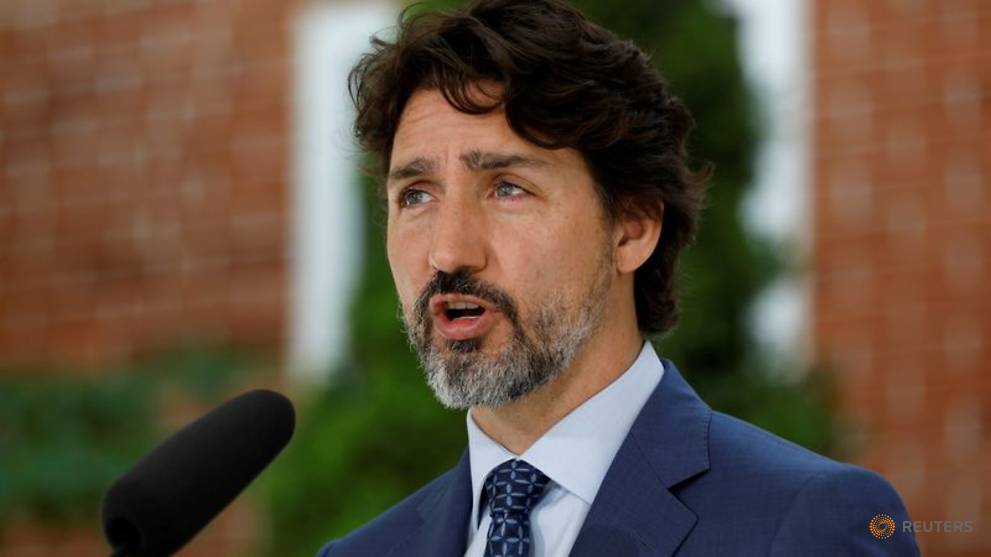
Prime Minister Justin Trudeau said on Friday that Canada was suspending its extradition treaty with Hong Kong due to the law and Canada's foreign minister called the legislation "a significant step back" for liberty.
China's embassy in Ottawa said in a statement on its website that Canada had "grossly interfered" in Chinese affairs, adding that the new legislation would safeguard security in Hong Kong.
"Some western countries including Canada have been meddling in Hong Kong affairs under the pretext of human rights, which seriously violates international law and basic norms of international relations," a spokesperson said in the statement.
China imposed the legislation this week despite protests by Hong Kongers and criticism from Western nations, which said the legislation was setting the financial hub on an authoritarian track.
Hong Kong officials said on Saturday they were "very disappointed" in Canada's suspension of the extradition treaty.
Officials in the offices of Canada's prime minister and deputy prime minister could not immediately be reached for comment.
Relations between Beijing and Ottawa have been tense since 2018 when Canada arrested Meng Wanzhou, the chief financial officer of Huawei Technologies, on a US warrant.
After Meng was detained, China arrested Canadian citizens Michael Kovrig, a former diplomat, and Michael Spavor, a businessman, on charges of espionage.
China also rebuked Canada a week ago over Ottawa's criticism about the prosecution of the Canadians.