Selasa, 30 Juni 2020

Hong Kong marks handover anniversary under shadow of new security law - CNA

HONG KONG: Hong Kong marks the 23rd anniversary of its handover to China on Wednesday (Jul 1) under the glare of a new national security law imposed by Beijing, with protests banned and the city's cherished freedoms looking increasingly fragile.

The anniversary comes a day after China passed a sweeping security law for the city, a historic move decried by many Western governments as an unprecedented assault on the finance hub's liberties and autonomy.

Activists have called on people to defy a ban on protests and march through the city's main island on Wednesday afternoon.

But it is unclear whether Hong Kongers will heed that call given the risks posed by the new security law – which came into effect overnight – and increasingly aggressive police tactics towards even peaceful gatherings in recent months.

READ: Hong Kong activist Joshua Wong quits democracy group Demosisto

The July 1 anniversary has long been a polarising day in the semi-autonomous city.

Beijing loyalists celebrate Hong Kong's return to the Chinese motherland after a century-and-a-half of what many considered humiliating colonial rule by Britain.

But democracy advocates have used the date to hold large protests as popular anger towards Beijing's rule swells.

During last year's huge demonstrations, the city's legislature was besieged and trashed by protesters.

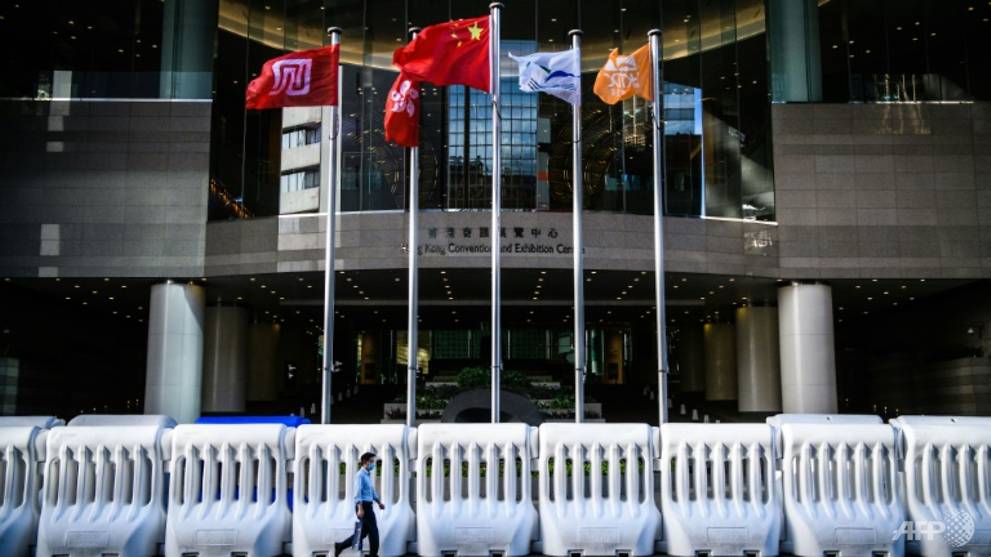
Hong Kong leader Carrie Lam is expected to attend a flag-raising with mainland Chinese officials on Wednesday morning with thousands of police on standby and security barriers around the venue.

For the first time since the ceremony began 17 years ago, authorities have banned the annual July 1 democracy march, citing fears of unrest and the coronavirus – although local transmissions have ceased.

CHINESE JURISDICTION AND LIFE SENTENCES

Ahead of the 1997 handover by Britain, China guaranteed Hong Kong civil liberties – as well as judicial and legislative autonomy – for 50 years in a deal known as "One Country, Two Systems".

The formula helped cement the city's status as a world-class business hub, bolstered by an independent judiciary and political freedoms unseen on the mainland.

Critics have long accused Beijing of chipping away at that status, but they describe the security law as the most brazen move yet.

Passage of the legislation was speedy and opaque even by Beijing's standards.

The law was passed in just six weeks, skipping Hong Kong's fractious legislature, and the precise wording was kept secret from the city's 7.5 million inhabitants even as it came into effect.

The law was finally published on Tuesday night. It outlaws subversion, secession, terrorism and colluding with foreign forces to undermine national security with sentences up to life in prison.

READ: Hong Kong national security law: 5 key facts you need to know

The new suite of powers radically restructures the relationship between Beijing and Hong Kong, toppling the legal firewall that has existed between the city's judiciary and the mainland's party-controlled courts.

China will have jurisdiction over "serious" cases and its security agencies will also be able to operate publicly in the city for the first time, unbound by local laws as they carry out their duties.

The United States, Britain, the European Union and the United Nations rights watchdog have all voiced fears the law will be used to stifle criticism of Beijing, which wields similar legislation to crush dissent on the mainland.

But Beijing says the law will restore stability after a year of protests and will not end Hong Kong's freedoms.

READ: Hong Kong leader Carrie Lam says national security law will not undermine HK autonomy

Popular anger towards Beijing exploded last year during seven consecutive months of huge and increasingly violent protests.

Millions took to the streets while a smaller hard core of protesters frequently battled police in vicious confrontations that saw more than 9,000 arrested.

The protests were initially sparked by an eventually scrapped law allowing extraditions to the mainland.

But they morphed into a popular revolt against Beijing's rule after years of concerns that Hong Kong's freedoms were being eroded.

Let's block ads! (Why?)


https://news.google.com/__i/rss/rd/articles/CBMibWh0dHBzOi8vd3d3LmNoYW5uZWxuZXdzYXNpYS5jb20vbmV3cy9hc2lhL2hvbmcta29uZy1jaGluYS1oYW5kb3Zlci1hbm5pdmVyc2FyeS1uYXRpb25hbC1zZWN1cml0eS1sYXctMTI4ODgyOTDSAQA?oc=5

2020-06-30 23:50:42Z
52780880940676

Hong Kong national security law: 5 key facts you need to know - CNA

BEIJING: China's controversial new law in Hong Kong is giving Beijing unprecedented judicial powers in the financial hub, with jurisdiction over cases, secret trials without jury and a national security agency.

The law was fast-tracked by Beijing after the semi-autonomous city was rocked by months of widespread protests last year.

READ: China passes national security law in turning point for Hong Kong

Communist Party officials in Beijing have condemned the protesters as violent, foreign-backed separatists.

The legislation will raise serious questions over the independence of Hong Kong's legal system guaranteed by its mini-constitution, and will have far-reaching consequences on life in the city of 7.5 million people.

Here are five key things you need to know about the controversial law:

MAXIMUM LIFE SENTENCE

The four categories of criminal offence outlined in the law are: Secession, subversion of state power, terrorist activities and collusion with foreign and external forces to endanger national security.

Lead perpetrators and serious offenders can receive a maximum life sentence, or long-term imprisonment of 10 years and above for offences in all categories.

Criminal acts under the category of foreign collusion include: Inciting Hong Kong residents' hatred of the Hong Kong or Chinese government, electoral manipulation or sabotage, and sanctions against Hong Kong or China.

Meanwhile, damaging public transport and certain public facilities would be classified as terrorism under the law.

READ: Commentary: Protests in Hong Kong may soon be a thing of the past

Anyone who organises or takes part in acts aimed at splitting the country, regardless of whether they use violence or not, would be committing an offence.

Those convicted would be barred from standing in any Hong Kong elections.

CHINESE JURISDICTION OVER "VERY SERIOUS" CRIMES

Prior to its passage, the law stoked widespread fears over the demise of Hong Kong's independent legal system.

According to the law, China may take over the entire prosecution from arrest to trial for: Complicated foreign interference cases, "very serious" cases and cases where national security faces "serious and realistic threats".

"Both the national security agency and Hong Kong can request to pass the case to mainland China," the law stated.

In China's opaque judicial system, criminal cases typically have a conviction rate of over 99 per cent.

Human rights advocates claim that some national security cases are highly likely to be politically motivated, with defendants denied the right to a fair and open trial.

Activists, dissidents, lawyers and other opponents of the government are routinely targeted by China's own national security laws, and often subjected to prolonged extralegal detention and even torture while awaiting trial.

SECRET TRIALS, NO JURY

The law states that certain national security cases could be held behind closed doors without juries in Hong Kong if they contained state secrets, although the verdict and eventual judgements would be made public.

City leader Carrie Lam will personally appoint judges for national security cases, but their terms are limited to one year.

Defendants will not be granted bail "unless the judge has sufficient reason to believe they will not continue to commit acts that endanger national security".

NEW NATIONAL SECURITY AGENCY

The controversial law empowers China to set up a national security agency in the city, staffed by officials who are not bound by local law when carrying out duties.

"The Hong Kong government has no jurisdiction over the national security agency in Hong Kong and its staff when they are discharging duties provided in this law," the text said.

Hong Kong's Justice Department is also required by the law to set up its own prosecution department for national security crimes, whose head will be appointed by Carrie Lam.

The law gives police far-reaching powers to collect evidence, including tapping communications and spying on suspects.

It can also request platforms and service providers to remove information and assist in investigations.

OVERSIGHT OF FOREIGN NGOs AND NEWS ORGANISATIONS

Government bodies will take "necessary measures to strengthen management ... of foreign and external NGOs and news organisations" in Hong Kong, according to the law.

Hong Kong's mini-constitution guarantees freedom of speech and freedom of the press, unlike in China, where the media and all forms of public commentary are heavily monitored by the government.

Foreign journalists in China say they have experienced frequent harassment and intimidation from authorities, while several US journalists have been expelled from the country in recent months.

The law also applies to non-permanent residents of Hong Kong that commit offences under the law, even if they are not on Hong Kong soil.

Companies that violate the national security laws will be fined and may have their operations suspended.

Let's block ads! (Why?)


https://news.google.com/__i/rss/rd/articles/CBMiXWh0dHBzOi8vd3d3LmNoYW5uZWxuZXdzYXNpYS5jb20vbmV3cy9hc2lhL2hvbmcta29uZy1jaGluYS1uYXRpb25hbC1zZWN1cml0eS1sYXctcGFzcy0xMjg4Nzg2ONIBAA?oc=5

2020-06-30 18:54:25Z
52780880940676

US tightens tech screw on China in move to strip Hong Kong special status - South China Morning Post

[unable to retrieve full-text content]

  1. US tightens tech screw on China in move to strip Hong Kong special status  South China Morning Post
  2. China passes national security law in turning point for Hong Kong  CNA
  3. Britain says it will not abandon Hong Kong after China unveils new security law  The Straits Times
  4. New law must allow Hong Kong to further flourish from its special status  South China Morning Post
  5. From London I watch the crisis engulfing my beloved Hong Kong, and I despair  The Guardian
  6. View Full coverage on Google News

https://news.google.com/__i/rss/rd/articles/CBMidGh0dHBzOi8vd3d3LnNjbXAuY29tL2Vjb25vbXkvY2hpbmEtZWNvbm9teS9hcnRpY2xlLzMwOTEyNTIvbmF0aW9uYWwtc2VjdXJpdHktbGF3LXVzLWV4cG9ydC1jb250cm9scy13aWxsLWhhbW1lci1ob25n0gF0aHR0cHM6Ly9hbXAuc2NtcC5jb20vZWNvbm9teS9jaGluYS1lY29ub215L2FydGljbGUvMzA5MTI1Mi9uYXRpb25hbC1zZWN1cml0eS1sYXctdXMtZXhwb3J0LWNvbnRyb2xzLXdpbGwtaGFtbWVyLWhvbmc?oc=5

2020-06-30 18:29:33Z
52780880940676

Beijing passes national security law for Hong Kong - South China Morning Post

[unable to retrieve full-text content]

  1. Beijing passes national security law for Hong Kong  South China Morning Post
  2. Hong Kong stocks, undeterred by new security law, rise with Asia  Aljazeera.com
  3. Hong Kong braces itself for unrest on July 1, the anniversary of its handover to China  The Straits Times
  4. New law must allow Hong Kong to further flourish from its special status  South China Morning Post
  5. China passes Hong Kong security law, deepening fears for future  Al Jazeera English
  6. View Full coverage on Google News

https://news.google.com/__i/rss/rd/articles/CBMiK2h0dHBzOi8vd3d3LnlvdXR1YmUuY29tL3dhdGNoP3Y9WkJMSE5ibTM1b3fSAQA?oc=5

2020-06-30 13:21:40Z
52780888828315

WHO to send second team into China to seek coronavirus source - South China Morning Post

[unable to retrieve full-text content]

  1. WHO to send second team into China to seek coronavirus source  South China Morning Post
  2. WHO sending team to China to investigate origins of coronavirus  CNA
  3. WHO: Countries complaining about contact tracing are 'lame'  Yahoo Singapore News
  4. WHO's Tedros - 'This is not even close to being over'  TODAYonline
  5. COVID-19 pandemic 'is not even close to being over': WHO chief  CNA
  6. View Full coverage on Google News

https://news.google.com/__i/rss/rd/articles/CBMiZmh0dHBzOi8vd3d3LnNjbXAuY29tL25ld3MvY2hpbmEvYXJ0aWNsZS8zMDkxMTk1L3doby1zZW5kLXNlY29uZC10ZWFtLWNoaW5hLXNlZWstc291cmNlLW5ldy1jb3JvbmF2aXJ1c9IBZmh0dHBzOi8vYW1wLnNjbXAuY29tL25ld3MvY2hpbmEvYXJ0aWNsZS8zMDkxMTk1L3doby1zZW5kLXNlY29uZC10ZWFtLWNoaW5hLXNlZWstc291cmNlLW5ldy1jb3JvbmF2aXJ1cw?oc=5

2020-06-30 12:31:32Z
52780885594808

WHO to send second team into China to seek coronavirus source - South China Morning Post

[unable to retrieve full-text content]

  1. WHO to send second team into China to seek coronavirus source  South China Morning Post
  2. WHO sending team to China to investigate origins of coronavirus  CNA
  3. WHO: Countries complaining about contact tracing are 'lame'  Yahoo Singapore News
  4. WHO's Tedros - 'This is not even close to being over'  TODAYonline
  5. COVID-19 pandemic 'is not even close to being over': WHO chief  CNA
  6. View Full coverage on Google News

https://news.google.com/__i/rss/rd/articles/CBMiZmh0dHBzOi8vd3d3LnNjbXAuY29tL25ld3MvY2hpbmEvYXJ0aWNsZS8zMDkxMTk1L3doby1zZW5kLXNlY29uZC10ZWFtLWNoaW5hLXNlZWstc291cmNlLW5ldy1jb3JvbmF2aXJ1c9IBZmh0dHBzOi8vYW1wLnNjbXAuY29tL25ld3MvY2hpbmEvYXJ0aWNsZS8zMDkxMTk1L3doby1zZW5kLXNlY29uZC10ZWFtLWNoaW5hLXNlZWstc291cmNlLW5ldy1jb3JvbmF2aXJ1cw?oc=5

2020-06-30 12:12:50Z
52780885594808

China passes national security law in turning point for Hong Kong - CNA

HONG KONG: China's parliament passed national security legislation for Hong Kong on Tuesday (Jun 30), setting the stage for the most radical changes to the former British colony's way of life since it returned to Chinese rule 23 years ago.

Details of the law - which comes in response to last year's often-violent pro-democracy protests in the city and aims to tackle subversion, terrorism, separatism and collusion with foreign forces - are due out later on Tuesday.

Amid fears the legislation will crush the global financial hub's freedoms, and reports that the heaviest penalty under it would be life imprisonment, pro-democracy activist Joshua Wong's Demosisto group said it would dissolve.

"It marks the end of Hong Kong that the world knew before," Wong said on Twitter.

The legislation pushes Beijing further along a collision course with the United States, Britain and other Western governments, which have said it erodes the high degree of autonomy the city was granted at its Jul 1, 1997, handover.

The United States, already in dispute with China over trade, the South China Sea and the novel coronavirus, began eliminating Hong Kong's special status under US law on Monday, halting defence exports and restricting technology access.

China said it would retaliate.

READ: Lam says national security law will not undermine HK autonomy

READ: EU 'deplores' Hong Kong law, discussing next steps

Hong Kong leader Carrie Lam, speaking via video link to the United Nations Human Rights Council in Geneva, urged the international community to "respect our country's right to safeguard national security".

She said the law, which is expected to come into force imminently, would not undermine the city's autonomy or its independent judiciary.

Authorities in Beijing and Hong Kong have repeatedly said the legislation is aimed at a few "troublemakers" and will not affect rights and freedoms, nor investor interests.

The editor-in-chief of the Global Times, a tabloid published by the People's Daily, the official newspaper of China's ruling Communist Party, said on Twitter the heaviest penalty under the law was life imprisonment, without providing details.

Details of the law would be published later on Tuesday, said Henry Tang, a Hong Kong delegate to China's top advisory body, after a meeting at Beijing's main representative office.

READ: China unveils details of national security law for Hong Kong amid backlash

READ: Hong Kong pro-democracy shops fear China's new security law

'OVERPOWERING'

The legislation may get an early test with activists and pro-democracy politicians saying they would defy a police ban, amid coronavirus restrictions, on a rally on the anniversary of the Jul 1 handover.

At last year's demonstration, which came amid a series of pro-democracy protests, a crowd stormed and vandalised the city's legislature.

"We will never accept the passing of the law, even though it is so overpowering," said Democratic Party chairman Wu Chi-wai.

It is unclear if attending the unauthorised rally would constitute a national security crime if the law came into force by then.

A majority in Hong Kong opposes the legislation, a poll conducted for Reuters this month showed, but support for the protests has fallen to only a slim majority.

Police dispersed a handful of activists protesting against the law at a shopping mall.

Dozens of supporters of Beijing popped champagne corks and waved Chinese flags in celebration in front of government headquarters.

"I'm very happy," said one elderly man, surnamed Lee.

"This will leave anti-China spies and people who brought chaos to Hong Kong with nowhere to go."

Pro-China supporters celebrate with Hong Kong and Chinese flags after China's parliament passe
Pro-China supporters celebrate with Hong Kong and Chinese flags after China's parliament passes the national security law for Hong Kong, in Hong Kong, China June 30, 2020. REUTERS/Tyrone Siu

This month, China's official Xinhua news agency unveiled some of the law's provisions, including that it would supersede existing Hong Kong legislation and that interpretation powers belong to China's parliament top committee.

Beijing is expected to set up a national security office in Hong Kong for the first time and could also exercise jurisdiction on certain cases.

Judges for security cases are expected to be appointed by the city's chief executive. Senior judges now allocate rosters up through Hong Kong's independent judicial system.

It is not known which specific activities are to be made illegal, how precisely they are defined or what punishment they carry.

Britain, the European Union, Japan, Taiwan and others have also criticised the legislation.

China has hit back at the outcry, denouncing "interference" in its internal affairs.

Let's block ads! (Why?)


https://news.google.com/__i/rss/rd/articles/CBMib2h0dHBzOi8vd3d3LmNoYW5uZWxuZXdzYXNpYS5jb20vbmV3cy9hc2lhL2NoaW5hLXBhc3Nlcy1uYXRpb25hbC1zZWN1cml0eS1sYXctaW4tdHVybmluZy1wb2ludC1mb3ItaG9uZy0xMjg4NDMwNtIBAA?oc=5

2020-06-30 09:11:15Z
52780880940676