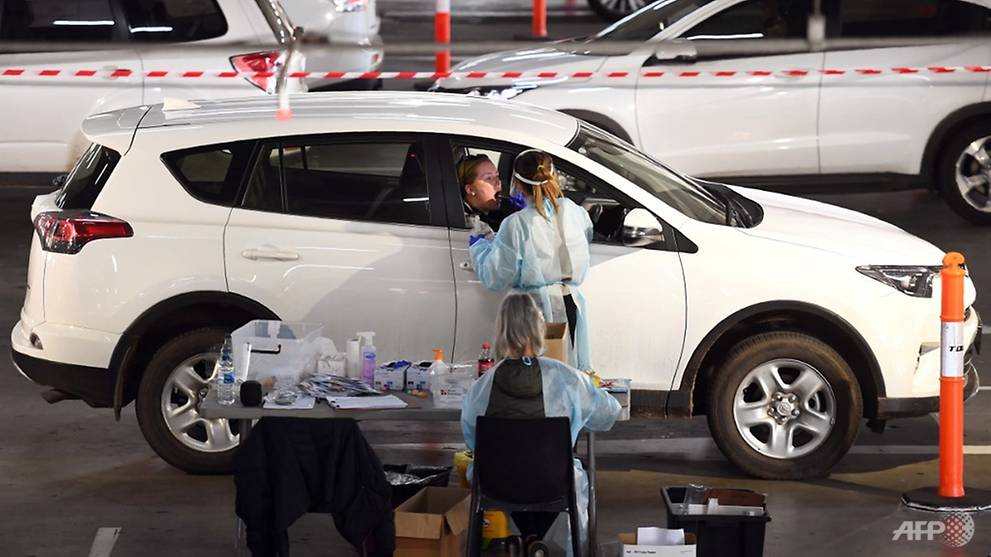
SYDNEY (REUTERS) - Australia’s second most populous state deployed ambulances and mobile test centres in a coronavirus testing blitz as the country recorded the biggest daily rise in cases in two months.
Victoria state said on Thursday (June 25) that 33 people tested positive for coronavirus in the past 24 hours, marking nine days of double digit new cases in the state.
It has around 200 current cases out of a country total of 270.
Desperate to contain the outbreak, Victoria state Premier Daniel Andrews said authorities are beginning a testing blitz across the 10 most effected suburbs.
“We have ambulances and other vans that will literally be at the end of people’s streets,” Andrews told reporters in Melbourne. “We will see these (case) numbers go up in coming days.”
Andrews said about 100,000 tests will be conducted over the next 10 days.
Victoria’s efforts to contain the virus will be supplemented by about 1,000 Australian military personnel who are expected to arrive on Friday (June 26), Minister for Defence Linda Reynolds said.
The bulk of the troops will assist with the mandatory 14-day quarantine of anyone who arrives in Australia, though Reynolds said about 150 personnel will also help the state’s testing programme.
The surge in new cases comes just weeks after Australia began easing social distancing restrictions, and authorities believe the increase in new cases stemmed from family get-togethers attended by people with mild symptoms.
Alarmed by the rise in new infections, thousands of people have flocked to testing centres, while Australia’s two biggest retail chains, Woolworths Group and Coles, have imposed fresh limits on how much customers can buy for specific goods amid a spate of panic buying.
Australia’s death toll from Covid-19 was on Thursday revised up after tests showed an 85-year-old man who died in April had contracted the virus.
Australia now has recorded 104 deaths from just over 7,500 infections.
Prime Minister Scott Morrison said Australia has safeguards in place to prevent the virus growing beyond the control of authorities, as he insisted states and territories must continue to reopen large swathes of the economy.
“We’ve gotta live alongside Covid. It’s not going anywhere,” Morrison told reporters in Sydney. “We’ve gotta keep forging ahead.”
Australia has committed to removing the bulk of social distancing restrictions by the end of July, but each state will determine when and how easing takes place.
Regular domestic travel is expected to begin within weeks, while sporting stadiums will from July 1 allow up to 10,000 fans to attend.
Australia’s international borders remain closed.
The reopening of Australia’s states and territories has stirred hopes its economy can avoid a prolonged trough, though it is on course for its first recession in nearly 30 years.
The International Monetary Fund on Thursday revised its estimate for Australia’s economic contraction to down 4.5 per cent. It previously saw Australia’s economy shrinking 6.7 per cent.
The IMF, however, cautioned that Australia’s A$250 billion (S$241 billion) stimulus package, including subsidising the wages of 3.5 million people, will need to be carefully withdrawn.
Morrison has said the wage subsidy scheme will end in September, though other targeted stimulus packages could be added, such as a A$250 million package for Australia’s arts sector announced on Thursday.
MELBOURNE (AFP) - Australia's military announced on Thursday (June 25) it would send 1,000 troops to Melbourne in an effort to help contain the country's only significant coronavirus outbreak over fears of a second wave.
While the numbers remain small compared to global tallies, the outbreak has rattled Australia, which has been rolling back restrictions after successfully curbing the virus spread.
Defence Minister Linda Reynolds said on Thursday that 1,000 troops would be deployed to Victoria "in the coming days".
Up to 850 Australian Defence Force personnel will help monitor returned international travellers being held in hotel quarantine while about 200 others will provide logistical and medical support to Covid-19 testing facilities, she added.
Military personnel are already manning the borders of states that are closed to outside visitors as well as providing planning support to health and emergency management services, including in Victoria.
However, the deployment of such a large military contingent to a major Australian city is unprecedented in the coronavirus crisis.
It comes as community concern about the virus spread ramps up in Melbourne, with pop-up testing centres set up in virus "hot spots" in response to long queues and supermarkets reimposing buying limits amid fears of a return of panic-buying.
Virus clusters have emerged in large family groups spread across the country's second city, at a hotel used for quarantining returned travellers and at a clothing store.
Australia has recorded roughly 7,500 cases of coronavirus and 103 deaths in a population of 25 million, with several regions believed to be effectively virus free.
MELBOURNE: Australia's military announced on Thursday (Jun 25) that it would send 1,000 troops to Melbourne in an effort to help contain the country's only significant coronavirus outbreak over fears of a second wave.
Victoria state has seen a spike in COVID-19 cases, recording almost 150 new infections over the past week as new clusters have emerged in Melbourne.
While the numbers remain small compared to global tallies, the outbreak has rattled Australia, which has been rolling back restrictions after successfully curbing the virus spread.
Defence Minister Linda Reynolds said Thursday that 1,000 troops would be rapidly deployed to Victoria "in the coming days".
Up to 850 Australian Defence Force personnel will help monitor returned international travellers being held in hotel quarantine while about 200 others will provide logistical and medical support to COVID-19 testing facilities, she added.
Military personnel are already manning the borders of states that are closed to outside visitors as well as providing planning support to health and emergency management services, including in Victoria.
However, the deployment of such a large military contingent to a major Australian city is unprecedented in the coronavirus crisis.
It comes as community concern about the virus spread ramps up in Melbourne, with pop-up testing centres set up in virus "hot spots" in response to long queues and supermarkets reimposing buying limits amid fears of a return of panic-buying.
Virus clusters have emerged in large family groups spread across the country's second city, at a hotel used for quarantining returned travellers and at a clothing store.
Desperate to contain the outbreak, Victoria state Premier Daniel Andrews said authorities are beginning a testing blitz across the worst effected suburbs.
"We have ambulances and other vans that will literally be at the end of people's streets," Andrews told reporters in Melbourne.
"We will see these (case) numbers go up in coming days."
Australia's death toll from COVID-19 was on Thursday revised up after tests showed an 85-year-old man who died in April had contracted the virus.
Australia now has recorded 104 deaths from just over 7,500 infections in a population of 25 million, with several regions believed to be effectively virus free.
Prime Minister Scott Morrison said Australia has safeguards in place to prevent the virus growing beyond the control of authorities, as he insisted states and territories must continue to reopen large swathes of the economy.
"We've gotta live alongside COVID. It's not going anywhere," Morrison told reporters in Sydney. "We've gotta keep forging ahead."
Australia has committed to removing the bulk of social distancing restrictions by the end of July, but each state will determine when and how easing takes place.
BANGKOK: A new breakthrough study powered by satellite technology has enabled researchers to measure the widespread damage to Southeast Asia’s peatlands, which are vitally important in capturing and reducing carbon emissions.
For the first time, inSAR satellites have been used to remotely scan vast vegetated areas - 2.7 million hectares of peatland, mostly in Indonesia and Malaysia. Typically, researchers would have to physically traverse difficult terrain to make these measurements.
Peat is the accumulation of generations of organic matter in naturally occurring wetland areas. They store huge amounts of carbon, which is released into the atmosphere once the land becomes degraded. In fact, about 6 per cent of annual global CO2 emissions is the result of damaged peatlands.
The mapping by a research team at the Singapore-MIT Alliance for Research and Technology shows this happening at an alarming rate.
Ninety per cent of the peatlands examined are sinking - on average by 2.24cm a year and up to 5cm in some areas. It means these carbon-rich areas are drying fast, increasing the risk of dangerous fires sweeping through them.
Satellite data helps show damage caused to peatlands across Southeast Asia. (Image: Alison Hoyt)
The outcomes are worrying, particularly for Indonesia, home to about 70 per cent of the region’s peatlands. Dangerous fires plague the country on an annual basis, bringing severe health risks to the population and the destruction of protected wilderness, especially in Sumatra and Kalimantan.
The country, as a result of the carbon being released from damaged peat, as well as expansive fires in those areas, was the fourth biggest CO2 emitter in the world in 2015.
“Regional carbon dioxide emissions from peat loss during a typical year are much greater than total fossil fuel emission from Singapore, and an important component of emissions from Indonesia and Malaysia,” said Charles Harvey, the principal investigator at SMART, and a professor at MIT’s Department of Civil and Environmental Engineering.
“Emissions from peatlands can surpass regional fossil fuel emissions during particularly dry years when there are widespread peat fires,” he told CNA.
Peatland is highly prone to fires, which typically over a large scale in Indonesia every year. (Photo: Jack Board)
This was land that just a few decades ago was covered in pristine forest. Since then, the conversion of forest and peatland to oil palm plantations has been rapid.
The SMART study found, however, that it was not only large concessions causing subsidence, but also other small-scale agriculture, the construction of canals and the preparation of land for “failed large scale rice-farming experiments”.
The latter is significant at this juncture. Negotiations are underway to create a vast new rice bowl to help feed Indonesians during the COVID-19 pandemic and address national food security issues.
DIFFICULTIES IN CLEARING LAND FOR RICE FARMING
The Joko Widodo administration has proposed opening up a 164,000ha area - potentially peatland - in Central Kalimantan, to be converted into agriculture. It follows a similar scheme in the mid 1990s, which resulted in the mass clearing of land for rice farming and huge internal worker migration, but little food.
Rice is not a native species in peatlands, and can only grow once the land is drained of its water and cleared. Even then, there are considerable complications and expenses.
Massive amounts of carbon are released into the atmosphere when peatlands are burnt. (Photo: Jack Board)
A “living document” to that failed experiment, Nyoman Suryadiputra, now the head of non-governmental organisation Wetlands International, experienced firsthand the difficulties of attempting to convert wet peatlands during extensive field work at the time.
He saw forests being destroyed and farmers turn to illegal logging, as they went hungry in the wetlands of Borneo.
He does not want history to be repeated but doubts the Indonesian government will make the same mistake.
“Even though I heard the area will be opened up, I don’t think it will be in the peat area. It will be a swamp area. But I also have to be very critical of it,” he said.
“We have to look at this type of ecosystem and see comprehensively if this area is connected to the peat area. They (the government) are aware how complicated it is and they already failed in 1995."
Canals for agriculture built through peatlands contribute to land subsidence. (Photo: Jack Board)
The attempted conversion of peat-rich land in Papua into the “future breadbasket of Indonesia” in a project launched in 2011 is also testament to the troubles associated with such schemes.
“It’s not only economic loss from making the same mistake but it’s to do with the ecosystems. The condition now is already bad. So if we open up again, it will get worse. The implication will be a long period of disasters," Suryadiputra told CNA.
ARE PEATLAND RESTORATION EFFORTS EFFECTIVE?
In 2016, President Jokowi announced the establishment of the Peatland Restoration Agency (BRG) to try and bring the about 2.5 million hectares of the country’s peatlands back to health within five years, a majority of it located in economic concession areas.
“I have tasked this agency with creating and implementing an action plan so that we can convince the world that we are very serious about overcoming the damage caused to forests and peatlands,” he said to reporters at the time.
By the end of 2018, the BRG said it has restored just less than 700,000 hectares.
“The restoration and recovery of peatlands can be a long process. While we have not yet seen evidence that subsidence is slowing in the region, efforts of the BRG ... are all steps in the right direction,” said Harvey, the principal investigator.
Earlier this week, President Jokowi reminded the agencies to maintain groundwater levels, so as to keep the peatlands wet.
Indonesia suffered vast fires and air pollution during fires in 2016. (Photo: Jack Board)
Deforestation rates have also reduced significantly in Indonesia, dropping to their lowest rates last year since 2003.
Despite that, 324,000 hectares of primary forest were still lost, making the country the third biggest forest clearer in the world in 2019, according to data from the World Resources Institute.
In addition, the new satellite data shows that overall, peat resources continue to be degraded at worrying levels. Meantime, the instigators or fires that have continued to burn over the past five years have not been punished.
A 2019 investigation by Greenpeace found that no serious civil or administrative sanctions had been given to the ten palm oil companies responsible for large areas of burned land from fires in 2015 to 2018. Mega blazes over that period burnt some 3.4 million hectares, resulting in huge emissions and irreversible changes to carbon capture.
“Fires on peatland happening every year are a testament to the government’s continued failure to fulfil its commitment to end forest and peatland destruction,” said Rusmadya Maharuddin, a forest campaigner for Greenpeace Indonesia.
“Two decades of forest and peatland destruction by the plantation sector have made parts of Indonesia a giant carbon bomb,” he added.
“Keeping Indonesia’s remaining peatland areas intact is a priority, which together with the restoration of degraded peatland by rewetting, revegetation and revitalisation should significantly reduce the chance of fires.”
NEW DELHI: India reported 16,000 new coronavirus cases on Wednesday (Jun 24), its highest daily increase since the outbreak began, and the government called in the army to manage new treatment centres with thousands of additional hospital beds in New Delhi.
At more than 456,000 confirmed coronavirus cases so far, India is the fourth worst hit country in the world, behind the United States, Brazil and Russia, according to a Reuters tally.
Cases are expected to keep rising as state governments ease restrictions in place since lockdown was first imposed in late March.
New Delhi, the sprawling capital of more than 20 million people, also recorded its highest single-day increase on Wednesday, with more than 3,900 cases. Local government data showed that of the roughly 13,400 beds allocated to COVID-19 patients in the city, around 6,200 were occupied.
The federal home ministry said the city would have around 20,000 additional beds available by next week at temporary facilities run by army doctors and nurses.
These include a 10,000 bed facility hosted at a religious centre and railway coaches turned into wards.
"Armed Forces personnel have been detailed for providing medical care and attention to COVID-19 patients housed in the Railway coaches in Delhi," Home Minister Amit Shah said.
The city government estimates it will have 550,000 COVID-19 cases by the end of July, and will require 150,000 beds by then.
Delhi's Deputy Chief Minister Manish Sisodia said that a new federal government order to take every positive patient to an assessment centre as opposed to evaluating them at home was stretching already limited resources.
"Our ambulance system, our medical system is under pressure now. Today, we are having to take patients in buses," Sisodia said, adding that he had written to the federal home ministry. "This (rule) is creating chaos in New Delhi."