The Republic is building up its vaccine-manufacturing capacity even as researchers around the world race to develop one for Covid-19.
Prime Minister Lee Hsien Loong said on Friday (June 5) that Singapore intends to offer fill-and-finish contract manufacturing services to vaccine developers.
In the pharmaceutical industry, contract development and manufacturing organisations work on a contractual basis to fulfil services such as the manufacture of drugs or vaccines.
"This should help them ramp up production faster, and assure them high standards of safety and quality in the manufacturing process," PM Lee told the Global Vaccine Summit, co-hosted by the British government and Gavi, the vaccine alliance, over a video call.
The discovery, production and distribution of a safe and effective vaccine is vital to getting life back to normal despite Covid-19, he said.
He added: "I hope that this summit will help focus our minds and resources, and forge partnerships to promote 'vaccine multilateralism'."
Singapore is also pulling its weight in the global fight against Covid-19 on other fronts, including investing in international efforts to combat the virus and leveraging its research expertise to develop new cures.
"The Covid-19 pandemic demands a unified and concerted response by all nations," he said, adding that Singapore welcomes this global call for action and is doing its part.
The Republic has contributed about US$13 million (S$18 million) towards international Covid-19 efforts through the World Health Organisation and the Coalition for Epidemic Preparedness Innovations, and in donations of essential medical equipment and supplies, said PM Lee.
The nation is also investing heavily in research and development on diagnostics, vaccines and therapeutics.
On the diagnostics front, for example, Singapore researchers have developed a range of serological and nucleic acid-based diagnostic tests, said PM Lee.
The Fortitude diagnostic kit, for example, was developed and rolled out by the Agency for Science, Technology and Research (A*Star) and Tan Tock Seng Hospital during the early stages of the outbreak in February.
Today, it has been deployed in 13 public and private hospitals and laboratories in Singapore, as well as in more than 20 other places, including New Zealand and the United States.
PM Lee said Singapore researchers have also been developing therapeutic monoclonal antibodies, as well as a vaccine, and have started clinical trials of various therapeutics.
Duke-NUS Medical School, for instance, is working with American medicine company Arcturus Therapeutics on a Covid-19 vaccine, which involves getting the human body to produce part of Sars-CoV-2, the virus that causes Covid-19.
For the latest updates on the coronavirus, visit here.
This article was first published in The Straits Times. Permission required for reproduction.
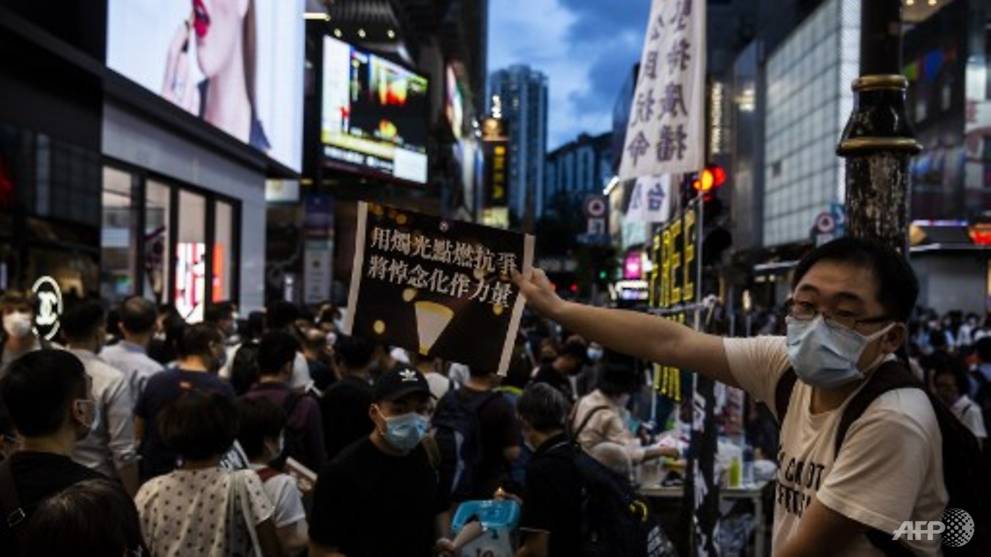
HONG KONG: Dozens of protesters marched through the IFC mall in Hong Kong's Central district on Friday afternoon (Jun 5), a day after thousands defied a police ban to hold a vigil for the anniversary of China's Tiananmen incident in 1989.
Protesters of all ages joined the march in the heart of the city's financial district, which ended peacefully after an hour.
Chanting slogans, some held banners that read "Hong Kong independence" and "Liberate Hong Kong, revolution of our times", as well as the former British colonial flag. Others chanted "Glory to Hong Kong", the unofficial anthem of the protests.
According to Apple Daily, about 50 people joined the protest. Police kept watch outside the mall but did not enter the building.
Thursday's anniversary of Chinese troops opening fire on student-led protests in and around Beijing's Tiananmen Square was particularly sensitive this year, as the central government drafts national security laws for the Asian financial hub.
It was the first time in 31 years that scuffles briefly disrupted what is usually a solemn day in Hong Kong, which traditionally organises the world's biggest memorial for the incident.
Officers would not have intervened if protesters had not blocked roads in the working class district of Mong Kok, police said on Twitter on Thursday. They had rejected the application for the vigil over concerns about COVID-19.
HONG KONG: Hong Kong protester Crystal has yet to tell her parents she has fled overseas to seek asylum in Canada, one of a growing number of residents choosing self-exile as Beijing tightens control.
The 21-year-old student spent months on the front lines of the protests in Hong Kong, which first exploded with huge marches last June and descended into increasingly violent battles with riot police as each month went by.
A year on, she is waiting to hear if she will be granted refugee status on the other side of the world.
"My friends and family don't know about my situation," she told AFP, asking for her full name and location to be withheld - like all applicants interviewed for this piece.
The Hong Kong protests have angered Beijing, which has announced plans for a national security law for the city. (Photo: AFP/Isaac Lawrence)
Activists in Canada say at least 50 former Hong Kong protesters lodged asylum applications before the COVID-19 pandemic ended most international travel.
Hundreds more have relocated to Taiwan, which under President Tsai Ing-wen has said it will try to accommodate Hong Kongers seeking to escape with freedoms sliding at home.
The current trickle could become an exodus after Beijing announced plans to impose a sweeping national security law on Hong Kong in response to the protests.
China says an anti-subversion law is needed to tackle "terrorism" and "separatism".
Opponents fear it might lead to political oppression to a business hub supposedly guaranteed freedoms and autonomy for 50 years after its 1997 handover to China by Britain.
TEST CASES
In response, Britain has said it will extend residency rights for 2.9 million Hong Kongers eligible for British National (Overseas) passports, including a possible pathway to citizenship.
The documents are only available to those born before the former colony's 1997 handover. Which means younger residents - the vanguard of last year's protests - must risk asylum instead.
The concept of a Hong Kong asylum seeker is somewhat untested - for decades the city was a place people fled to rather than from.
Campaigners fear that planned new laws in Hong Kong will bring political oppression. (Photo: AFP/Dale de la Rey)
Last year, Germany granted sanctuary to two independence activists wanted for their involvement in a violent protest in 2016.
It was the first time a western government decided Hong Kong dissidents were fleeing persecution and the move infuriated Beijing.
Canada has emerged as a favourite destination, aided by a network of activists who have helped people escape Beijing ever since the 1989 Tiananmen crackdown.
"Canada is always a country that welcomes refugees," said Martin, a member of the New Hong Kong Cultural Club which is currently helping 29 applicants.
"We believe there will be more Hong Kongers seeking asylum in Canada because the Hong Kong situation is falling into chaos."
Taiwan President Tsai Ing-wen has created a task force to look into how the island can assist Hong Kongers wanting to flee. (Photo: AFP/Sam Yeh)
Richard Kurland, a veteran Canadian immigration lawyer, said asylum claims would be decided on a case by case basis.
"An 'over the top' reaction by either Beijing or the local Hong Kong proxies would strengthen the case for bona fide refugee claims in Canada," he told AFP.
Asked whether plans for the new security law might constitute such a reaction, he replied: "It will all turn on the details of the new law, and how it is implemented."
LONELY WINTERS
Canada's asylum cases are decided by an independent tribunal, not the government.
But refugee claims could further strain already frosty ties with Beijing after Canada acted on a US arrest warrant for Meng Wanzhou, a top executive at Chinese tech giant Huawei.
Bonnie Glaser, an expert on China with the Centre for Strategic and International Studies, said cooperation between western nations would make it harder for Beijing to respond.
"If one country acts by itself, it is possible that Beijing will try to impose punishment to deter other countries from doing the same: Killing the chicken to scare the monkey," she said, using a popular Chinese idiom.
Those fleeing abroad face an uncertain future in an unfamiliar land.
There are widespread fears that Hong Kong's treasured freedoms are under threat. (Photo: AFP/Richard A Brooks)
Ah Gor, a graphic designer in his early thirties, arrived in Canada after he was charged with rioting, an offence that carries up to 10 years jail.
"Hong Kongers are unable to fully exploit their potential because we are forcibly fused together with the totalitarian Chinese state," he told AFP, saying he now supports independence, a red line for Beijing.
As someone who studied overseas, language has not been an issue.
But he has struggled with the Canadian winter: "Never in Hong Kong had I experienced temperatures that left my skin in pain."
"FREEDOM IS IMPORTANT TO ME"
Taiwan offers potential sanctuary closer to home, although it comes with caveats.
The island has no refugee law so most Hong Kongers must seek business and student visas.
Beijing also views the self-ruled island as its own territory, vowing to one day seize it, by force if necessary.
Last week, President Tsai created a task force to look into how it can better assist Hong Kongers wanting to flee, a move that angered Beijing.
Xiao Hua of Hong Kong, a 35-year-old nurse, is considering a permanent move to Taiwan. (Photo: AFP/Sam Yeh)
Xiao Hua, a 35-year-old registered nurse, worked as a medic during the early stage of the 2019 protests, has spent the last few months in Taiwan and is considering a full-time move.
"I feel Taiwan is a place where we can still voice our opinions freely," she told AFP inside a restaurant in Taipei that finds employment for Hong Kongers.
"It will be unbearable, to leave my family, my friends in Hong Kong. But freedom is a very important thing to me."
Prime Minister Lee Hsien Loong said on Friday (June 5) that Singapore intends to offer fill-and-finish contract manufacturing services to vaccine developers.
In the pharmaceutical industry, contract development and manufacturing organisations work on a contractual basis to fulfil services such as the manufacture of drugs or vaccines.
"This should help them ramp up production faster, and assure them high standards of safety and quality in the manufacturing process," PM Lee told the Global Vaccine Summit, co-hosted by the British government and Gavi, the vaccine alliance, over a video call.
The discovery, production and distribution of a safe and effective vaccine is vital to getting life back to normal despite Covid-19, he said.
He added: "I hope that this summit will help focus our minds and resources, and forge partnerships to promote 'vaccine multilateralism'."
Singapore is also pulling its weight in the global fight against Covid-19 on other fronts, including investing in international efforts to combat the virus and leveraging its research expertise to develop new cures.
"The Covid-19 pandemic demands a unified and concerted response by all nations," he said, adding that Singapore welcomes this global call for action and is doing its part.
The Republic has contributed about US$13 million (S$18 million) towards international Covid-19 efforts through the World Health Organisation and the Coalition for Epidemic Preparedness Innovations, and in donations of essential medical equipment and supplies, said PM Lee.
The nation is also investing heavily in research and development on diagnostics, vaccines and therapeutics.
On the diagnostics front, for example, Singapore researchers have developed a range of serological and nucleic acid-based diagnostic tests, said PM Lee.
The Fortitude diagnostic kit, for example, was developed and rolled out by the Agency for Science, Technology and Research (A*Star) and Tan Tock Seng Hospital during the early stages of the outbreak in February.
Today, it has been deployed in 13 public and private hospitals and laboratories in Singapore, as well as in more than 20 other places, including New Zealand and the United States.
PM Lee said Singapore researchers have also been developing therapeutic monoclonal antibodies, as well as a vaccine, and have started clinical trials of various therapeutics.
Duke-NUS Medical School, for instance, is working with American medicine company Arcturus Therapeutics on a Covid-19 vaccine, which involves getting the human body to produce part of Sars-CoV-2, the virus that causes Covid-19.
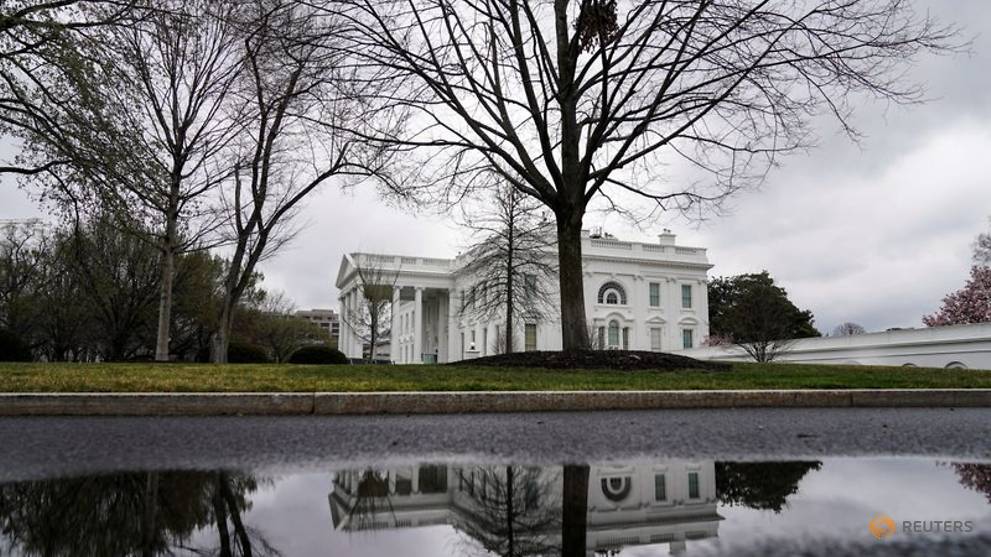
WASHINGTON: The White House said on Thursday (Jun 4) that China's "slaughter" of protesters in Tiananmen Square in 1989 has not been forgotten, urging Beijing to give its first accurate accounting of the bloodshed.
"The Chinese Communist Party's slaughter of unarmed Chinese civilians was a tragedy that will not be forgotten," President Donald Trump's press secretary Kayleigh McEnany said in a statement.
"The United States calls on China to honour the memory of those who lost their lives and to provide a full accounting of those who were killed, detained, or remain missing in connection with the events surrounding the Tiananmen Square massacre on Jun 4, 1989."
China's leadership has never provided a death toll from the crackdown, in which hundreds if not thousands are believed to have been killed, and has sought to suppress all public mention of the episode.
Open discussion of the brutal suppression is forbidden in mainland China.
In Hong Kong, where Beijing is tightening its central rule, a mass vigil meant to mark the anniversary was banned.
Every year, the United States issues a similar statement demanding China be held accountable. On Wednesday, Secretary of State Mike Pompeo met with survivors, including Wang Dan, perhaps the most prominent of the student leaders from the doomed pro-democracy protest.
Pompeo, who had earlier denounced China for preventing Hong Kong's annual commemoration on the grounds that mass gatherings went against guidelines in fighting the coronavirus, tweeted a photo of the meeting.
However, this year, Washington's message has been overshadowed by what critics describe as Trump's heavy-handed response to nationwide protests - some marred by rioting and arson - against police brutality.
Hong Kong's pro-Beijing leader has also accused the United States of double standards in criticising the city's own clampdown on protesters.
Relations between China and the United States are already at a low ebb in the wake of the COVID-19 outbreak that began in Wuhan.
Trump blames Beijing for allowing the virus to spread rapidly across the world and has broken off relations with the World Health Organization, accusing it of bias toward the Chinese government.
SINGAPORE: While most people stayed at home during the “circuit breaker”, Mr Lim Han Eng was living at his factory with about 180 foreign workers.
As construction work ground to a halt, the 59-year-old owner of Aik San Construction took up the role of manager at his factory-converted dormitory.
“This is my rice bowl, I have to get through this with my workers. This is the dormitory for my own company,” he told CNA in an interview conducted in Mandarin.
“Honestly speaking, no one is willing to do this job, as the virus is spreading mainly in the dormitories … so the only way was for me to do it myself.”
Mr Lim Han Eng, founder of Aik San Group, is living at his factory-converted dormitory with his workers while they are in quarantine. (Photo courtesy of Lim Han Eng)
There are more than 1,200 factory-converted dormitories housing nearly 100,000 workers in Singapore. They complement 43 purpose-built dormitories with 3,000 to 25,000 workers each, housing about 200,000 migrant workers altogether. Another 20,000 workers live in temporary quarters within construction sites.
The vast majority of COVID-19 cases in Singapore have been in foreign worker dormitories, and hundreds of new cases are being found daily even as infections in the general community have declined.
Two dormitories were first declared isolation areas on Apr 5, with dozens more gazetted since then. Seventy-seven dormitories are COVID-19 clusters as of Wednesday, including nearly all of the 43 purpose-built dorms.
Dedicated teams have been sent to help manage larger dormitories, with another 127 mobile Forward Assurance and Support Teams providing support to factory-converted dormitories, construction temporary quarters and workers in private residences.
Authorities have stipulated that employers need to provide food and daily necessities to their workers, and have to continue paying their salaries. There are also stepped up hygiene and safety guidelines that the dormitories have to follow.
On Apr 21, Manpower Minister Josephine Teo said that all migrant workers living at dormitories would have to stop moving in and out of the dormitories. Even as the situation at the larger dormitories stabilised, the conditions at smaller dorms were still “mixed”, Mrs Teo had said in Parliament on May 4.
While Singapore exited its circuit breaker period on Jun 2, most workers have to continue staying in, as only those who are cleared of COVID-19 infection can resume work. In Phase 1 of re-opening, which the country is currently in, the cleared workers can only leave their dormitories for work.
“DIFFERENT RULES EVERY DAY”
Mr Lim said that besides the daily maintenance of the dormitory, he has had to communicate quarantine rules to the workers.
He’s organised a team of about 10 workers to help him, and sweetened the deal by giving them more pay. The daily tasks include cleaning the toilets and clearing the rubbish regularly, as well as arranging for meals and snacks for the workers.
“The Government is issuing different rules and regulations almost every day, which the workers don’t really understand … they don’t know what they can do and what they should not do. Someone here needs to understand and let them know all this,” said Mr Lim.
Workers of Aik San Group at a factory-converted dormitory. (Photo courtesy of Lim Han Eng)
A positive side effect is that he and his workers have become closer, he said.
“Normally we are working and everyone is very busy … under quarantine, we all have time. We tell each other stories, they talk about their hometowns and families. We also tell jokes so everyone can relax,” he said. He also tells them how he started his company and tries to share life lessons with them.
So far, there has been one worker infected with COVID-19 at his dormitory who was sent for treatment, while those who had been in close contact with him were taken to a hotel to be isolated. He also sends additional food and other essentials to his workers living at the hotel.
“I hope that they will be touched and work harder after this outbreak,” he said.
“NO BREAK FOR ME”: DORM OPERATOR
Some factory-converted dormitory operators and managers CNA spoke to said it’s been a challenging time for them.
“Every day, I’m in Tuas – all the 60 days, no break for me,” said Ms Sowmia Latha who runs a few dormitories housing more than 600 workers mainly in construction companies and shipyards.
Some of them are employed by her engineering firm, while she also provides accommodation for other firms. Most of her staff who are not in dormitories are on stay-home notices, she said.
Mr Chelladurai Dhanasekaran, who is helping Ms Latha manage the dorms after serving his notice, said that his workload has increased a great deal.
Their next challenge is to figure out how to put recovered workers back to work, and housing the workers under new regulations issued by the Manpower Ministry on Monday, which requires all dormitories to give each worker more space, she said.
At one dormitory, there were about 100 cases of COVID-19 over the last month and the workers have mostly recovered, said Mr Dhanasekaran. The dormitory has to prepare to receive the workers who are returning from community care facilities such as Changi Exhibition Centre.
“There’s a lot of work for me … we need to take care of the workers day and night,” he said.
Dorm operators say that the majority of the workers are from Bangladesh and India, with a small number from other countries, like China, Thailand and Myanmar.
“SPREADS LIKE WILDFIRE”
Mr Eugene Aw, dormitory business director for RT Group, said it was a mad scramble at first to “ramp up” the management of five dormitories with about 300 to 500 workers each.
“Suddenly you had up to 500 workers cooped inside the dormitories and no one is supposed to come out,” he said. “You had to do a lot of distribution of food, of materials, increase the trash disposal and cleaning of common areas … One of the biggest challenges was to find more manpower.”
They hired two more supervisors, while setting up communication channels with the workers by starting WhatsApp groups and appointing representatives among them to help with co-ordination.
“The planning of it on paper is very easy to say but the execution is not so easy … some employers they were caught off-guard, they didn’t prepare, and suddenly the Government said: No more cooking. Some couldn’t react fast enough,” he said.
When the situation stabilised, the mass swabbing began, and they had to monitor the health of the workers. He saw first-hand how infectious the coronavirus could be: “It really spreads like wildfire. If one person reports positive symptoms, it can then suddenly mushroom to 100 people.”
They too, have to prepare for the re-entry of the “cleared” workers into the workforce, as well as adapt to changes to dormitory regulations.
“I really salute my guys … they could very easily have given up,” he said of his dormitory supervisors, maintenance workers and cleaners. “Not every Singaporean or every worker is willing to put themselves into such a situation, and we are right at the front lines.
“We are thankful that a lot of charity organisations stepped in and on our own end we supplemented when employers couldn’t supply (food).”
SOME WORKERS LEFT IN THE LURCH
At one point, the Alliance of Guest Worker Outreach (AGWO) was providing about 20,000 meals a day to the workers who were mostly confined to factory-converted dormitories, said chairman Sam Gift Stephen.
As employers rushed to meet the needs of the workers, this number has fallen and is hovering around 15,000 meals a day. They are looking out for 267 dormitories, and providing meals to more than 110 as of Tuesday, he said.
Alliance of Guest Workers Outreach chairman Sam Gift Stephen delivers food to migrant workers. (Photo: Hope Initiative Alliance)
“Some of the employers pick up the tab and pay for the food, but there’s a big majority who say they can’t. They don’t have the financial muscle to do it, they don’t have the bandwidth to take care of the worker,” he said.
For some employers, they gradually take over the food catering one meal at a time, so it is more manageable, he said.
AGWO has also started an “adopt-a-dorm” programme which has seen about 60 dormitories taken under the wing of volunteers or organisations.
“We also do counselling and befriending, one of the problems we found was many of them are depressed, many of them have become very frustrated. Somehow there is a lack of information being fed to the factory-converted dorms.”
For example, early on, some workers did not know that employers were required to provide catered meals to them, and on Jun 2, many did not know they still could go out after circuit breaker ended, he said.
Many fear that they may not have a job after the pandemic, while some are worried about their family back home but are unable to return because most flights have been cancelled.
Migrant workers living in factory-converted dormitories in particular face tough conditions of limited space and the lack of a proper logistical set-up, unlike residents in purpose-built dorms. Volunteer groups step in, to arrange meal deliveries and check on their needs.
To keep their spirits up, the non-government organisation ran fitness competitions, giving a mobile phone to a worker who did the most push-ups, and is conducting English classes via Zoom.
“THE WHOLE SPECTRUM EXISTS”
In some extreme cases, the workers were unable to reach their bosses, he said. Ms Ruchi Trivedi who is a lead volunteer at ItsRainingRainCoats (IRR), another NGO helping migrant workers, has also come across such cases.
IRR has distributed tens of thousands of meals, fruit, essentials, SIM cards and other items to migrant workers through this crisis. The NGO has expanded its network of volunteers from about 200 to almost 500 during this period.
There have also been employers who approached them to sign their workers up for virtual English lessons conducted by their volunteers, a programme called MadWish, which IRR had launched before the circuit breaker.
“To be fair, the whole spectrum of employers exists. If there are FCDs that are doing okay, they won't call us. And we've actually reached out to few who told us they're doing okay - especially if the employer of the workers is responsible - but those that lack support do reach out to us for help, and we do our best to help them” she said.
Mr Rubel, a worker who lives at a dormitory at Tuas View Square, told CNA that he has been getting meals, fruit and other essentials, although he cannot go out.
“Now (the) situation is good, still our dormitory (is) safe,” he said in a WhatsApp message. “Thanks for Singapore and Singaporean all people for helping.”