CHICAGO, Illinois: A conversation during which President Donald Trump urged US state governors to crack down on nationwide protests became testy on Monday when Illinois governor J B Pritzker accused Trump of making the situation worse.
Trump, who last week tweeted “when the looting starts, the shooting starts,” urged governors to get tough on disturbances following the death of George Floyd, an unarmed black man, in police custody in Minneapolis. A white officer has been charged.
In a recording of the conference call heard by Reuters, Trump said: "You have to dominate, if you don’t dominate you’re wasting your time. They’re going to run over you, you’re going to look like a bunch of jerks. You have to dominate."
Near the end of the nearly hour-long call, Pritzker, a Democrat, challenged the Republican president.
He called some of Trump's public statements inflammatory and unhelpful to governors and mayors trying, not always with success, to keep peaceful protests from boiling over into violence and looting.
"The rhetoric that’s been coming out of the White House has been making it worse," Pritzker said on the call. "We’ve got to have national leadership in calling for calm."
"I don’t like your rhetoric much either," Trump replied, adding that Floyd's death was "horrible" and that he had spoken of it "with great compassion."
White House representatives did not immediately respond to a request for comment on the call.
Asked about it later, Pritzker said he decided to take Trump to task after other governors failed to "call it out."
"And so I spoke out and felt that was my obligation," he said. "I don't want to dominate peaceful protesters who have legitimate grievances. I do want us to put down the situations of people destroying property or violent behavior."
Having sent 375 National Guard troops to help restore order in Chicago, Pritzker said he was activating another 250 to help local officials in other parts of the state.
WASHINGTON: US President Donald Trump on Monday (Jun 1) said he was deploying thousands of "heavily armed" soldiers and police to prevent further protests in Washington, where buildings and monuments have been vandalised near the White House.
"What happened in the city last night was a total disgrace," he said during a nationwide address as tear gas went off and crowds protested in the streets nearby.
"I am dispatching thousands and thousands of heavily armed soldiers, military personnel and law enforcement officers to stop the rioting, looting, vandalism, assaults and the wanton destruction of property."
He denounced "acts of domestic terror" after nationwide protests against the death of an unarmed African American George Floyd in police custody devolved into days of violent race riots across the country.
"I want the organisers of this terror to be on notice that you will face severe criminal penalties and a lengthy sentence in jail," Trump said as police could be heard using tear gas and stun grenades to clear protestors just outside the White House.
He also called on state governors to "deploy the National Guard in sufficient numbers that we dominate the streets" before heading on foot for a photo op at the riot-damaged St John's, the two-century-old "church of the presidents" across from the White House.
He stopped in front of boarded-up windows at the yellow church, where many presidents have attended services, along with several members of his administration, including Attorney General William Barr, national security Adviser Robert O'Brien and other top aides.
As an acrid smell still hung in the air, Trump held up a Bible for cameras before walking back to the White House, but took no questions from reporters.
The president said in his White House remarks that he was mobilising all civilian and military resources "to stop the rioting and looting, to end the destruction and arson and to protect the rights of law-abiding Americans, including your Second Amendment rights" - a reference to the US constitutional protections for gun ownership.
"We cannot allow the righteous cries of peaceful protesters to be drowned out by an angry mob," Trump said, adding that the nation was gripped by "professional anarchists."
Police officers clash with protestors near the White House on Jun 1, 2020 as demonstrations against George Floyd's death continue. (Photo: AFP / Jose Luis Magana)
The backlash was swift.
"What the president did today was he called out the American military against American citizens," New York governor Andrew Cuomo said on Twitter.
"He used the military to push out a peaceful protest so he could have a photo op at a church. It's all just a reality TV show for this president."
The demonstrations, largely peaceful during the day but turning violent after dark, have erupted over the death of George Floyd, a 46-year-old African American who died in Minneapolis police custody after being pinned beneath a white officer's knee for nearly nine minutes.
A second autopsy ordered by Floyd's family and released on Monday found that his death was a homicide by "mechanical asphyxiation," meaning some physical force interfered with his oxygen supply. The report says three officers contributed to Floyd's death.
"The evidence is consistent with mechanical asphyxia as the cause of death, and homicide as the manner of death," Aleccia Wilson, a University of Michigan expert who examined his body at the family's request, told a news conference.
The Hennepin County Medical Examiner on Monday released details of its autopsy findings that also said Floyd's death was a homicide caused by asphyxiation.
The county report added that Floyd suffered cardiopulmonary arrest while being restrained by police and that he had arteriosclerotic and hypertensive heart disease, fentanyl intoxication and recent methamphetamine use.
The unrest has been the most widespread in the United States since 1968, when cities went up in flames over the slaying of civil rights icon Martin Luther King Jr, and rekindled memories of 1992 riots in Los Angeles after police were acquitted in the brutal beating of black motorist Rodney King.
WASHINGTON - The United States teetered on the brink of its most serious internal conflict in decades on Monday (June 1) evening as President Donald Trump said he was “dispatching thousands and thousands of heavily armed soldiers, military personnel and law enforcement officers to stop the rioting, looting, vandalism, assaults and wanton destruction of property” in Washington DC.
He vowed to do the same in other cities if mayors and governors fail to regain control of the streets as nationwide protests entered their sixth day.
As he spoke in the Rose Garden minutes before a 7pm curfew was to come into effect, military and mounted police used tear gas and rubber bullets to push back protesters who ran helter skelter through the capital’s shuttered downtown. Explosions could be heard in the Rose Garden.
The protests were mostly peaceful - a characteristic of the demonstrations across dozens of cities in recent days since the death of George Floyd, a 56-year-old black man, while restrained in police custody in Minneapolis a week ago. A police officer had placed a knee on Floyd’s neck for several minutes.
An independent autopsy ordered by Floyd’s family and released on Monday, concluded that he died from “mechanical asphyxiation”, meaning his oxygen supply was cut off.
Derek Chauvin, the police officer who knelt on Floyd’s neck, and three others who stood by, were swiftly fired, but it took four days to charge Chauvin with third degree murder. He was arrested and on Monday transferred to a maximum security prison.
The other three officers have not been charged – a continuing source of outrage for the protesters.
The protesters have comprised not just African Americans but also to a large extent white people and also by and large young people.
They have been largely peaceful during the day, but have turned violent mostly after dark when stores and buildings have been looted and torched.
The administration blames radical left wing and anarchist groups for the destruction, which has hit several cities. State authorities have also said the violence is perpetrated by elements other than the protesters.
“In recent days the nation has been gripped by violent anarchists,” Mr Trump said. “What happened in the city (Washington) last night was a total disgrace.”
“Mayors and governors must establish an overwhelming law enforcement presence until the violence has been quelled,” Mr Trump said. “If a city or state refuses to take the actions that are necessary to defend the life and property of their residents, then I will deploy the United States military and quickly solve the problem for them.”
On Sunday night in Washington protesters set fires outside the White House and clashed with police.
There were clashes and looting overnight in a slew of other cities as well, from New York to Philadelphia to Atlanta – all of which again saw protesters gathering on Monday in defiance of curfews.
Earlier on Monday, Mr Trump told state governors in a conference call that they were weak to have lost control of the streets.
“If you don’t dominate, you’re wasting your time,” he told them. “They’re going to run over you, you’re going to look like a bunch of jerks.”
During the day Floyd’s brother, speaking in Minneapolis, called for a stop to violence.
Former President Barack Obama in a statement said: “The waves of protests… represent a genuine and legitimate frustration over a decades-long failure to reform police practices and the broader criminal justice system in the United States.
The overwhelming majority of participants have been peaceful, courageous, responsible, and inspiring.”
But he added: “The small minority of folks who’ve resorted to violence in various forms, whether out of genuine anger or mere opportunism, are putting innocent people at risk, compounding the destruction of neighbourhoods that are often already short on services and investment and detracting from the larger cause.”
Analysts see this as a pivotal moment in a country already under severe stress from the Covid-19 pandemic that has killed well over 100,000 people and crashed the economy leaving some 40 million unemployed.
That has come on top of a severely polarised, toxic political environment heading into a presidential election on Nov 3 which is seen as one of the most critical in the nation’s modern history.
“How do you tell other countries that America is a democracy to be emulated when this is what is happening on the ground in the United States?” tweeted Dr Ian Bremmer, CEO of The Eurasia Group.
“From the global perspective… the biggest problem is America’s… ability to lead by example which has been eroding for certainly a decade plus but much more quickly now. You can say it’s all about President Trump but in my view it’s a lot deeper and more structural.”
MINNEAPOLIS, Minnesota: Two doctors who carried out an independent autopsy of George Floyd, the black man whose death in Minneapolis police custody last week triggered nationwide protests, said on Monday (Jun 1) that he died from asphyxiation and that his death was a homicide.
The doctors also said Floyd had no underlying medical conditions that contributed to his death - and that he was likely dead before he was placed into an ambulance.
That contradicts the initial findings of the official autopsy by the Hennepin County Medical Examiner, which was cited in the court charging document against the police officer who drove his knee into Floyd's neck for several minutes.
Those initial findings said there was no evidence of traumatic strangulation. It also said coronary artery disease and hypertension also likely contributed to Floyd's death. The county's full autopsy report has not yet been released. Later on Monday, the medical examiner declared Floyd's death was a homicide.
"The evidence is consistent with mechanical asphyxia as cause of death and homicide as manner of death," said Dr Allecia Wilson of the University of Michigan, one of the two forensic doctors who performed an independent autopsy.
DEAD WITHIN MINUTES
Bystander video showed Floyd pleading to be let up and saying repeatedly that he couldn't breathe as a police officer Derek Chauvin kept his knee firmly pinned into Floyd's neck for nearly nine minutes. Two other officers applied pressure with their knees to Floyd's back.
Chauvin, who is white and has been fired from the Minneapolis police department, was hit with third-degree murder and manslaughter charges last week.
But Dr Michael Baden, who also took part in the independent autopsy at the behest of Floyd's family, said that the two other officers' actions also caused Floyd to stop breathing.
"We can see after a little bit less than four minutes that Mr Floyd is motionless, lifeless," Baden said, adding he found no underlying health conditions in Floyd that caused his death.
Baden has worked on several high-profile cases, including the 2014 death of Eric Garner, a black man who died after being choked by police in New York City.
Baden shot down the argument that if Floyd could speak then he could breathe.
"Many police are under the impression that if you can talk, that means you're breathing. That is not true," Baden said. "I am talking right now in front of you and not taking a breath."
MORE CHARGES DEMANDED
Antonio Romanucci, one of the attorney's representing the Floyd family, said that all four officers at the scene should be facing charges, not just Chauvin.
"Not only was the knee on George's neck a cause of his death, but so was the weight of the other two police officers on his back, who not only prevented the blood flow into his brain, but the air flow into his lungs," Romanucci said. "That makes all of those officers on the scene criminally liable."
Ben Crump, lead attorney for the Floyd family, said the independent autopsy and video evidence make it clear that Floyd was dead while he was still lying on the street with police atop him.
"That ambulance was his hearse," he said.
Crump said the Floyd family wants to see charges lodged against all four officers who were at the scene - and for Chauvin, who kneed Floyd's neck, to be facing first-degree murder charges.
But they are also seeking an end to the violent protests that have beset the United States to end.
"George died because he needed a breath, a breath of air," Crump said. "I implore you all to join his family in taking a breath - taking a breath for justice, taking a breath for peace."
WASHINGTON, DC: US President Donald Trump on Monday (Jun 1) urged state governors to crack down on protests over racial inequality that have engulfed the nation's cities, as officials extended curfews to prevent a seventh night of looting and vandalism.
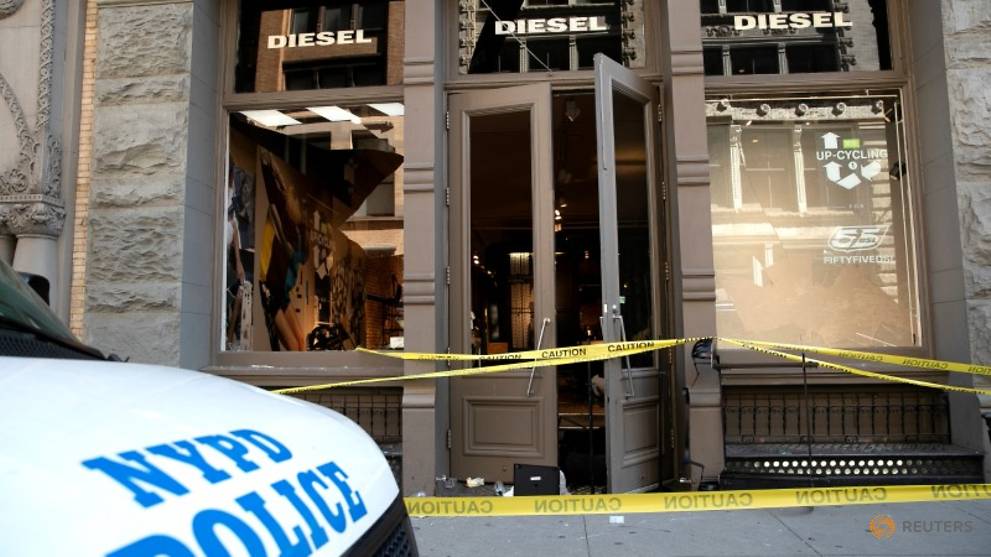
Residents and business owners in cities from New York to Santa Monica, California, spent Monday sweeping up broken glass and taking stock of damage after protests over excessive police force against African Americans turned violent again overnight.
"You have to dominate," Trump told the governors in a private call obtained by media including Reuters. "If you don’t dominate, you’re wasting your time - they’re going to run over you, you’re going to look like a bunch of jerks."
Police in riot gear keep protesters at bay in Lafayette Park near the White House in Washington, DC. REUTERS/Jonathan Ernst
Trump said the federal government was going to clamp down "very strong" on the violence.
Dozens of cities across the United States remain under curfews at a level not seen since riots following the 1968 assassination of civil rights activist Martin Luther King Jr. The National Guard deployed in 23 states and Washington, DC.
Protesters rally against the death in Minneapolis police custody of George Floyd, near Manhattan bridge in the Brooklyn borough of New York City. REUTERS/Jeenah Moon
Curfews were extended in Washington, DC, where authorities fought to put out fires near the White House overnight; in Minnesota, which has experienced some of the worst violence, and in Los Angeles.
One person was killed in Louisville, Kentucky, overnight where police and National Guard troops returned fire while trying to disperse a crowd. Police in Chicago, the country's third-largest city, fielded more than 10,000 calls for looting, Mayor Lori Lightfoot told a briefing.
The unrest, which erupted as the country was easing lengthy lockdowns to stop the spread of the coronavirus, began with peaceful protests over the death of a black man, George Floyd, in police custody in Minneapolis last Monday.
Terrence Floyd, brother of George Floyd, arrives at a makeshift memorial honouring George Floyd, at the spot where he was taken into custody, in Minneapolis, Minnesota. REUTERS/Lucas Jackson
Terrence Floyd, brother of George Floyd, reacts at a makeshift memorial honouring George Floyd, at the spot where he was taken into custody, in Minneapolis, Minnesota. REUTERS/Lucas Jackson
Video footage showed a white police officer kneeling on the neck of Floyd, 46, for nearly nine minutes before he died. Derek Chauvin, a since-fired 44-year-old police officer, has been charged with third-degree murder and second-degree manslaughter. He was released on US$500,000 bail and is due to appear in court on June 8, according to jail records.
On Monday, dozens of people quietly paid their respects to Floyd at the scene outside the Cup Foods where he lost his life. Visitors left flowers and signs honoring Floyd on the pavement. A little girl wrote, “I’ll fight with you,” in aqua blue chalk in the road.
"This is therapeutic. My heart was real heavy this morning so I came down extra early and when I got here, the heaviness lifted,” said Diana Jones, 40, the mother of four children. “This right here let’s me know that things are going to be ok.”
Terrence Floyd, the victim's brother, told the gathering he wanted people to get educated, vote and not destroy their own communities. "Let's do this another way," he said.
In the US capital, St. John's Episcopal Church, a historic place near the White House where many US presidents have worshipped, suffered minor damage while the nearby headquarters of the AFL-CIO labor group was vandalised.
Floyd's death was the latest in a string of similar incidents to prompt an outcry over racism in law enforcement. It reignited outrage across a politically and racially divided country that has been hit hard by the coronavirus pandemic, with African Americans accounting for a disproportionately high number of coronavirus cases.
The US Justice Department has directed the Bureau of Prisons to send riot-control teams to Miami and Washington, DC, to help manage the protests, a senior department official told reporters.
Department investigators are interviewing people arrested during protests who might face federal charges for such offenses as crossing state lines to incite violence, the official said.
Many cities affected by the unrest are restarting some normal economic activity after more than two months of stay-at-home orders to stem a pandemic that has killed more than 104,000 people and plunged more than 40 million people into joblessness.
New York City Police Commissioner Dermot Shea told a news briefing with Mayor Bill de Blasio that police are seeing "outside agitators coming and trying to rally people to do bad things."
Trump has condemned the killing of Floyd and promised justice but has made no major public statement to address the crisis. In tweets he has described protesters as "thugs" and threatened to use the US military.
"These are terrorists ... They're Antifa and they're the radical left," Trump told the governors, referring to the shorthand name for a loosely organised movement of anti-fascists but without offering evidence.
Critics accuse the Republican president, who is seeking re-election in November, of stoking conflict and racial tension rather than seeking to bring the country together and address the underlying issues.
Democratic presidential candidate Joe Biden, critical of Trump's handling of the crisis, met black community leaders in a church and said he would create a police oversight board within his first 100 days in the White House.
Former vice president and Democratic presidential candidate Joe Biden (right) prays as he meets with clergy members and community activists during a visit to Bethel AME Church in Wilmington, Delaware. (JIM WATSON/AFP)
HONG KONG: Hong Kong police on Monday (Jun 1) banned an upcoming vigil marking the anniversary of the Tiananmen protests, citing the COVID-19 pandemic.
It is the first time the gathering has been halted in three decades.
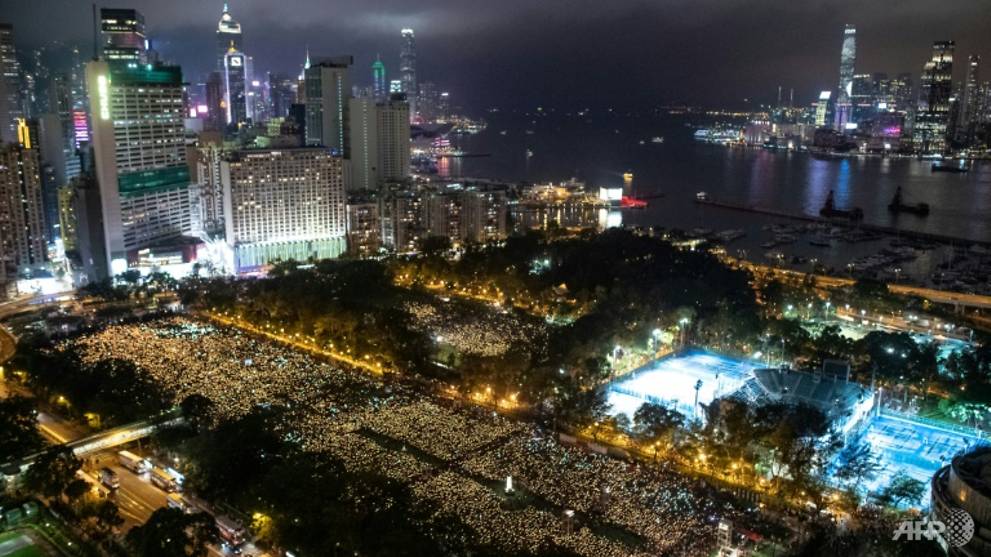
The candlelight Jun 4 vigil usually attracts huge crowds and is the only place on Chinese soil where such a major commemoration of the anniversary is still allowed.
Last year's gathering was especially large and came just a week before seven months of protests and clashes exploded onto the city's streets, sparked initially by a plan to allow extraditions to the authoritarian mainland.
But police rejected permission for this year's rally, saying it would "constitute a major threat to the life and health of the general public", according to a letter of objection to organisers obtained by AFP.
Hong Kong has managed to keep the virus mostly in check, with more than 1,000 infections and four deaths. Bars, restaurants, gyms and cinemas have largely reopened in recent weeks.
Organisers accused police of using the virus as an excuse to ban the rally.
"I don't see why the government finds political rallies unacceptable while it gave green lights to resumption of schools and other services ranging from catering, karaoke to swimming pools," said Lee Cheuk-yan, chairman of the Hong Kong Alliance which has organised every vigil since 1990.
The alliance called on residents to instead light a candle at 8pm on Thursday and observe one minute of silence wherever they can.
"If we are not allowed to light a candle at a rally, we will let the candles be lit across the city," Lee said.
Lee also vowed that the alliance would continue to chant the slogan "end one-party rule" during the commemoration despite Beijing's recently announced plans to impose a law criminalising acts of subversion, secession, terrorism and foreign interference.
Beijing says the law – which will bypass Hong Kong's legislature – is needed to tackle "terrorism" and "separatism".
Opponents fear it will bring mainland-style political oppression to a business hub supposedly guaranteed freedoms and autonomy for 50 years after its 1997 handover to China by Britain.
Three decades on, the Tiananmen incident remains one of the most sensitive subjects in mainland China and any mention of it is strictly censored. But in Hong Kong the memory of what happened is kept alive.
The annual vigils swelled before the 1997 handover to China and have become especially charged in recent years, as many Hong Kong people chafe under Beijing's rule.