Kamis, 28 Mei 2020

MOH revises discharge criteria for Covid-19 patients, those who are well by day 21 can be discharged - The Straits Times

SINGAPORE - All coronavirus patients who are assessed to be clinically well and no longer infectious by day 21 of their illness will be discharged without having to undergo further tests, said Health Minister Gan Kim Yong on Thursday (May 28).

As a further precaution, these patients must stay at home or in their dormitories for a further seven days until day 28, he added. After this, they will be able to return to work.

"This revised approach will allow patients who are well and not infectious to return to the community," Mr Gan said at a press conference.

These changes to the discharge criteria for Covid-19 patients will take effect immediately.

Previously, patients needed two negative swab tests, 24 hours apart, in order to be discharged, even if they had not been sick for some time.

But a local study has shown that while patients may continue to test positive for some time, the virus is no longer viable after 11 days of a person getting sick and cannot be spread to others.

The findings were revealed in a position paper by the National Centre for Infectious Diseases (NCID) and the Academy of Medicine's Chapter of Infectious Disease Physicians.

NCID executive director Leo Yee Sin, who was at the press conference, highlighted three local studies on the virus.

The first, involving 218 coronavirus patients, showed that virus shedding is highest during the early onset of critical illness.

Another study, which looked at 766 cases, found that three in 10 patients cleared the polymerase chain reaction test by day 15, with nearly seven in 10 doing so by day 21.

By day 33, 95 per cent were able to clear their tests, Prof Leo said.

A third study found that when the viral quantity has been reduced to a certain level, the virus can no longer be cultured from a sample.

Associate Professor Kenneth Mak, the Health Ministry's director of medical services, noted the World Health Organisation on Wednesday recommended that coronavirus patients should stay isolated for at least 10 days after the onset of symptoms, and be symptom-free for another three days after that.

Singapore has decided to take the extra precaution of isolating patients for 21 days, he said.

"It is already with an abundance of caution that we have put together our protocol," Prof Mak said. "We want to take the precaution for individuals who have conditions that suppress their immune system."

Related Stories: 

Let's block ads! (Why?)


https://news.google.com/__i/rss/rd/articles/CBMif2h0dHBzOi8vd3d3LnN0cmFpdHN0aW1lcy5jb20vc2luZ2Fwb3JlL21vaC1yZXZpc2VzLWRpc2NoYXJnZS1jcml0ZXJpYS1mb3ItY292aWQtMTktcGF0aWVudHMtdGhvc2Utd2hvLWFyZS13ZWxsLWJ5LWRheS0yMS1jYW4tYmXSAQA?oc=5

2020-05-28 11:26:19Z
CBMif2h0dHBzOi8vd3d3LnN0cmFpdHN0aW1lcy5jb20vc2luZ2Fwb3JlL21vaC1yZXZpc2VzLWRpc2NoYXJnZS1jcml0ZXJpYS1mb3ItY292aWQtMTktcGF0aWVudHMtdGhvc2Utd2hvLWFyZS13ZWxsLWJ5LWRheS0yMS1jYW4tYmXSAQA

US revocation of Hong Kong's special status 'barbaric': China's HK office - CNA

HONG KONG: Washington's decision to revoke Hong Kong's special status over fears freedoms were slipping was "most barbaric", China's foreign ministry office in the financial hub said Thursday (May 28). 

"This is the most barbaric, the most unreasonable and the most shameless," the Commissioner's Office said in the first reaction from a Chinese government ministry.

READ: Hong Kong loses US 'special status' - what next?

READ: China's parliament approves Hong Kong national security Bill

Under a law passed last year by the US Congress aimed at supporting Hong Kong's pro-democracy movement, the US administration must certify that Hong Kong still enjoys the freedoms promised by Beijing when it negotiated with Britain to take back the colony.

Washington's decision on Wednesday that Hong Kong does not enjoy those freedoms means it could lose trading privileges - including lower tariffs than the mainland - with the world's largest economy.

US President Donald Trump will ultimately decide which actions to take, said David Stilwell, the top State Department official for East Asia.

"The steps will be considered and they will be as targeted as possible to change behaviour," Stilwell told reporters.

He said the United States did not want to hurt the people of Hong Kong, adding: "This decision was made by the government in Beijing, and not by the US."

China's National People's Congress of more than 2,800 delegates on Thursday voted in favour of the proposal to draft the law, which would punish secession, subversion of state power, terrorism and acts that endanger national security.  

The security legislation could also pave the way for Chinese security agencies to open up branches in Hong Kong.​​​​​​​

Authorities in Beijing and Hong Kong insist there is no threat to the city's freedoms. 

MORE: Our coverage of the Hong Kong protests

Follow us on Telegram for the latest on Hong Kong: https://cna.asia/telegram

Let's block ads! (Why?)


https://news.google.com/__i/rss/rd/articles/CBMiZmh0dHBzOi8vd3d3LmNoYW5uZWxuZXdzYXNpYS5jb20vbmV3cy9hc2lhL2hvbmcta29uZy1wcm90ZXN0cy1jaGluYS1zZWN1cml0eS1sYXctdW5pdGVkLXN0YXRlcy0xMjc3OTY0ONIBAA?oc=5

2020-05-28 10:24:10Z
52780800526630

Hong Kong loses US 'special status' - what next? - CNA

HONG KONG: Washington's declaration that Hong Kong is no longer sufficiently autonomous from China is a historic moment with potentially far-reaching consequences for the finance hub - though much will depend on what President Donald Trump does next.

The revocation of special status could radically rearrange the fortunes of a city that has served for decades as China's economic gateway to the world if targeted sanctions, tariffs or trade restrictions are imposed.

But it may also end up being little more than a symbolic move.

WHAT IS HONG KONG'S SPECIAL STATUS?

In the run-up to Britain returning Hong Kong to China in 1997, a "one country, two systems" deal was forged to allow the city to maintain certain freedoms and autonomy for 50 years.

Those liberties included a free market economy, an independent judiciary, free speech and a local legislature.

As a result many countries, including the United States, brought in laws that allowed them to treat Hong Kong as a separate trade entity to the economically restrictive mainland.

The arrangement turned Hong Kong into a world-class financial centre on a par with London and New York.

Reciprocal visa-free travel deals, a currency pegged to the dollar, the world's fourth-largest stock exchange as well as friendly laws, taxes and legal protections all helped grease the wheels of business.

Hong Kong-US trade
Chart showing changes in the volume of trade between Hong Kong and the US for the past few years. (Infographic: AFP/Laurence Chu)

If Washington opts for hardline measures it would risk "all of the financial connectivity that China has to the free market", according to Robert Spalding, a US-China expert at the Hudson Institute.

"Once that goes away, stocks, bonds, financial transactions, SWIFT, all of that is imperilled," he told Bloomberg News.

WHAT HAPPENS NEXT?

Analysts say the ball is now in Trump's court.

Julian Ku, an expert on international law at Hofstra University, says the president has "lots of flexibility".

"He can alter Hong Kong's tariff treatment to make it the same as China's, or he could alter its treatment under export control laws to make it harder to export high tech ... or he could do both," he told AFP.

But Ku believes a gentler approach is more likely.

"I expect him to take some major steps that would show China he is serious, but not to change every US law that applies to Hong Kong," he said.

"I expect he would hold back on some matters so that he can offer China a chance to back down."

David Stilwell, the top State Department official for East Asia, told reporters will be "as targeted as possible to change behaviour", while acknowledging it was unlikely Beijing would change course.

HOW DID THIS COME ABOUT?

The decision by Secretary of State Mike Pompeo on Wednesday was sparked by growing fears that Beijing is prematurely stamping out freedoms.

Of most concern is a plan by Beijing to impose a sweeping national security law on the trade hub after months of pro-democracy protests last year.

The crackdown on those protests sparked rare bipartisan support in Washington with lawmakers last year passing a Bill punishing China.

One of the provisions in that Bill was for the State Department to certify each year whether Hong Kong maintains enough autonomy from China to justify its special trade status.

"No reasonable person can assert today that Hong Kong maintains a high degree of autonomy from China, given facts on the ground," Pompeo said.

IS THIS THE END OF HONG KONG INC?

The Trump administration's China policy is mercurial.

Trump has taken a hardline against Beijing on trade but shown little interest in human rights and spoken warmly of his Chinese counterpart Xi Jinping.

He is also reluctant to jeopardise his trade agreement with China as he seeks re-election in November.

American businesses could be hit hard by moves to economically punish Hong Kong.

According to the Congressional Research Service, nearly 300 US companies have a regional headquarters in the city, while 434 that have regional offices.

In 2018, the trade surplus with Hong Kong was America's largest at US$31.1 billion.

But attitudes towards China are hardening within the Trump administration, especially after the coronavirus pandemic.

For Beijing, Hong Kong remains a city of major economic importance, especially for Chinese companies seeking to access foreign currency, international banks and trading firms.

But it is less pivotal than it used to be - last year 12 per cent of China's exports went to or through the city, down from 45 per cent in 1992.

China has threatened countermeasures against any attempt to punish it for imposing security laws on Hong Kong.

Let's block ads! (Why?)


https://news.google.com/__i/rss/rd/articles/CBMiXmh0dHBzOi8vd3d3LmNoYW5uZWxuZXdzYXNpYS5jb20vbmV3cy9hc2lhL2hvbmcta29uZy1sb3Nlcy11cy1zcGVjaWFsLXN0YXR1cy13aGF0LW5leHQtMTI3NzkxNjbSAQA?oc=5

2020-05-28 08:39:22Z
52780800526630

China's parliament approves Hong Kong national security Bill - CNA

BEIJING: China's parliament on Thursday (May 28) approved Hong Kong's national security Bill that has caused uproar in the city about concerns over freedoms in the financial hub.

The National People's Congress of more than 2,800 delegates voted in favour of the proposal to draft the law, which would punish secession, subversion of state power, terrorism and acts that endanger national security. 

Only one person opposed the proposal, while six abstained.

The legislators gathered in the Great Hall of the People burst into sustained applause when the vote tally was projected onto screens.

On Wednesday, Beijing expanded the scope of draft national security legislation to include organisations as well as individuals.

READ: Riot police shield Hong Kong legislature as protests gather against anthem Bill

The security legislation could pave the way for Chinese security agencies to open up branches in Hong Kong. It targets secession, subversion, terrorism and foreign interference - terms that are increasingly used by authorities to describe last year's protests in the city.

The Bill has revived mass protests by demonstrators who say China aims to curb the freedoms enjoyed in Hong Kong, a global financial centre with broad autonomy.

Authorities in Beijing and Hong Kong insist there is no threat to the city's freedoms. 

The NPC Standing Committee - which is likely to meet next in June - will now be tasked with formulating the legislation, which Beijing has said must be done "at an early date".

Ahead of the Chinese parliament approving the Bill, the US revoked Hong Kong's special status under US law, opening the way for the city to be stripped of trading privileges, as Washington accused China of trampling on the territory's autonomy.

"No reasonable person can assert today that Hong Kong maintains a high degree of autonomy from China, given facts on the ground," said Secretary of State Mike Pompeo, adding the trade hub "does not continue to warrant" its special status.

READ: US revokes Hong Kong special status as anger grows over China law

READ: Hong Kong police fire pepper ball rounds at protesters, arrest 300 people

UNREST IN HONG KONG

The national security Bill triggered the first big street unrest in Hong Kong in months on Sunday, with police firing tear gas and water cannon to disperse protesters, evoking memories of violent anti-government protests that paralysed parts of the city last year.

More protests took place in the city over the week against a Bill to criminalise disrespect of the Chinese anthem as well.

The Bill carries penalties of up to three years jail and/or fines of up to HK$50,000 (US$6,450) for those who insult the anthem. It also orders that primary and secondary school students in Hong Kong be taught to sing the March of the Volunteers, along with its history and etiquette.

The anthem Bill is expected to be turned into law next month.

Police fired pepper pellets and made 360 arrests on Wednesday as thousands of people took to the streets in anger over both Bills. Riot police were also deployed on Thursday.

MORE: Our coverage of the Hong Kong protests

Follow us on Telegram for the latest on Hong Kong: https://cna.asia/telegram

Let's block ads! (Why?)


https://news.google.com/__i/rss/rd/articles/CBMiaWh0dHBzOi8vd3d3LmNoYW5uZWxuZXdzYXNpYS5jb20vbmV3cy9hc2lhL2hvbmcta29uZy1jaGluYS1uYXRpb25hbC1zZWN1cml0eS1iaWxsLXBhc3MtcGFybGlhbWVudC0xMjc3OTIwNNIBAA?oc=5

2020-05-28 07:22:19Z
52780800526630

China prepared for international backlash over Hong Kong law - South China Morning Post

[unable to retrieve full-text content]

  1. China prepared for international backlash over Hong Kong law  South China Morning Post
  2. US revokes Hong Kong special status as anger grows over China law  CNA
  3. US working on 'strong response' to China's security law plans  The Straits Times
  4. National security law leaves too many unanswered questions to feel safe  South China Morning Post
  5. Will President Trump Stand With Hong Kong?  The New York Times
  6. View Full coverage on Google News

https://news.google.com/__i/rss/rd/articles/CBMid2h0dHBzOi8vd3d3LnNjbXAuY29tL25ld3MvY2hpbmEvZGlwbG9tYWN5L2FydGljbGUvMzA4NjQ2My9jaGluYS1wcmVwYXJlZC1pbnRlcm5hdGlvbmFsLWJhY2tsYXNoLW92ZXItaG9uZy1rb25nLW5hdGlvbmFs0gF3aHR0cHM6Ly9hbXAuc2NtcC5jb20vbmV3cy9jaGluYS9kaXBsb21hY3kvYXJ0aWNsZS8zMDg2NDYzL2NoaW5hLXByZXBhcmVkLWludGVybmF0aW9uYWwtYmFja2xhc2gtb3Zlci1ob25nLWtvbmctbmF0aW9uYWw?oc=5

2020-05-28 06:00:06Z
52780800526630

Huawei CFO Meng loses key court fight against extradition to United States - CNA

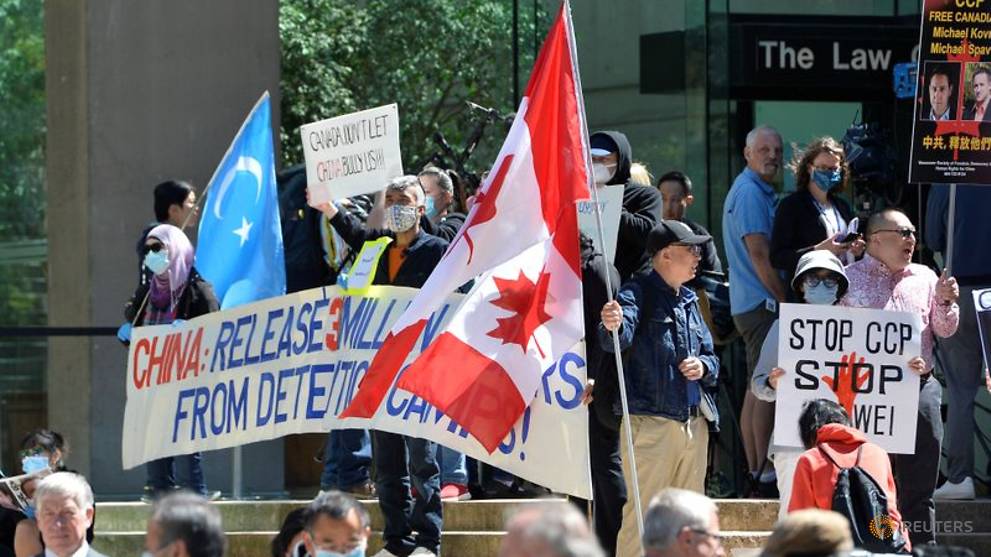
VANCOUVER/TORONTO: Huawei Technologies Co's Chief Financial Officer Meng Wanzhou was dealt a setback by a Canadian court on Wednesday as she tries to avoid extradition to the United States to face bank fraud charges, dashing hopes for an end to her 18-month house arrest in Vancouver.

The ruling, which could further deteriorate relations between Ottawa and Beijing, elicited immediate strong reaction from China's embassy in Canada, which said Canada is "accomplice to United States efforts to bring down Huawei and Chinese high-tech companies."

Meng, a Chinese citizen and daughter of Huawei's billionaire founder Ren Zheng, was arrested in December 2018 on a warrant issued by U.S. authorities. They accuse her of bank fraud for misleading HSBC about Huawei's relationship with a company operating in Iran, putting HSBC at risk of fines and penalties for breaking U.S. sanctions on Tehran.

Meng's lawyers argued the case should be thrown out because Canada did not have sanctions against Iran.

But British Columbia's Superior Court Associate Chief Justice Heather Holmes disagreed, ruling the legal standard of double criminality had been met.

"Ms. Meng's approach ... would seriously limit Canada's ability to fulfill its international obligations in the extradition context for fraud and other economic crimes," Holmes said.

Huawei said it was disappointed by the Canadian court ruling and it expects that Canada's judicial system will ultimately prove her innocence.

The ruling paves the way for the extradition hearing to proceed to the second phase starting June, examining whether Canadian officials followed the law while arresting Meng.

Closing arguments are expected in the last week of September and first week of October.

Reid Weingarten, a U.S. lawyer for Meng, said Meng should "not be a pawn or a hostage" in the China-U.S. relationship. Ties between the two superpowers are deteriorating steadily amid disputes over trade and the future of Hong Kong.

"Today's ruling in Canada is only the opening salvo in a very long process ... we are confident that ultimately justice will be done," Weingarten said.

Shortly after the ruling was released Meng, 48, arrived at the courthouse for an in-person briefing and left without talking to the media. Meng says she is innocent..

Shortly after Meng's arrest, Beijing detained two Canadians on national security charges and halted imports of canola seed.

ICE canola futures dipped on Wednesday, giving up gains after the ruling.

The Global Times, published by the People's Daily, the official newspaper of China's ruling Communist Party, said the ruling "will make Canada a pathetic clown and a scapegoat in the fight between China and the U.S."

The Chinese embassy in Ottawa said in a statement that China expresses strong dissatisfaction and firm opposition to the decision on Meng and has made serious representations with Canada.

The U.S. Department of Justice thanked Canada for its continued assistance. Canada's justice ministry said its lawyers were committed to moving ahead as fast as possible.

(Reporting by Tessa Vikander and Moira Warburton; Additional reporting by David Ljunggren and Steve Scherer in Ottawa, Rod Nickel in Winnipeg and Karen Freifeld in New York; Editing by Denny Thomas and Lisa Shumaker)

Let's block ads! (Why?)


https://news.google.com/__i/rss/rd/articles/CBMigQFodHRwczovL3d3dy5jaGFubmVsbmV3c2FzaWEuY29tL25ld3MvYnVzaW5lc3MvaHVhd2VpLWNmby1tZW5nLWxvc2VzLWtleS1jb3VydC1maWdodC1hZ2FpbnN0LWV4dHJhZGl0aW9uLXRvLXVuaXRlZC1zdGF0ZXMtMTI3NzUwMjjSAQA?oc=5

2020-05-28 06:48:47Z
52780810943255

Rabu, 27 Mei 2020

Riot police deployed across Hong Kong as US-China tensions rise - CNA

HONG KONG: Riot police were deployed across Hong Kong on Thursday (May 28) as lawmakers debated a Bill that would criminalise disrespect of China's national anthem, and as the United States piled pressure on China to preserve the city's freedoms.

Heated debate over the Bill - the latest spark of anti-government unrest in the city - saw two pro-democracy lawmakers removed from the Legislative Council which was then adjourned.

Police fired pepper pellets and made 360 arrests on Wednesday as thousands of people took to the streets in anger over the anthem B​​​​​​​ill and national security legislation proposed by China that has raised international alarm over freedoms in the city.

HK protests (1)
Hundreds of demonstrators with banners march along a downtown street during a protest against Beijing's national security legislation in Hong Kong. (AP Photo/Vincent Yu)

Late into the evening, protesters were still cramming sidewalks, chanting for full democracy and for Hong Kong to seek independence from China, saying this is now "the only way out".

US Secretary of State Mike Pompeo said Hong Kong no longer qualified for special treatment under US law, potentially dealing a crushing blow to its status as a major financial hub.

READ: US revokes Hong Kong special status as furore grows on China law​​​​​​​

China's plan to impose the new legislation was "only the latest in a series of actions that fundamentally undermine Hong Kong’s autonomy and freedoms", he told Congress.

"No reasonable person can assert today that Hong Kong maintains a high degree of autonomy from China, given facts on the ground," he said.

Beijing unveiled plans last week for national security legislation for Hong Kong that aims to tackle secession, subversion and terrorist activities.

It could see Chinese intelligence agencies set up bases in the city that was supposed to have a high degree of autonomy under the terms of its 1997 handover to China by former colonial power Britain.

Chinese authorities and the Beijing-backed government in Hong Kong say there is no threat to the city's high degree of autonomy and the new security law would be tightly focused.

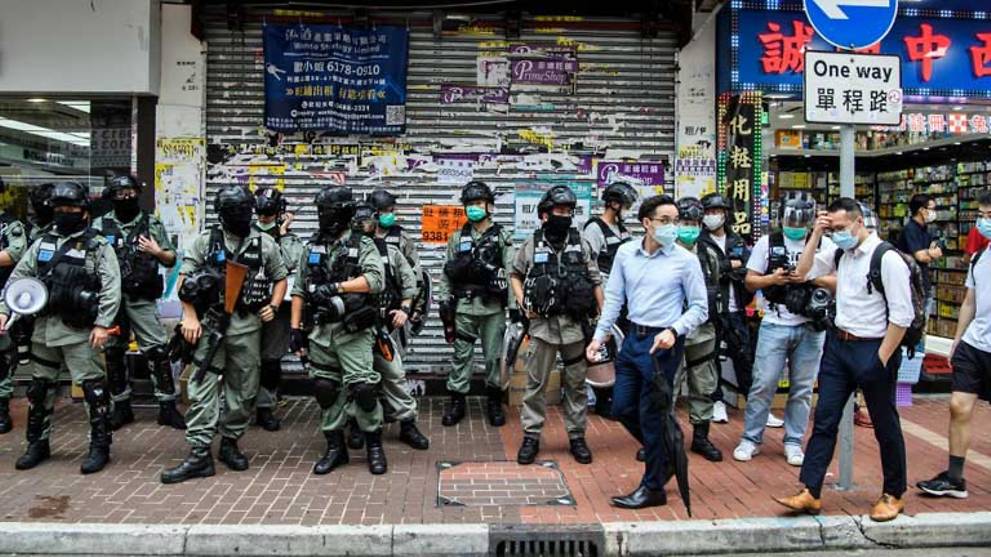
HK situation
Pedestrians walk past riot police standing guard in a front of a shop in the Causeway Bay district of Hong Kong. (Photo: AFP/ANTHONY WALLACE)

The United States and China clashed over Hong Kong at the United Nations on Wednesday after Beijing opposed a request by Washington for the Security Council to meet over the national security legislation.

The US mission to the United Nations said the issue was "a matter of urgent global concern ​that implicates international peace and security". China said the legislation was an internal matter for China.

Explainer: Hong Kong's China national anthem Bill aims to legislate 'respect'

"SHOW TIME"

Tensions between Beijing and Washington had already been rising over China's militarisation of the South China Sea, trade and the coronavirus pandemic.

"Already, international business is facing the pressure of increased tension between the U.S. and China, but the enactment of China's security law for Hong Kong could take the tension to a whole new level," said Tara Joseph, president of the American Chamber of Commerce in Hong Kong.

"This is show time for Hong Kong," Joseph said in a commentary in the South China Morning Post.

US President Donald Trump has promised an announcement on what action he will take over Hong Kong at the end of the week. More than 1,300 US companies have offices in the city, providing around 100,000 jobs.

READ: US business to Trump: Go slowly on Hong Kong response

Trump has a long list of possible responses, including visa and economic sanctions, David Stilwell, the State Department's assistant secretary for East Asia, told reporters.

"Sanction is painful but necessary," Agnes Chow from Hong Kong's pro-democracy group Demosisto said at a news conference.

China's security plan ignited the first large protests in Hong Kong for months, after the city was rocked by often violent pro-democracy demonstrations in 2019 over an unsuccessful bid to introduce an extradition law to China.

Protesters and pro-democracy politicians say Hong Kong’s National Anthem Bill, which aims to govern the use and playing of the Chinese national anthem, represents another sign of what they see as accelerating interference from Beijing.

Among other things, the Bill carries penalties of up to three years jail and/or fines of up to HK$50,000 (US$6,450) for those who insult the anthem.

The anthem Bill is expected to become law next month.

MORE: Our coverage of the Hong Kong protests

Follow us on Telegram for the latest on Hong Kong: https://cna.asia/telegram

Let's block ads! (Why?)


https://news.google.com/__i/rss/rd/articles/CBMia2h0dHBzOi8vd3d3LmNoYW5uZWxuZXdzYXNpYS5jb20vbmV3cy9hc2lhL2hvbmcta29uZy1wcm90ZXN0cy1sYXdtYWtlcnMtcmVtb3ZlZC1sZWdpc2xhdGl2ZS1jb3VuY2lsLTEyNzc4Mjcy0gEA?oc=5

2020-05-28 04:18:45Z
52780800526630