Selasa, 19 Mei 2020

Home-based learning: Odds stacked against teachers in Malaysia's public primary schools, while private counterparts are more prepared - CNA

KUALA LUMPUR: The odds are stacked against public primary schools in Malaysia, with teachers having to grapple with connectivity issues and drawing up online classes overnight for home-based learning during the movement control order (MCO). 

Private schools, on the other hand, have a head start over their peers as they have some prior experience in e-learning that they can draw on. 

Students in public primary schools who are used to face-to-face interactions with teachers and using textbooks as their main study materials are struggling to adapt to home-based learning, said K Tamilarasi, who teachers at a national school in Klang, Selangor. 

“You see all these students are so accustomed to using textbooks and having teachers guide them through homework, then now suddenly you’re expecting them to manoeuvre through online learning like experts, it’s unfair,” she said.

The mathematics teacher, 34, added that most of her students could not seek guidance from their parents as the adults also do not have any prior experience in using electronic devices to study. 

(kd)e-learning 2
Some students in Malaysia have no prior experience in online learning. (File photo: Bernama)

Schools nationwide have been closed for two months since MCO kicked in on Mar 18 to control the spread of COVID-19, with two national level examinations for Year 6 students in the primary schools and Form 3 students in secondary schools called off this year. 

The other public examinations for the Malaysian equivalent of O-Level and A-Level qualifications have been postponed. 

While there has been no announcement so far on when schools will reopen, Education Minister Mohd Radzi Md Jidin had said that the government would inform parents two week prior to the reopening. Form 5 and Upper 6 students, who are set to complete their secondary school and pre-university education, would be allowed to return to schools first. 

Goh Sui Hui, a 40-year old science teacher in a Chinese primary school in Johor, told CNA that most of her students "feel abandoned" with distance learning, something that they have no prior experience of. 

“With my students devices isn’t a problem. Internet connectivity is spotty sometimes. But even all that we can manage. The issue here is being able to guide them to learn on an e-platform. It’s like starting them back from kindergarten all over again,” she said. 

VARIOUS HURDLES IN DISTANCE LEARNING 

The first hurdle encountered by many public school teachers is that not every children own electronic devices, especially those from families that are less well-to-do. Dr Mohd Radzi had earlier noted that 36.9 per cent of about 900,000 students surveyed do not own electronic devices to study at home. 

Tamilarasi said some of her students in elite classes also have the same problem. 

“I teach two different primary levels and have three classes in each level. Of the six classes two classes are students who need a lot of hands-on coaching and constant monitoring. Now with the MCO, I have completely lost them," she said. 

Admitting that this is one of the hardest things she has experienced after eight years of teaching, Tamilarasi said MCO had led to her losing her momentum of teaching. 

READ: Home-based learning is strange, new ground but we can conquer that too, a commentary

The lack of training and experience in handling online lessons have left the teachers overwhelmed and frustrated. They have to individually figure out a method that works for each class if not each student.

Goh said that with her students she was used to giving each of them lessons differently. Their science syllabus is in English, she added. 

“Mine being a Chinese school, some of the students are not fluent in Malay or English, so when they come to me, I explain in Mandarin. But I cannot write homework separately in Mandarin for these children and neither can I have two separate lessons in different languages.

Malaysia schools
There has been no announcement so far on when schools in Malaysia will reopen. (File photo: Bernama) 

“It’s extremely frustrating. Not to mention that we have to formulate all this classwork on our own because the education department doesn’t have anything for us to use,” she said adding that it would have been helpful if teachers were given training before on conducting classes online.

Marlina Azhar, a 29-year-old Malay language teacher at a national primary school in Kuala Lumpur also said some training would have been useful. 

“You see as much as it is challenging for the students, we as teachers are also struggling. We need to put together our own homework and figure out how best to convey it to students. 

“Then we have to worry about whether the students get it, if they understand it, if they submit it on time, all this without any prior experience of doing this,” she said. 

HARD TO MAINTAIN CLASSROOM DISCIPLINE VIA ZOOM

With the distance, it appears that many students are using the newfound freedom to evade teachers and homework, the teachers shared.

Goh said it was extremely difficult to maintain classroom discipline during her Zoom classes. 

“I use Google classroom for homework and Zoom for tutoring. I found out that some of my students actually just mute their audio and mute me and play games with each other," she said. 

Similarly, Marlina also shared that a lot of her students despite having devices, make up excuses to sit out of classes. 

“Everything from Internet connection to unclear audio to not knowing how to charge their devices and all of that. If we keep going like this, it will undo all the work I’ve put in so far,” she said.  

Malaysia e-learning
Students in Malaysia have to resort to online learning when schools are closed to control the spread of COVID-19. (File photo: Bernama) 

READ: E-learning sees no smooth sailing in Malaysia and Indonesia, a commentary

With many teachers and students complaining about lack of devices and a steady Internet connection, the Ministry of Education had introduced television-based learning in the second phase of the MCO. 

Asked on whether any of the resources given by the government was helpful in conducting her classes, Marlina said: “The lessons on television, I asked my students to watch them and they all said okay, but only a handful tuned in.”

“All this is too new for them,” she said. 

PRIOR EXPERIENCE AN ADDED ADVANTAGE FOR INTERNATIONAL SCHOOL TEACHERS

The situation appears to be different for international school teachers and students, as many of them have had experience teaching and learning online.

Shri Thivya Kanagendran, 27, who teaches science to upper primary students said that though fully teaching online has been challenging, her students have been exposed to online learning before this. 

She explained that her school in Selangor has online homework modules for students to work on during school holidays or weekends.  

“In fact, a few other teachers and I used to even schedule Zoom sessions with students for them to clarify doubts.

“So when the government announced the MCO, we knew what we had to do,” she said. 

Similarly, Zoe Ng, a mathematics teacher in an international school in Negeri Sembilan told CNA that she was able to get by this MCO period without much challenges.

“Maybe because my students are all in upper primary, so they are not too hard to control. I have spoken to many of my student’s parents and they also shared that the children are doing pretty well,” she said.

(kd) e-learning 4
Schools in Malaysia have been closed since Mar 18, 2020 as part of the movement control order measures. (File photo: Bernama)

Nonetheless, the teachers said that children still need direct guidance in order to learn effectively. 

Even though the kids may not find online learning a challenge, Shri Thivya said "they are accustomed to asking questions in person and teachers are also used to giving them guidance in person." 

Similarly, Ng said setting up online separate tutor sessions for the kids whenever they need guidance gets tiring after awhile. 

READ: Singapore's Doctor Love launches online platform for migrant workers to consult doctors in their home countries

“In addition to that, these children miss interacting with their friends. They get very excited when we have Zoom classes, especially when I do not require them to mute their audio. They get to talk to one another instead of just hearing me talk. On some days, I just allow the chatter,” she said.

BOOKMARK THIS: Our comprehensive coverage of the coronavirus outbreak and its developments

Download our app or subscribe to our Telegram channel for the latest updates on the coronavirus outbreak: https://cna.asia/telegram

Let's block ads! (Why?)


https://news.google.com/__i/rss/rd/articles/CBMicGh0dHBzOi8vd3d3LmNoYW5uZWxuZXdzYXNpYS5jb20vbmV3cy9hc2lhL21hbGF5c2lhLWNvdmlkLTE5LWhvbWUtYmFzZWQtbGVhcm5pbmctcHJpbWFyeS1zY2hvb2wtdGVhY2hlcnMtMTI3MzUzMDbSAQA?oc=5

2020-05-19 22:15:11Z
CBMicGh0dHBzOi8vd3d3LmNoYW5uZWxuZXdzYXNpYS5jb20vbmV3cy9hc2lhL21hbGF5c2lhLWNvdmlkLTE5LWhvbWUtYmFzZWQtbGVhcm5pbmctcHJpbWFyeS1zY2hvb2wtdGVhY2hlcnMtMTI3MzUzMDbSAQA

WHO chief vows to continue leading coronavirus response after Trump threat to quit - CNA

GENEVA: The head of the World Health Organization vowed on Tuesday (May 19) to continue to lead the global fight against the coronavirus pandemic, after President Donald Trump threatened to cut off funding and to quit the body.

WHO Director-General Tedros Adhanom Ghebreyesus defended his agency's role, after the United States again caused ripples by withholding full support for a resolution on the pandemic.

Washington allowed the resolution calling for a review into the global response to the pandemic to pass by consensus, but announced it was objecting to language about reproductive health rights and permission for poor countries to waive patent rules.

"We want accountability more than anyone," Tedros told a virtual meeting of the body's 194 member states. "We will continue providing strategic leadership to coordinate the global response" to the pandemic.

Hours after Trump tweeted his threat to quit the WHO, the United States allowed the resolution to be adopted without a vote. The resolution calls for a review into the WHO-led global response, something the United States has demanded.

But in a statement, Washington said it dissociated itself from language in the resolution on patents and reproductive healthcare.

Paragraphs on the right of poor countries to waive patents to obtain medicine during a health emergency would "send the wrong message to innovators" trying to produce new drugs and vaccines, the US mission in Geneva said in an "explanation of position".

The reproductive healthcare language could be interpreted as requiring countries to permit abortion: "The United States believes in legal protections for the unborn," it said.

BACKING FROM CHINA

Even as Trump has proposed quitting the WHO, the body has received backing and a two-year pledge of US$2 billion in funds from China's President Xi Jinping.

During his three years in office, Trump has criticised many international organisations and quit some. Still, European diplomats said they were taken aback by Washington's decision to stand aside at the WHO while China is boosting its role.

"It was so striking to see Xi Jinping seizing the opportunity to open up, with broad (cooperation), and make a proposal for US$2 billion, and say if ever there is a vaccine they will share it with everyone," a European diplomat said.

"It's exactly what we feared: the space liberated by Washington will be taken up by China."

The Geneva-based body declined to comment on Trump's threat to quit, saying only that it had received a letter from Trump and was considering its contents.

Tuesday's resolution, sponsored by the European Union, calls for a review into how the novel coronavirus spread after making the jump from animals to humans, believed to have happened in the Chinese city of Wuhan late last year.

On Monday, the WHO said an independent review of the global coronavirus response would begin as soon as possible. "I will initiate such an evaluation at the earliest appropriate moment," Tedros said on Tuesday.

Diplomats said ultimately Washington had decided not to block it outright, despite its objections.

"There is a strong desire on their part to join consensus," a Western diplomat said ahead of adoption. Referring to the intellectual property issue in particular, the diplomat added: "If they don't join, they are isolated, unfortunately. There is really a global consensus on the importance of this." 

BOOKMARK THIS: Our comprehensive coverage of the coronavirus outbreak and its developments

Download our app or subscribe to our Telegram channel for the latest updates on the coronavirus outbreak: https://cna.asia/telegram

Let's block ads! (Why?)


https://news.google.com/__i/rss/rd/articles/CBMidGh0dHBzOi8vd3d3LmNoYW5uZWxuZXdzYXNpYS5jb20vbmV3cy93b3JsZC93aG8tY2hpZWYtdm93cy10by1jb250aW51ZS1sZWFkaW5nLWNvdmlkLTE5LWNvcm9uYXZpcnVzLXJlc3BvbnNlLTEyNzUwMTU20gEA?oc=5

2020-05-19 15:33:45Z
52780795923142

EU Rips Trump ‘Finger-Pointing’; Brazil Hotspot: Virus Update - Yahoo Finance

EU Rips Trump ‘Finger-Pointing’; Brazil Hotspot: Virus Update

(Bloomberg) -- The European Union criticized President Donald Trump’s threat to permanently freeze U.S. funding to the World Health Organization, saying the fight against the coronavirus required global cooperation. China may look to target exports from Australia over its calls for a probe into the origin of Covid-19.

Brazil is now the world’s fastest-growing virus hotspot, accounting for 13% of new cases globally in the past week, while infections in India rose at the fastest pace in Asia to top 100,000. Deaths linked to the virus in Britain exceeded 40,000, making it the first country in Europe to reach that threshold.

Singapore plans to reopen more businesses as the virus there is seen to be under control. Russia’s prime minister returned to office three weeks after testing positive -- a period that saw total cases in the country almost triple to just under 300,000. Earlier, Trump said he is taking hydroxychloroquine, despite warnings of serious side effects.

Key Developments:

Virus Tracker: Cases top 4.8 million; deaths exceed 319,000U.S. airlines see signs of life after April travel collapseHK unemployment rate soars; jobless claims rise in BritainCovid patients testing positive after recovery aren’t infectiousModerna to raise as much as $1.3 billion to fund vaccineCrisis brings gaming boom, adding billions to makers’ wealth

Subscribe to a daily update on the virus from Bloomberg’s Prognosis team here. Click VRUS on the terminal for news and data on the coronavirus. See this week’s top stories from QuickTake here.

Kudlow: Nobody Can Confidently Invest in China (9:52 a.m. NY)

Trump’s economic adviser, Larry Kudlow, said nobody can invest confidently in Chinese companies and that the U.S. needs to protect investors from the country’s lack of transparency and accountability.

Speaking on the Fox Business Network on Tuesday, Kudlow pointed to potential lawsuits related to the coronavirus, saying “until that stuff is sorted out, nobody really can invest with confidence in China.”

The Trump administration is increasingly blaming China for the pandemic, while his critics accuse the president of trying to deflect attention from the U.S.’s handling of the outbreak.

EU Cheers WHO’s Approval of Resolution (9:06 a.m. NY)

The European Union hailed the World Health Assembly’s approval of an EU-sponsored resolution on the virus, saying the move highlights the importance of a “collective response” to the pandemic.

“Strengthening multilateralism is now more important than ever,” EU foreign-policy chief Josep Borrell and Health Commissioner Stella Kyriakides said in a statement after the endorsement by the governing body of the WHO. “The role of equitable access to a vaccine in bringing the pandemic to an end is crucial.”

The EU earlier criticized Trump’s threat to permanently cut U.S. funding for the WHO.

“This is the time for solidarity; it is not the time for finger-pointing or undermining multilateral cooperation,” Virginie Battu-Henriksson, a spokeswoman for the European Commission, the 27-nation EU’s executive arm, told reporters in Brussels.

Separately, the U.K.’s Lancet medical journal said Trump’s claim that the WHO ignored reports of a new virus spreading last year -- including an article in the Lancet -- is wrong and “damaging.”

“The Lancet published no report in December, 2019, referring to a virus or outbreak in Wuhan or anywhere else in China,” the journal said in an emailed statement. “It is essential that any review of the global response is based on a factually accurate account of what took place.”

Southwest Sees Signs of Life in Bookings (8:50 a.m. NY)

Southwest Airlines Co. joined other U.S. carriers noting nascent signs of revival, saying that bookings in May are outpacing cancellations for the first time since March and that travel reservations for next month are showing “modest improvement.”

U.S. Housing Starts Slump by Most on Record (8:34 a.m. NY)

U.S. home construction starts plunged in April by the most in records back to 1959, as the nationwide lockdown hammered the housing market and broader economy.

Residential starts plummeted 30.2% to an 891,000 from a month earlier, the lowest level since February 2015, according to a government report released Tuesday. The median forecast in a Bloomberg survey called for a 900,000 pace. Applications to build, a proxy for future construction, dropped 20.8%, the most since July 2008, to a five-year low.

Singapore to Reopen More Businesses (8 a.m. NY)

Singapore will allow more businesses to reopen on June 2 -- increasing the active proportion of the economy to three-quarters. Restrictions will be introduced in three phases provided “community” infection rates remain low during the current lockdown ending June 1 and health workers are protected, officials said at a press briefing Tuesday.

The government will extend more support to businesses and their workers, with a priority on companies that remain closed on June 1, National Development Minister Lawrence Wong said. Deputy Prime Minister Heng Swee Keat is expected to announce details of a fourth stimulus package next Tuesday in parliament.

EasyJet Says Hackers Accessed Data of 9 Million (7:50 a.m. NY)

EasyJet Plc. said email addresses and travel data of about 9 million customers had been accessed in a “highly sophisticated” cyberattack. Credit card details for 2,208 customers had also been accessed, EasyJet said Tuesday in a statement. It said it’s closed off the unauthorized access and will contact customers over the next few days.

Cyberattacks against businesses and their employees have surged this year as hackers take advantage of the disruption caused by the pandemic.

Contested Jerusalem Holy Site to Reopen (7:40 a.m. NY)

A contested Jerusalem site, holy to both Jews and Muslims, will reopen next week after being closed for almost two months. The Waqf, an Islamic trust that administers the site, said it will open the Al-Aqsa compound immediately after Eid al-Fitr, the holiday that marks the end of Ramadan. There are 16,650 confirmed cases of coronavirus in Israel.

Separately, the Health Ministry said it will let wedding halls and other event venues reopen beginning June 14 under certain restrictions. The ministry also temporarily lifted a requirement to wear masks in public areas amid a heat wave, and schoolchildren were given a temporary reprieve from wearing them in classrooms.

Chinese Tycoon Expects Vaccine Trials at Home Soon (7:10 a.m. NY)

The billionaire founder of Fosun Group expects to soon win approvals for testing a vaccine against the new coronavirus in his home country China. In March, Guo’s Shanghai Fosun Pharmaceutical Group Co. teamed up with German partner BioNTech SE, which has already been conducting human clinical trials of the vaccine in Germany. Early-stage results should be available soon, the tycoon said.

Guo declined to elaborate on when Fosun Pharmaceutical will obtain all the required approvals. The group has also been working with overseas partners in trying to find an effective medicine against the virus, but so far it hasn’t found any, he said.

Walmart Sales Soar on Stockpiling (7:08 a.m. NY)

Walmart Inc. posted strong quarterly sales fueled by coronavirus-related stockpiling, showing how it’s one of the few retailers that’s thriving even amid the unprecedented carnage in the U.S. retail sector. Comparable-store sales, a key retail metric, increased 10% for U.S. Walmart stores in the period, compared with the 8.6% estimate compiled by Consensus Metrix. That’s the fastest pace of growth in almost two decades. Profit in the quarter also beat expectations.

The “significant uncertainty” surrounding the length and intensity of the coronavirus’s impact prompted the retailer to withdraw its full-year guidance, given just three months ago. Still, Walmart said its “business fundamentals are strong.”

Earlier, Home Depot also suspended its full-year forecast citing uncertainty related to the duration of COVID-19 and its impact on the broader economy, while Kohl’s suspended its dividend and stock buyback.

Singapore May Announce Fourth Stimulus Package (6:45 a.m. NY)

Deputy Prime Minister Heng Swee Keat will deliver a statement in Parliament on May 26 on plans to help businesses and individuals amid the coronavirus pandemic, the Straits Times reported. The statement is expected to contain a fourth round of Covid-19 support measures since February, the paper said,

Dimon Says Pandemic Is a Wake-Up Call (6 a.m. NY)

Jamie Dimon said he hopes policy makers use the Covid-19 crisis as a catalyst to rebuild a more-inclusive economy as the pandemic exposes stark inequalities among Americans.

“This crisis must serve as a wake-up call and a call to action for business and government to think, act and invest for the common good and confront the structural obstacles that have inhibited inclusive economic growth for years,” the chief executive officer of JPMorgan Chase & Co. wrote in a memo to employees ahead of the bank’s annual shareholder meeting Tuesday.

Russian Prime Minister Returns to Office (5:39 p.m. HK)

Russian Prime Minister Mikhail Mishustin returned to his position nearly three weeks after he tested positive for coronavirus. President Vladimir Putin signed a decree canceling a temporary transfer of Mishustin’s authority to First Deputy Prime Minister Andrey Belousov, who was named acting premier on April 30.

Following his diagnosis, Mishustin, 54, reappeared on state television on May 8 and has repeatedly participated in video-conferences with Putin and other ministers since then. Mishustin, three government ministers and at least five State Duma deputies have been diagnosed with the virus, as well as Putin’s spokesman Dmitry Peskov.

Mishustin returns to office with Russian cases just shy of 300,000, having nearly tripled since he tested positive at the end of last month. After a surge over the past few weeks, the number of new diagnoses is now starting to decline.

Watch Out for Chinese M&A, Vestager Says (5:25 p.m. HK)

The European Union needs to be “vigilant” about Chinese takeovers if the bloc’s economic recovery from the Covid-19 pandemic lags behind, antitrust chief Margrethe Vestager warned.

“It is very important to be vigilant, especially in a situation where they may be sort of a staggered recovery, where some parts of the world recover faster than others are,” Vestager said in an interview with Bloomberg TV on Tuesday when asked about the potential threat from China.

Pakistan Malls Open After Court Intervenes (5:10 p.m. HK)

After being closed for almost two months, shopping malls in Pakistan have been allowed to open following a judgment by the Supreme Court.

Pakistan’s government had allowed some domestic flights to operate and neighborhood shops to open over the past week, but had decided against reopening shopping malls.

The court’s order came as Pakistan added 3,815 new cases, the biggest single day increase, taking its total to 43,966 with 939 deaths, according to data compiled by John Hopkins University.

German Investor Confidence Jumps (5:06 p.m. HK)

Investors are growing more confident that the German economy will recover from its worst postwar slump in the second half of the year, with businesses resuming activity after the government lifted restrictions. A ZEW gauge measuring investor expectations for the next six months climbed to 51.0, the highest level in five years and above all estimates in a Bloomberg survey.

At the same time, concerns about the present state of Europe’s largest economy are running deep amid rising unemployment and surging bankruptcies. A leading business lobby said German gross domestic product will contract by 10% in 2020. Europe’s largest economy would then bounce back with a 5% expansion next year, the Association of German Chambers of Industry and Commerce, or DIHK, said.

The group’s 2020 outlook is worse than the government’s forecast of a 6.3% contraction this year.

U.K. Virus-Related Deaths Rise to More Than 40,000 (4:51 p.m. HK)

The number of deaths linked to coronavirus in the U.K. exceeded 40,000, making it the first country in Europe to reach that threshold. Almost 43,000 fatalities mentioned Covid-19 on the death certificate through May 16, according to the latest data registered with national statistics offices. Mortalities are leveling off in the countries, with England and Wales reporting a decrease in the number of deaths involving the virus on the previous week.

The government is facing calls to be more open about its strategy to combat the pandemic, with some lawmakers called for the publication of the scientific advice behind Britain’s response to the virus.

Austria’s Virus Reproduction Rate Rises (4:45 p.m. HK)

Austria’s so-called reproduction factor has risen above 1 again after an outbreak clustered around a temporary work agency in and around capital Vienna. The reproduction factor, calculated on the basis of 13 days of new infections, had been below 1 since April 4 and rose to 1.07 as of May 15, according to health Agency AGES, which publishes the factor in varying intervals.

A rate above one indicates every infected person is statistically passing it to more than one other person. Austria was among the first European countries to ease the coronavirus lockdown from April 14 after containing infections early and quickly. A surge of infections in Vienna and the province surrounding it this month have driven up the 7-day average of daily new infections to 55, the highest since May 2.

Hong Kong Unemployment Rate Rises to Highest Since 2009 (4:39 p.m. HK)

Hong Kong’s jobless rate rose for a seventh straight month to the highest in more than a decade, as the economy remains in recession amid the coronavirus pandemic and braces for the prospect of renewed political unrest.

The jobless rate for the February-to-April period rose to 5.2%, worse than the median estimate of 4.6% among economists surveyed by Bloomberg. The level is the highest since October 2009, the data show. The rise extended the longest stretch of increases since the aftermath of the global financial crisis.

Sweden Plans Record 30-Fold Jump in Borrowing (4:38 p.m. HK)

The National Debt Office estimates that the net borrowing requirement will rise to 402 billion kronor ($41.5 billion) this year, compared with a previous forecast for just 14 billion kronor. As a result, Scandinavia’s biggest economy will need to rely much more on debt markets than in previous years.

Sweden has adopted a laxer approach to fighting Covid-19 than many other countries, with much of the economy remaining open. Instead, the government has relied on citizens following social distancing guidelines. For now, there’s little sign Sweden’s economy is doing much better than others.

China Dismisses Trump’s WHO Comments (3:54 p.m. HK)

Trump’s latest complaints of favoritism by World Health Organization are “futile,” Chinese Ministry of Foreign Affairs spokesman Zhao Lijian said on Tuesday. The comments come after Trump escalated his threats against the international body over its handling of the coronavirus pandemic, saying he would permanently cut U.S. funding if it does not make sweeping reforms.

In a four-page letter detailing his many grievances with the WHO, Trump called on the group to “demonstrate independence from China,” renewing a complaint that led him in April to temporarily suspend U.S. funding. He posted the letter late Monday on Twitter.

Europe’s Bank Watchdogs Put Further Relief on Hold (3:45 p.m. HK)

Europe’s banking regulators plan to wait until the end of the third quarter before deciding whether to grant more relief or start a gradual return to stricter demands, according to people familiar with the matter.

After providing unprecedented flexibility for banks to help keep credit flowing to the economy, euro-area watchdogs on the European Central Bank’s supervisory board now want to see how hard lenders will be hit by the fallout from the virus, said the people, who asked not to be named discussing private conversations. The ECB could still act quickly should the need arise earlier, they said.

Hong Kong Limits on Public Gatherings to Continue (3:33 p.m. HK)

Hong Kong will extend social-distancing measures, despite objections from pro-democracy groups that a ban on large gatherings was being used to suppress protests. Food and Health Secretary Sophia Chan confirmed in a briefing Tuesday afternoon that the city would extend restrictions, including a ban on gatherings of more than eight people, for another two weeks until June 4.

Earlier, Chief Executive Carrie Lam said Hong Kong needed to “remain vigilant” after new coronavirus infections broke a 23-day streak without local cases. She denied a desire to prevent gatherings, such as an annual June 4 vigil commemorating the 1989 crackdown on Tiananmen Square activists, weighed on the decision.

“There’s no political consideration at all on certain anniversaries or political gatherings and so on,” Lam told reporters before a regular meeting of her Executive Council advisory panel. “Our only consideration is public safety and public health concerns.

Spain Will Work To Improve German, French Proposal (3:29 p.m. HK)

The proposal from Germany and France for a 500 billion euro aid package “is a truly important agreement,” Spanish Economy Minister Nadia Calvino said. “It’s an important step in the right direction,” and is aligned with what Spain and Italy have been requesting, Calvino said.

“It is important that the four main countries in the union be in agreement and have a shared vision on how to overcome the crisis” but the proposal still needs wider support and “we will work to improve” it, she said. Germany and France on Monday agreed to support the package, which would be funded by additional borrowing by the EU and would make grants to member states hardest hit by the virus.

Indian Cases Pass 100,000 (2:11 p.m. HK)

India’s infections are rising at the fastest pace in Asia, just as Prime Minister Narendra Modi further relaxed a nationwide lockdown to boost economic activities. Infections in the South Asian nation of 1.3 billion people were at 100,328, including 3,156 deaths, as of Tuesday. As many as 5,242 new cases were added on Tuesday.

India is now among the nations worst hit by the epidemic, with a 28% increase in cases since last week. Neighbor and nuclear rival Pakistan has 42,125 cases including 903 deaths. Its cases increased by 19% over the same period.

U.K. Jobless Claims Surge (2:10 p.m. HK)

The number of Britons seeking jobless benefits spiked the most on record last month as the lockdown sent shock waves through the U.K. economy. Jobless claims rose 856,500 to more than 2 million in April, the Office for National Statistics said. The claimant count rate climbed to 5.8%, the highest in more than two decades.

Europe Lockdowns Pummel Car Sales (2 p.m. HK)

European car sales dropped the most on record after the coronavirus halted production and closed dealerships from Spain to Germany. Passenger vehicle registrations in the European Union, the European Free Trade Association and the U.K. fell 78% year-over-year. Companies sold just 292,182 cars -- the lowest number since data-gathering began in 1990.

China Mulls Targeting Australia (1:47 p.m. HK)

Australian exports of wine, seafood, oatmeal, fruit and dairy are in danger of being targeted by China if Beijing decides to escalate a row over Canberra’s calls for an investigation into the origin of Covid-19, according to people familiar with the matter.

Chinese officials have compiled a list of potential goods that it could target by implementing stricter quality checks, anti-dumping probes or tariffs, adding steps to or delaying customs clearances, or using state media to encourage consumer boycotts, the people said, asking not to be identified as the discussions are private.

For more articles like this, please visit us at bloomberg.com

Subscribe now to stay ahead with the most trusted business news source.

©2020 Bloomberg L.P.

Let's block ads! (Why?)


https://news.google.com/__i/rss/rd/articles/CBMiS2h0dHBzOi8vZmluYW5jZS55YWhvby5jb20vbmV3cy90cnVtcC10YWtlcy1hbnRpLW1hbGFyaWEtZHJ1Zy0wMjA3MjcxODUuaHRtbNIBU2h0dHBzOi8vZmluYW5jZS55YWhvby5jb20vYW1waHRtbC9uZXdzL3RydW1wLXRha2VzLWFudGktbWFsYXJpYS1kcnVnLTAyMDcyNzE4NS5odG1s?oc=5

2020-05-19 14:27:00Z
52780795701541

Senin, 18 Mei 2020

Trump says taking hydroxychloroquine as hedge against coronavirus; calls WHO 'puppet of China' - The Straits Times

WASHINGTON (REUTERS, AFP) - US President Donald Trump said in a surprise announcement on Monday (May 18) he is taking hydroxychloroquine, a malaria drug that he has touted despite medical warnings about its use, as a preventive medicine against the coronavirus.

Trump volunteered the disclosure during a question-and-answer session with reporters at the White House as he met restaurant executives whose businesses are reeling from the impact of the virus. 

"I've been taking it for the last week and a half. A pill every day," Trump told reporters.

Weeks ago, Trump had promoted the drug as a potential treatment for the virus but subsequent studies found that it was not helpful. The Food and Drug Administration has issued a warning about its use.

In an April 24 statement, the FDA said it was “aware of reports of serious heart rhythm problems” in patients with Covid-19 treated with hydroxychloroquine or an older drug, chloroquine. 

Trump, 73, who is tested daily for the virus, said he had asked the White House physician if it was OK to take the drug, and the doctor told him, "well, if you'd like it". The president, a well-known germaphobe, has nonetheless refused to wear a protective mask in the West Wing.

White House physician Sean Conley said in a memo that Trump was in “very good health” and had been receiving regular Covid-19 testing, which has all been negative since one of his support staff tested positive for the disease two weeks ago.

“After numerous discussions he and I had regarding the evidence for and against the use of hydroxychloroquine, we concluded the potential benefit from treatment outweighed the relative risks,” Conley said in the memo released by the White House.

'RECKLESS'

Democratic House of Representatives Speaker Nancy Pelosi, asked on CNN about Trump’s taking the drug, said: "He’s our president. I would rather he not be taking something that has not been approved by the scientists, especially in his age group and his, shall we say weight group what is morbidly obese, they say."

According to the results of an annual presidential physical examination conducted in February 2019, Trump had gained weight over the past year and was now in the obese range, although remaining in "very good health overall." 

Morbid obesity is generally defined as a body mass index (BMI) – a measure of weight relative to height – of 40 or higher. A BMI of 25 to 29.9 is overweight and 30 or above is obese. 

In an interview with MSNBC, Senate Democratic leader Chuck Schumer said: “What the president did with hydroxychloroquine was reckless, simply reckless.” “He’s giving people false hope,” Schumer added.

The disclosure came as Moderna Inc reported progress in a potential vaccine for the virus. The only drug that has emerged as a potential treatment is Gilead Sciences Inc's remdesivir, a drug reserved for hospital patients.

Fox News Channel, immediately after Trump's remarks, interviewed Dr Bob Lahita, who cautioned people not to take hydroxychloroquine.

"There's no effect that we have seen and we have treated multiple patients with it," he said.

Trump also attacked the United Nations health body as a Chinese "puppet" on Monday and confirmed he is considering slashing or canceling US support.

"They're a puppet of China, they're China-centric to put it nicer," he said at the White House.

Trump said the United States pays around US$450 million annually to the World Health Organisation, the largest contribution of any country.

Plans are being crafted to slash this because "we're not treated right." "They gave us a lot of bad advice," he said of the WHO.

Trump spoke as the WHO held its first annual assembly since the pandemic swept the world after originating in China, causing massive economic disruption and killing 316,000 people - close to a third of them in the United States.

Trump said China only pays about US$40 million a year and one idea was for Washington to bring "our 450 down to 40," but "some people thought that was too much."

Related Stories: 

Let's block ads! (Why?)


https://news.google.com/__i/rss/rd/articles/CBMifGh0dHBzOi8vd3d3LnN0cmFpdHN0aW1lcy5jb20vd29ybGQvdW5pdGVkLXN0YXRlcy90cnVtcC1zYXlzLXRha2luZy1oeWRyb3h5Y2hsb3JvcXVpbmUtYXMtaGVkZ2UtYWdhaW5zdC1jb3JvbmF2aXJ1cy1jYWxscy13aG_SAQA?oc=5

2020-05-19 02:38:54Z
52780788895001

Trump says taking hydroxychloroquine as hedge against coronavirus; calls WHO 'puppet of China' - The Straits Times

WASHINGTON (REUTERS, AFP) - US President Donald Trump said on Monday (May 18) he is taking hydroxychloroquine, a malaria drug that he has touted despite medical warnings about its use, as a preventive medicine against the coronavirus.

"I've been taking it for the last week and a half. A pill every day," Trump told reporters.

Trump made the disclosure during a question-and-answer session with reporters during a meeting with restaurant executives about the impact of the virus.

Weeks ago, Trump had promoted the drug as a potential treatment for the virus but subsequent studies found that it was not helpful.

Trump, 73, who is tested daily for the virus, said he had asked the White House physician if it was OK to take the drug, and the doctor told him, "well, if you'd like it".

The disclosure came as Moderna Inc reported progress in a potential vaccine for the virus. The only drug that has emerged as a potential treatment is Gilead Sciences Inc's remdesivir, a drug reserved for hospital patients.

Fox News Channel, immediately after Trump's remarks, interviewed Dr Bob Lahita, who cautioned people not to take hydroxychloroquine.

"There's no effect that we have seen and we have treated multiple patients with it," he said.

Trump also attacked the United Nations health body as a Chinese "puppet" on Monday and confirmed he is considering slashing or canceling US support.

"They're a puppet of China, they're China-centric to put it nicer," he said at the White House.

Trump said the United States pays around US$450 million annually to the World Health Organisation, the largest contribution of any country.

Plans are being crafted to slash this because "we're not treated right." "They gave us a lot of bad advice," he said of the WHO.

Trump spoke as the WHO held its first annual assembly since the pandemic swept the world after originating in China, causing massive economic disruption and killing 316,000 people - close to a third of them in the United States.

Trump said China only pays about US$40 million a year and one idea was for Washington to bring "our 450 down to 40," but "some people thought that was too much."

Related Stories: 

Let's block ads! (Why?)


https://news.google.com/__i/rss/rd/articles/CBMifGh0dHBzOi8vd3d3LnN0cmFpdHN0aW1lcy5jb20vd29ybGQvdW5pdGVkLXN0YXRlcy90cnVtcC1zYXlzLXRha2luZy1oeWRyb3h5Y2hsb3JvcXVpbmUtYXMtaGVkZ2UtYWdhaW5zdC1jb3JvbmF2aXJ1cy1jYWxscy13aG_SAQA?oc=5

2020-05-18 21:22:59Z
52780788895001

COVID-19: Macron, Merkel agree US$545b recovery plan for Europe - CNA

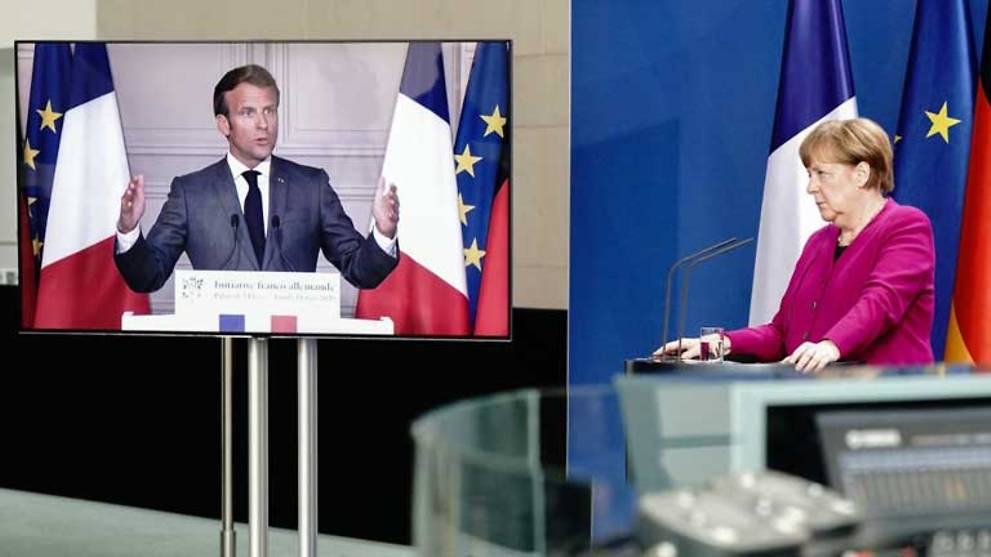
BERLIN: France and Germany proposed on Monday (May 18) a 500-billion-euro (US$545-billion) fund to finance the recovery of the European Union's economy from the devastation wrought by the coronavirus crisis.

Putting aside past differences and seeking to prove that the Franco-German core of Europe remains intact, President Emmanuel Macron and Chancellor Angela Merkel announced the unprecedented package after talks by video conference.

European Central Bank head Christine Lagarde told major European newspapers that "the Franco-German proposals are ambitious, targeted and welcome."

With the European economy facing its biggest challenge since World War II, Macron also acknowledged that the EU had fallen short in its initial response to the virus and needed to coordinate more closely on health.

Financed by "borrowing from the market in the name of the EU," the 500 billion euros will flow to the "worst-hit sectors and regions" in the 27-member bloc, the two countries said in a joint statement.

"We are convinced that it is not only fair but also necessary to now make available the funds ... that we will then gradually repay through several future European budgets," Merkel said.

Countries benefitting from the financing would not have to repay the money, Macron added, emphasising that the funds "were not loans."

The eurozone economy overall is forecast to contract by a whopping 7.7 per cent this year, with the damage set to be most severe in southern members like Italy and Greece.

St Peter's Basilica and the Acropolis in Athens opened their doors to visitors alongside many European shops, restaurants and churches, as Italy reported that its daily death toll from the virus had fallen below 100 for the first time since early March.

More than 4.7 million people have tested positive and 315,270 have been killed by the disease since it emerged in Wuhan late last year, according to an AFP tally. Recent days have seen soaring infections in Brazil, India and South Africa.

Battling against allegations from the United States and elsewhere that it concealed the scale of the problem, China vowed to back an independent inquiry into the handling of the coronavirus after it is "brought under control".

Chinese President Xi Jinping insisted during an address to the World Health Assembly - the WHO's decision-making body - that Beijing had been "transparent" throughout the crisis. Beijing also offered to share a vaccine once one became available.

READ: China's Xi says supports WHO probe, pledges US$2 billion to deal with COVID-19

But China's main critic US sharpened the tone at the same talks, accusing the WHO of being too close to Beijing.

US Secretary of State Mike Pompeo cited the move to include Taiwan in the UN health agency as a sop to Beijing, as he charged that China "continues to withhold vital information about the virus and its origins".

Amid the blame game, UN chief Antonio Guterres warned the virus' impact on the southern hemisphere could be "even more devastating" than in the global north.

READ: UN says COVID-19 is 'wake-up call' for the world

SOUTH AMERICA, AFRICA HIT HARD

In Asia, India extended its lockdown covering 1.3 billion people to the end of May as it reported its biggest single-day jump in infections on Sunday.

But natural catastrophe threatened to derail the plans to keep transmission at bay - with Cyclone Amphan barrelling towards India and Bangladesh at speeds of 240km per hour, two million people face evacuation.

READ: India evacuates thousands threatened by cyclone amid COVID-19 pandemic

In Latin America, Brazil now has the fourth-highest caseload in the world at 241,000 confirmed infections, and deaths have risen sharply in recent days.

Far-right President Jair Bolsonaro has blamed lockdowns for unnecessarily hurting the Brazilian economy. He has defied social distancing measures, even as experts and regional leaders have warned that the country's healthcare infrastructure could collapse.

Ecuador reported the first COVID-19 case in one of its indigenous Amazon tribes, deepening the crisis in one of South America's hardest-hit countries.

Nicaraguan hospital staff have said the country's health system is overwhelmed with patients suffering from respiratory illnesses.

Relatives have reported that the bodies of loved ones were being carted off in pick-up trucks for "express burials" without their consent.

"Mourners are forced to chase trucks with the coffin to find out where their loved ones are being buried," the opposition National Coalition said in a statement denouncing government secrecy.

There was also grim data in Africa, where the number of infections rose rapidly.

South Africa on Sunday reported 1,160 new coronavirus infections, the highest daily number since the first case was recorded in March, taking the total to 15,515 - the highest on the continent.

DEEP ECONOMIC PAIN

The coronavirus has also left the world economy facing its worst downturn since the Great Depression. Fresh evidence of the deep economic damage came when Japan announced its first recession since 2015.

The world's biggest economy is also going to suffer a massive downturn, US Federal Reserve chairman Jerome Powell warned.

"The data we'll see for this quarter, which ends in June, will be very, very bad. There'll be a big decline in economic activity, big increase in unemployment," Powell said.

Global markets were nevertheless buoyed by the Franco-German economic relaunch plan, lower death rates in some countries - and encouraging results from clinical trials of a potential vaccine by Moderna.

READ: US firm announces 'positive interim' phase 1 results for COVID-19 vaccine

The first stage trial provoked an immune response similar to people convalescing from the COVID-19 disease in eight recipients, according to the company. It has a larger phase 2 trial involving more patients due to begin soon.

'COURAGEOUS'

In a sign of solidarity, French President Emmanuel Macron and German Chancellor Angela Merkel proposed "borrowing from the market in the name of the EU" to fund 500 billion euros of spending on the 27-strong bloc's "worst-hit sectors and regions".

Countries benefiting from the financing would not have to repay the sum, said Macron.

"The aim is to ensure that Europe comes out of the crisis more cohesive and with more solidarity," said Merkel, calling the proposal "courageous".

If agreed with other EU members, the fund would break through the bloc's fiscal deadlock. Northern countries such as Germany have until now firmly rejected joint debt in the name of budget discipline.

But it immediately ran into resistance, with Austrian Chancellor Sebastian Kurz insisting that any help "has to be in the form of loans, not grants".

With infection numbers falling, Europe sought to pick up the pace on its exit from the lockdown.

READ: Restaurants and cafes reopen in parts of Europe, but no mad rush

In Venice, the gondolas returned to the waters again, even if the gondoliers wore gloves and masks. Locals welcomed the sight.

"It's good news, a sign of everyone's desire to get back to normal as soon as possible, but without ever lowering our guard in order to defeat the virus once and for all," said Giovanni Giusto, city councillor for the Protection of Traditions.

BOOKMARK THIS: Our comprehensive coverage of the coronavirus outbreak and its developments

Download our app or subscribe to our Telegram channel for the latest updates on the coronavirus outbreak: https://cna.asia/telegram​​​​​​​​​​​​​​

Let's block ads! (Why?)


https://news.google.com/__i/rss/rd/articles/CBMicGh0dHBzOi8vd3d3LmNoYW5uZWxuZXdzYXNpYS5jb20vbmV3cy93b3JsZC9jb3ZpZC0xOS1jb3JvbmF2aXJ1cy1tYWNyb24tbWVya2VsLTU0NWItcmVjb3ZlcnktcGxhbi1ldXJvcGUtMTI3NDczMjjSAQA?oc=5

2020-05-18 20:26:15Z
CBMicGh0dHBzOi8vd3d3LmNoYW5uZWxuZXdzYXNpYS5jb20vbmV3cy93b3JsZC9jb3ZpZC0xOS1jb3JvbmF2aXJ1cy1tYWNyb24tbWVya2VsLTU0NWItcmVjb3ZlcnktcGxhbi1ldXJvcGUtMTI3NDczMjjSAQA