WASHINGTON: The United States COVID-19 death toll rose to more than 40,000 on Sunday (Apr 19), the highest in the world and almost double the number of deaths in the next highest country Italy, according to a Reuters tally.
It took the US 38 days after recording its first fatality on Feb 29 to reach 10,000 deaths on Apr 6, but only five more days to reach 20,000 dead, according to a Reuters tally. The United States' toll increased to 40,000 from 30,000 in four days after including untested but probable COVID-19 deaths reported by New York City.
A refrigerated truck is seen outside Lenox Health Medical Pavilion during the outbreak of the coronavirus in New York City. REUTERS/Jeenah Moon
The United States has by far the world's largest number of confirmed coronavirus cases, with more than 750,000 infections - a number that has doubled in 13 days. New cases on Saturday rose by nearly 29,000, the lowest increase in three days.
More than 22 million Americans have filed for unemployment benefits in the past month as closures of businesses and schools and severe travel restrictions have hammered the economy.
Governors in US states hardest hit by the coronavirus sparred with President Donald Trump over his claims they have enough tests and should quickly reopen their economies as more protests are planned over the extension of stay-at-home orders.
Demonstrators begin to gather at a protest opposing Washington state's stay-home order to slow the coronavirus outbreak, in Olympia. (AP Photo/Elaine Thompson)
The regions of Maryland, Virginia and Washington DC are still seeing increasing cases. New Jersey reported on Sunday that its new cases rose by nearly 3,900, the most in more than two weeks. Boston and Chicago are also emerging hot spots with recent surges in cases and deaths.
Several states, including Ohio, Texas and Florida, have said they aim to reopen parts of their economies, perhaps by May 1 or even sooner, but appeared to be staying cautious.
NEW YORK: American families slammed by the coronavirus pandemic are turning more and more to food banks to get by, waiting hours for donations in lines of cars stretching as far as the eye can see.
And with 22 million people out of work seemingly overnight as business after business closes under the Great Lockdown, these charities feeding hungry and scared people fear the day will come when they cannot cope with the tsunami of demand.
On Tuesday (Apr 14), for instance, some 1,000 cars lined up at a distribution center set up in Pennsylvania by the Greater Pittsburgh Community Food Bank. Demand for its bags of food soared nearly 40 percent in March.
At eight centers like that one, some 227 tonnes of food were placed in the trunks of cars of families suddenly unable to put meals on the table, said the organization's vice president Brian Gulish.
"A lot of people are utilizing our service for the first time. They've never turned to a food bank before," said Gulish. So they do not know there is a network of 350 distribution points in southwest Pennsylvania.
"That's why those lines are so long. Because they don't know that network that we have," Gulish added.
All over America, from New Orleans to Detroit, people abruptly stripped of a paycheck are flocking to food banks - sad scenes of desperation among people waiting for their small share of stimulus money included in the US$2.2 trillion emergency relief package approved by Congress last month.
Perhaps the most dramatic picture of some Americans' new food insecurity unfolded April 9 in San Antonio, Texas, where a staggering 10,000 cars showed up at one food bank, with some families arriving the night before to just sit and wait.
National Guard soldiers prepare packages of food in Indiana AFP/Justin ANDRAS
"We have gone for months without work," a woman who gave her name only as Alana said at a food distribution center in Chelsea in suburban Boston.
"I find a lady yesterday with a 15-day-old baby, a newborn. The husband is not working, she has two more kids. She was having no food in her house," said Alana.
Everywhere, food bank officials say their needs in the pandemic era have skyrocketed all of a sudden - by 30 percent, for example, at a network in Akron, Ohio.
"We built a supply chain over the years that would serve a certain anticipated need for food. Ramping that up 30 percent overnight is nearly impossible," said Dan Flowers, CEO of the Akron-Canton Regional Foodbank.
In part this is because the food banks are caught up in the maelstrom that has hit the US food industry.
With restaurants closed because of the lockdown, Americans are stocking up on everything in grocery stores, which no longer can make as many product donations as they usually do. Ditto for restaurants that often donate surplus food to homeless shelters.
Fortunately, the US food industry is in fact making donations.
Food banks including 200 local branches of an organization called Feeding America are even getting special kinds of loads to hand out.
People line up at a food bank in Los Angeles AFP/Frederic J. BROWN
US food giant JM Smucker, maker of many well-known products such as Folgers coffee, is a regular donor and has sent extra pallets of food to banks in Ohio. And a distillery called Ugly Dog in Michigan dispatched a truckload of hand sanitizing gel made from residual alcohol and packed in pint bottles that normally hold booze, said Flowers.
"WORN OUT"
Cash donations are also coming in, ranging from anonymous people to the likes of Jeff Bezos, the world's richest person, who donated US$100 million to Feeding America.
"If it wasn't for that, these food banks would not be able to meet this demand," said Flowers.
The Food Bank For New York City, a major one in the Big Apple, is ordering higher volume than it normally does, said Zanita Tisdale, its director of member engagement.
"We know if we're going to go back in a week the cost may have increased significantly or the turnaround time for getting that product to our warehouse may have extended exponentially," she said.
As supply chains get more complex and the legions of desperate families grow, there is the issue of those manning the food banks, who are simply exhausted after weeks of toil.
"Our staff are worn out. They've been working so hard. We're all ready for this to end," said Flowers.
After a month of all this frenetic work, the food banks are holding up, at least for now. But the future - like for so much of the new world created by the pandemic - is uncertain.
"The supply is still good, but a month from now we don't know," said Gulish.
The relief plan passed by Congress includes US$850 million for food banks and Flowers says he expects that cash to start flowing in June.
"I think we'll get back on track then. I'm mostly concerned about the next six to eight weeks," said Flowers.
NEW YORK: American families slammed by the coronavirus pandemic are turning more and more to food banks to get by, waiting hours for donations in lines of cars stretching as far as the eye can see.
And with 22 million people out of work seemingly overnight as business after business closes under the Great Lockdown, these charities feeding hungry and scared people fear the day will come when they cannot cope with the tsunami of demand.
On Tuesday (Apr 14), for instance, some 1,000 cars lined up at a distribution center set up in Pennsylvania by the Greater Pittsburgh Community Food Bank. Demand for its bags of food soared nearly 40 percent in March.
At eight centers like that one, some 227 tonnes of food were placed in the trunks of cars of families suddenly unable to put meals on the table, said the organization's vice president Brian Gulish.
"A lot of people are utilizing our service for the first time. They've never turned to a food bank before," said Gulish. So they do not know there is a network of 350 distribution points in southwest Pennsylvania.
"That's why those lines are so long. Because they don't know that network that we have," Gulish added.
All over America, from New Orleans to Detroit, people abruptly stripped of a paycheck are flocking to food banks - sad scenes of desperation among people waiting for their small share of stimulus money included in the US$2.2 trillion emergency relief package approved by Congress last month.
Perhaps the most dramatic picture of some Americans' new food insecurity unfolded April 9 in San Antonio, Texas, where a staggering 10,000 cars showed up at one food bank, with some families arriving the night before to just sit and wait.
National Guard soldiers prepare packages of food in Indiana AFP/Justin ANDRAS
"We have gone for months without work," a woman who gave her name only as Alana said at a food distribution center in Chelsea in suburban Boston.
"I find a lady yesterday with a 15-day-old baby, a newborn. The husband is not working, she has two more kids. She was having no food in her house," said Alana.
Everywhere, food bank officials say their needs in the pandemic era have skyrocketed all of a sudden - by 30 percent, for example, at a network in Akron, Ohio.
"We built a supply chain over the years that would serve a certain anticipated need for food. Ramping that up 30 percent overnight is nearly impossible," said Dan Flowers, CEO of the Akron-Canton Regional Foodbank.
In part this is because the food banks are caught up in the maelstrom that has hit the US food industry.
With restaurants closed because of the lockdown, Americans are stocking up on everything in grocery stores, which no longer can make as many product donations as they usually do. Ditto for restaurants that often donate surplus food to homeless shelters.
Fortunately, the US food industry is in fact making donations.
Food banks including 200 local branches of an organization called Feeding America are even getting special kinds of loads to hand out.
People line up at a food bank in Los Angeles AFP/Frederic J. BROWN
US food giant JM Smucker, maker of many well-known products such as Folgers coffee, is a regular donor and has sent extra pallets of food to banks in Ohio. And a distillery called Ugly Dog in Michigan dispatched a truckload of hand sanitizing gel made from residual alcohol and packed in pint bottles that normally hold booze, said Flowers.
"WORN OUT"
Cash donations are also coming in, ranging from anonymous people to the likes of Jeff Bezos, the world's richest person, who donated US$100 million to Feeding America.
"If it wasn't for that, these food banks would not be able to meet this demand," said Flowers.
The Food Bank For New York City, a major one in the Big Apple, is ordering higher volume than it normally does, said Zanita Tisdale, its director of member engagement.
"We know if we're going to go back in a week the cost may have increased significantly or the turnaround time for getting that product to our warehouse may have extended exponentially," she said.
As supply chains get more complex and the legions of desperate families grow, there is the issue of those manning the food banks, who are simply exhausted after weeks of toil.
"Our staff are worn out. They've been working so hard. We're all ready for this to end," said Flowers.
After a month of all this frenetic work, the food banks are holding up, at least for now. But the future - like for so much of the new world created by the pandemic - is uncertain.
"The supply is still good, but a month from now we don't know," said Gulish.
The relief plan passed by Congress includes US$850 million for food banks and Flowers says he expects that cash to start flowing in June.
"I think we'll get back on track then. I'm mostly concerned about the next six to eight weeks," said Flowers.
NEW YORK: American families slammed by the coronavirus pandemic are turning more and more to food banks to get by, waiting hours for donations in lines of cars stretching as far as the eye can see.
And with 22 million people out of work seemingly overnight as business after business closes under the Great Lockdown, these charities feeding hungry and scared people fear the day will come when they cannot cope with the tsunami of demand.
On Tuesday (Apr 14), for instance, some 1,000 cars lined up at a distribution center set up in Pennsylvania by the Greater Pittsburgh Community Food Bank. Demand for its bags of food soared nearly 40 percent in March.
At eight centers like that one, some 227 tonnes of food were placed in the trunks of cars of families suddenly unable to put meals on the table, said the organization's vice president Brian Gulish.
"A lot of people are utilizing our service for the first time. They've never turned to a food bank before," said Gulish. So they do not know there is a network of 350 distribution points in southwest Pennsylvania.
"That's why those lines are so long. Because they don't know that network that we have," Gulish added.
All over America, from New Orleans to Detroit, people abruptly stripped of a paycheck are flocking to food banks - sad scenes of desperation among people waiting for their small share of stimulus money included in the US$2.2 trillion emergency relief package approved by Congress last month.
Perhaps the most dramatic picture of some Americans' new food insecurity unfolded April 9 in San Antonio, Texas, where a staggering 10,000 cars showed up at one food bank, with some families arriving the night before to just sit and wait.
National Guard soldiers prepare packages of food in Indiana AFP/Justin ANDRAS
"We have gone for months without work," a woman who gave her name only as Alana said at a food distribution center in Chelsea in suburban Boston.
"I find a lady yesterday with a 15-day-old baby, a newborn. The husband is not working, she has two more kids. She was having no food in her house," said Alana.
Everywhere, food bank officials say their needs in the pandemic era have skyrocketed all of a sudden - by 30 percent, for example, at a network in Akron, Ohio.
"We built a supply chain over the years that would serve a certain anticipated need for food. Ramping that up 30 percent overnight is nearly impossible," said Dan Flowers, CEO of the Akron-Canton Regional Foodbank.
In part this is because the food banks are caught up in the maelstrom that has hit the US food industry.
With restaurants closed because of the lockdown, Americans are stocking up on everything in grocery stores, which no longer can make as many product donations as they usually do. Ditto for restaurants that often donate surplus food to homeless shelters.
Fortunately, the US food industry is in fact making donations.
Food banks including 200 local branches of an organization called Feeding America are even getting special kinds of loads to hand out.
People line up at a food bank in Los Angeles AFP/Frederic J. BROWN
US food giant JM Smucker, maker of many well-known products such as Folgers coffee, is a regular donor and has sent extra pallets of food to banks in Ohio. And a distillery called Ugly Dog in Michigan dispatched a truckload of hand sanitizing gel made from residual alcohol and packed in pint bottles that normally hold booze, said Flowers.
"WORN OUT"
Cash donations are also coming in, ranging from anonymous people to the likes of Jeff Bezos, the world's richest person, who donated US$100 million to Feeding America.
"If it wasn't for that, these food banks would not be able to meet this demand," said Flowers.
The Food Bank For New York City, a major one in the Big Apple, is ordering higher volume than it normally does, said Zanita Tisdale, its director of member engagement.
"We know if we're going to go back in a week the cost may have increased significantly or the turnaround time for getting that product to our warehouse may have extended exponentially," she said.
As supply chains get more complex and the legions of desperate families grow, there is the issue of those manning the food banks, who are simply exhausted after weeks of toil.
"Our staff are worn out. They've been working so hard. We're all ready for this to end," said Flowers.
After a month of all this frenetic work, the food banks are holding up, at least for now. But the future - like for so much of the new world created by the pandemic - is uncertain.
"The supply is still good, but a month from now we don't know," said Gulish.
The relief plan passed by Congress includes US$850 million for food banks and Flowers says he expects that cash to start flowing in June.
"I think we'll get back on track then. I'm mostly concerned about the next six to eight weeks," said Flowers.
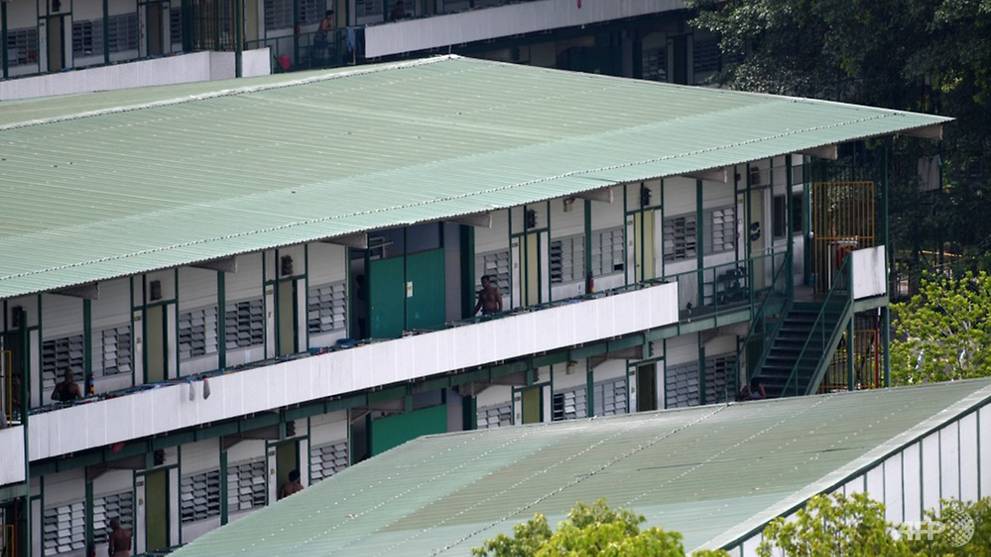
SINGAPORE: Singapore reported 596 new cases of COVID-19 on Sunday (Apr 19), bringing the total number of infections in the country to 6588.
Twenty-five were Singapore citizens or Permanent Residents, while the vast majority were work permit holders residing in foreign worker dormitories, the Ministry of Health (MOH) said in a press release announcing the preliminary numbers.
More details of the cases, and further updates will be shared through its press release later tonight, the ministry said.
In a clarification regarding Saturday's release, MOH said on its website that the COVID-19 daily update had included cases that were confirmed and verified after 12pm.
These cases had been included in the clusters case listing, the ministry said in a notice on its website.
"We have amended the listing to exclude them from the Annex of the 18 April press release," the ministry added.
Citing significant public interest, MOH has begun releasing the daily numbers earlier in the day, while sharing details on the cases at night.
CONSTRUCTION SECTOR WORKERS PLACED ON STAY-HOME NOTICE
The Ministry of Manpower announced on Saturday that all work permit holders and S Pass holders in the construction sector would be placed on mandatory stay-home notices.
While the recent rise in number of foreign workers infected with the coronavirus has mostly been concentrated in dormitories, there have been cases at construction worksites, MOM and the Building and Construction Authority (BCA) noted.
"Contact tracing suggests that transmissions at common construction worksites may have contributed to the increase in numbers," said MOM and BCA.
"Thus far, the cases detected among workers living outside the dormitories have been low. All those infected and their close contacts have been isolated."
Employers whose workers are affected by the latest stay-home notice are required to make arrangements for them such as providing food, and ensuring that their addresses and mobile phone numbers registered with MOM are up to date.
Sunday is day 13 of Singapore's month-long "circuit breaker" - a period with enhanced safe distancing measures in a bid to stem the spread of COVID-19. Most workplaces are closed and schools have transitioned to full home-based learning.
The Prime Minister said there are "a few early signs" that the circuit breaker is bringing down local cases in the broader community.
"But we are still worried about hidden cases circulating in our population, which are keeping the outbreak going," he added.
"The next few days will be critical. All of us must do our part, in order to defeat COVID-19."
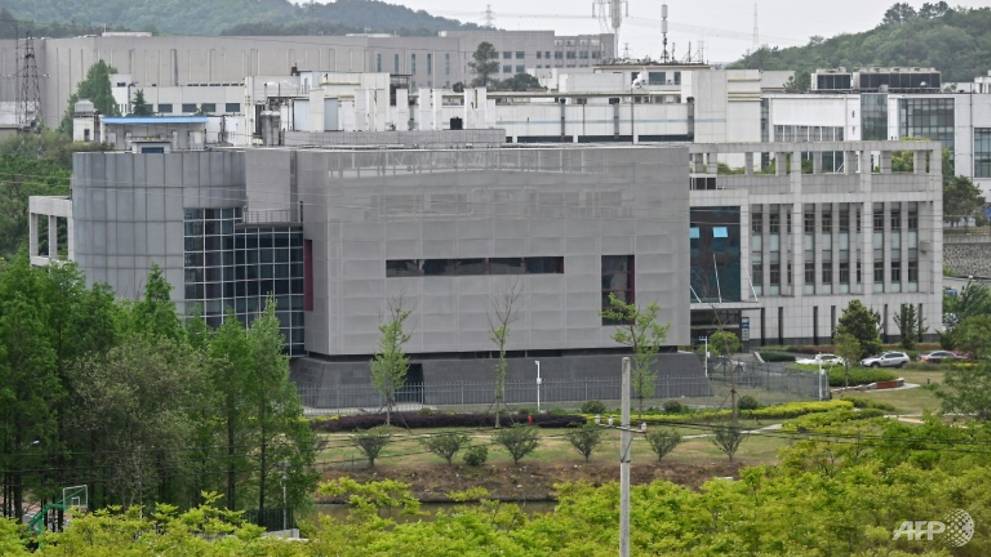
BEIJING: The director of a maximum-security laboratory in China's coronavirus ground-zero city of Wuhan has rejected claims that it could be the source of the outbreak, calling it "impossible".
Beijing has come under increasing pressure over transparency in its handling of the pandemic, with the US probing whether the virus actually originated in a virology institute with a high-security biosafety laboratory.
Chinese scientists have said the virus likely jumped from an animal to humans in a market that sold wildlife.
But the existence of the facility has fuelled conspiracy theories that the germ spread from the Wuhan Institute of Virology, specifically its P4 laboratory which is equipped to handle dangerous viruses.
In an interview with state media published Saturday Yuan Zhiming, director of the laboratory, said that "there's no way this virus came from us".
None of his staff had been infected, he told the English-language state broadcaster CGTN, adding the "whole institute is carrying out research in different areas related to the coronavirus".
The institute had already dismissed the theory in February, saying it had shared information about the pathogen with the World Health Organization in early January.
But this week the United States has brought the rumours into the mainstream, with Secretary of State Mike Pompeo saying US officials are doing a "full investigation" into how the virus "got out into the world".
When asked if the research suggested the virus could have come from the institute, Yuan said: "I know it's impossible."
"As people who carry out viral studies we clearly know what kind of research is going on at the institute and how the institute manages viruses and samples," he said.
He said that because the P4 laboratory is in Wuhan "people can't help but make associations", but that some media outlets are "deliberately trying to mislead people".
Reports in the Washington Post and Fox News have both quoted anonymous sources who voiced concern that the virus may have come - accidentally - from the facility.
Yuan said the reports were "entirely based on speculation" without "evidence or knowledge".
Authorities in Wuhan initially tried to cover up the outbreak and there have been questions about the official tally of infections with the government repeatedly changing its counting criteria at the peak of the outbreak.
This week authorities in the city admitted mistakes in counting its death toll and abruptly raised the figure by 50 per cent.
WASHINGTON (REUTERS) - US President Donald Trump said on Saturday (April 18) that China should face unspecified consequences if it was "knowingly responsible" for the coronavirus pandemic.
“If it was a mistake, a mistake is a mistake. But if they were knowingly responsible, yeah, I mean, then sure there should be consequences,” Trump told reporters at a daily briefing. He did not elaborate on what actions the United States might take.
Trump and senior aides have sharply criticised China for a lack of transparency after the coronavirus broke out in its Wuhan province. Last week he suspended aid to the World Health Organisation accusing it of being “China-centric.”
Washington and Beijing, the world’s two biggest economies, have publicly sparred over the virus repeatedly.
Trump initially praised China’s response to the outbreak, but he and other senior officials have also referred to it as the “Chinese virus” and in recent days have ratcheted up their rhetoric.
They have also angrily rejected earlier attempts by some Chinese officials to blame the origin of the virus on the US military.
Trump’s domestic critics say that while China performed badly at the outset and must still come clean on what happened, he is now seeking to use Beijing to help deflect from the shortcomings of his own response and take advantage of growing anti-China sentiment among some voters for his 2020 re-election bid.
At the same time, however, White House officials are mindful of the potential backlash if tensions get too heated. The United States is heavily reliant on China for personal protection equipment desperately needed by American medical workers, and Trump also wants to keep a hard-won trade deal on track.
Trump said the US-China relationship was good “until they did this,” citing a recent first-phase agricultural deal aimed at quelling a trade war between the two countries. “But then all of a sudden you hear about this,” he said.
He said the Chinese were “embarrassed” and the question now was whether what happened with the coronavirus was “a mistake that got out of control, or was it done deliberately?” “There’s a big difference between those two,” he said.
WUHAN LAB
Trump also raised questions about a Wuhan virology laboratory that Fox News this week reported had likely developed the coronavirus as part of China’s effort to demonstrate its capacity to identify and combat viruses.
Trump has said his government is seeking to determine whether the virus emanated from a Chinese lab.
As far back as February, the Chinese state-backed Wuhan Institute of Virology dismissed rumours that the virus may have been artificially synthesised at one of its labs or perhaps escaped from such a facility.
Wandering off the topic of the coronavirus, Trump also used the White House briefing to take a swipe at presumed Democratic presidential nominee Joe Biden and his long record on China as a senator and former vice president.
While stressing his own confrontational trade policies toward China, Trump, using his nickname “Sleepy Joe” for his rival, said if Biden wins the White House that China and other countries “will take our country.”
Trump also again cast doubt on China’s death toll, which was revised up on Friday. China said 1,300 people who died of the coronavirus in Wuhan – half the total – were not counted, but has dismissed allegations of a cover-up.
The United States has by far the world’s largest number of confirmed coronavirus cases, with more than 720,000 infections and over 37,000 deaths.
Even Dr. Deborah Birx, coordinator of the White House coronavirus task force who has steered clear of political aspects of Trump’s contentions briefings, questioned China’s data.
Showing on a chart that China’s death rate per 100,000 people was far below major European countries and the United States, she called China’s numbers “unrealistic” and said it had a “moral obligation” to provide credible information.