Senin, 16 Maret 2020

Spain goes into lockdown as first lady tests positive for coronavirus - CNN

The Spanish capital, like the rest of the country, is now on partial lockdown in an attempt to stem the worst coronavirus outbreak in Europe after Italy.
Spain's recorded cases of the virus surged by 1,400 overnight, to a total of 9,190, with 309 deaths, its Health Ministry said. Meanwhile Italy has over 24,000 cases and more than 1,800 deaths, according to the World Health Organization.
The country's land borders were closed Monday, Interior Minister Fernando Grande-Marlaska announced. The closure does not include Spanish nationals and residents, workers required to cross the border, and the transport of goods.
Some 47 million Spanish residents have been banned from leaving their homes -- with the exception of those going to work, buying food, going to a hospital, or supporting an elderly person or child in their care.
A member of the Spanish Military Emergency Unit (UME) stands guard near Madrid's Atocha train station on Sunday.
Priests in the deeply Catholic country are celebrating Mass alone, with services shown only on TV or via social media. Restaurants and bars have been closed. And cultural sites like the Prado Museum and Royal Palace in Madrid are also shut, as part of the tough measures announced by Spanish Prime Minister Pedro Sanchez on Saturday.
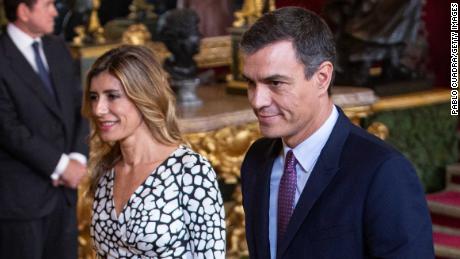
The same day, the government announced that the prime minister's wife, Maria Begona Gomez Fernandez, had tested positive for the virus. The couple are both "well" and following preventative measures at their official residence, La Moncloa Palace in Madrid, the statement added.
Spanish Prime Minister Pedro Sanchez and his wife Maria Begona Gomez Fernandez in October last year.
Spain's 15-day state of emergency comes after school closures were announced last week.
Tougher measures are expected to follow after the health ministry identified a 25% daily increase in the number of cases, its emergencies coordinator, Fernando Simon, said Monday.

Metro falls silent but commuter trains packed

Around half of the cases reported in the country so far have been in Madrid, where the region's president, Isabel Diaz Ayuso, has also tested positive for the virus, officials said.
Streets and metro stations in the capital remain all but empty. Madrid's Metro posted CCTV images of deserted platforms Monday morning, adding that it had seen 75% fewer commuters than during rush hour last week.
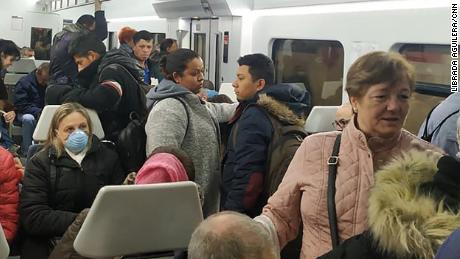
It was a different story on the trains however, which passengers from out of town rely on to get into the city. At the central Atocha train station, commuters lined the platform and many told CNN that safe distances were not being maintained on board.
Commuters on a busy train at Madrid's Atocha train station.
"It's shameful," passenger Librada Aguilera told CNN. "There are fewer trains which means they are very full. I had to travel with people all around me, very close."
"What is the point of me being at home all weekend if I am going to have to travel like this today?" she asked, adding that a "safe distance" was not being implemented.
"I can't work from home, so I don't have another option but to travel like this," she said.
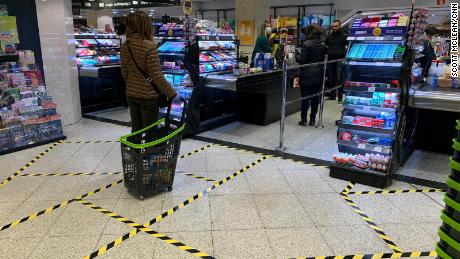
Elsewhere in the city, some supermarkets were going to extremes to stop customers standing too close to one another, by taping markings on the ground.
Supermarkets were largely empty on Monday, with cashiers changing their gloves and disinfecting conveyor belts after every every customer, CNN reporters found.
At a supermarket in central Madrid, lines taped on the ground indicate how far apart customers should stand.
"Most Spaniards are compliant" with the restrictions, one police officer patrolling the streets of Madrid told CNN. "Though they are taking far too much time to walk the dog or shop for food," he said, adding that this was "a trick" to stay outside for longer.
To get people off the streets, police can issue fines starting at $100. But the officer admitted that "fines won't solve this."
"We all have to do this in solidarity, knowing that everyone is staying at home," he said.
Some hotels have offered up their beds to help ease the strain on hospitals. On Monday, the country's Parachute Brigade delivered 45 hotel beds in army trucks to Alcalá de Henares in Madrid.
Elsewhere, high-profile budget airlines Ryanair and Easyjet announced on Sunday they would be canceling and reducing flights to and from Spain.
The previous day, at least five Jet2 flights from the United Kingdom to Malaga and Alicante in Spain turned around in mid-air over coronavirus fears.

Let's block ads! (Why?)


https://news.google.com/__i/rss/rd/articles/CBMiUGh0dHBzOi8vd3d3LmNubi5jb20vMjAyMC8wMy8xNi9ldXJvcGUvc3BhaW4tY29yb25hdmlydXMtbG9ja2Rvd24taW50bC9pbmRleC5odG1s0gFUaHR0cHM6Ly9hbXAuY25uLmNvbS9jbm4vMjAyMC8wMy8xNi9ldXJvcGUvc3BhaW4tY29yb25hdmlydXMtbG9ja2Rvd24taW50bC9pbmRleC5odG1s?oc=5

2020-03-16 17:06:35Z
CAIiENHhRJKSOJkwRlbmYJYTkFoqGQgEKhAIACoHCAowocv1CjCSptoCMPrTpgU

Life In Rome Under Coronavirus Lockdown - NPR

In normal times the pubs and cafes of Piazza Trilussa are the heart of Roman nightlife. Now all is shuttered; the rental bike stand is full and the only sound is the waterfall in the fountain. Sylvia Poggioli/NPR hide caption

toggle caption
Sylvia Poggioli/NPR

It has been less than a week since, along with 60 million Italians, I was put under a government-ordered quarantine to try to curb the spread of Italy's coronavirus outbreak, the worst outside Asia. The new slogan is #iostoacasa — I'm staying home.

Overnight, life across the country has been turned upside down. Even for someone who has reported from war zones and experienced three months of NATO bombing in the Balkans, it's unnerving. I'm constantly wary. Of what? Who knows. Something is lurking around me and I don't know what it is. I wash my hands constantly — but I haven't been out all day and haven't seen anyone.

Life in Italy's COVID-19 red zone is like being suspended between the Dark Ages and a sci-fi future.

Here in Rome, all of a sudden the city's usual chaotic, horn-honking soundtrack has been transformed. With hardly any traffic, you can actually hear the squeak of rusty door hinges. The chirping of birds, an early sign of spring, is almost too loud.

The lockdown measures are strictly enforced. All restaurants, cafes, pubs, retail stores, cinemas, theaters, museums — you name it — are shut down until at least March 25.

The only exceptions are grocery stores, pharmacies and newsstands. The government wants to ensure all citizens have access to information, and many older Italians still prefer newsprint to small screens.

With Roman Catholic Mass banned, the bells of the Basilica di Santa Maria in Trastevere chimed for 10 minutes Saturday at 8 p.m., in a sign of solidarity and prayer for all suffering from the coronavirus. Sylvia Poggioli/NPR hide caption

toggle caption
Sylvia Poggioli/NPR

Everyone who ventures out has to carry a police form, downloadable from the Ministry of Interior website, in which you have to "self-certify" why you are out. The only purposes allowed are shopping for food and medicines, health reasons, emergencies, work or returning home. Violators face three months in jail or a fine of about $230.

I live in Trastevere, in the heart of old Rome, not far from Piazza Trilussa. The square is known for its lively nightlife, and it's usually full of people 24/7.

Not anymore. Every single storefront is shuttered. The bike rental stand is full. The only sound is the waterfall in the large fountain that dominates the square.

There is some human activity nearby, in the Frutteria Er Cimotto, a high-end fresh produce shop. As I walk in, Federico Seracchiani is bagging artichokes for a lone customer. I ask him what it feels like here now.

"This neighborhood was always packed with young people, now nobody! It's totally surreal, feels like another world," he says. "The lockdown was the only solution, even if it is drastic. I think it'll work. At least I hope so."

In fact, some polls have indicated that more than 60% of Italians approve of the government lockdown decision.

As I continue to meander through my neighborhood, it seems the only inhabitants these days, along with birds, are cats and ghosts. Walking on these centuries-old cobblestones, it's hard not to think they've seen this before. It was here, along the Tiber River, that a plague broke out in 1656 that claimed more than 14,000 lives.

In normal times, visitors to Rome tell me how struck they are by the near absence of police and the abundance of priests. Suddenly, the priests have disappeared and cops are everywhere — roaming streets, making random checks that people are carrying their "self-certification" form.

I'm prepared. If I'm stopped by police, I'll tell them I'm a reporter and I'm out to report. As it happened, at noon Friday, the only person I ran into was another journalist, Marina Garbesi.

What's scary about the virus, she told me, is the enemy is invisible.

"It's like a shark swimming very far below the surface, very dangerous. We should keep this metaphor in mind," she said.

I asked her how Italians are handling the quarantine.

"Italians do not respect rules. That's not a stereotype, it's the truth," she replied. "But they know how to handle situations of great danger because they have a sense of community — even in big cities, people help each other out."

Those who need spiritual help, though, are out of luck. Roman Catholic Masses are suspended, as are weddings and funerals. But lo, this is the era of the blessed cellphone — some priests are celebrating Mass on WhatsApp.

And some of Rome's churches are still sending out messages the old way. At 8 p.m. Saturday, the bells of all the churches in Trastevere rang out for 10 minutes in a sign of closeness, solidarity and prayer for all those suffering from the consequences of the virus.

To record those bells, I had to venture out in the dark. I wondered: Should a cop stop me, would the Roman officer consider recording church bells a legitimate form of work? I doubt it.

But I went into the unknown anyway. The only sounds of the night were ambulance sirens in the distance, and all that moved were police cars with flashing blue lights.

My street is poorly lit, which for once served my purpose. I encountered no one as I moved furtively along the walls and in the shadows to Piazza Santa Maria in Trastevere, were I hid in an alley behind a potted plant until 8 p.m. When I returned home, I had one of the best church bell recordings I've ever made. But I also felt as if I had violated what truly feels like a wartime curfew.

While churchgoers may be consoled with the chiming of bells, more secular Italians have found a different way to exorcise the coronavirus demon. Many homes display banners with pictures of rainbows and the words of another new slogan, andrĂ  tutto bene — everything will be OK.

And there's been an eruption of musical flash mobs from windows and balconies, as neighbors join in song — the national anthem, pop, opera and tarantellas.

Even if homebound, Italians are reacting — at least so far — with a characteristic sense of humor, brio and musical flair.

Let's block ads! (Why?)


https://news.google.com/__i/rss/rd/articles/CBMiW2h0dHBzOi8vd3d3Lm5wci5vcmcvMjAyMC8wMy8xNi84MTYwODAyNjMvcmVwb3J0ZXJzLW5vdGVib29rLXJvbWUtdW5kZXItY29yb25hdmlydXMtbG9ja2Rvd27SAQA?oc=5

2020-03-16 16:26:42Z
52780667648184

Amid coronavirus fears, Israel's Benjamin Netanyahu sees an opening - CNN

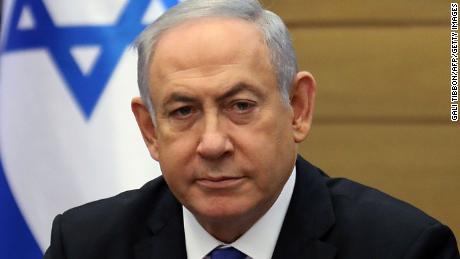
Netanyahu has called for a national emergency government, consisting of all of the parties in the Knesset -- except the Arab parties -- to deal with the impact of the coronavirus. "In light of the world and national crisis, we have to unite our strength and form a strong and stable government that can pass a budget and take tough decisions," he said in a statement Sunday.
Live updates: Coronavirus deaths pass 6,500 worldwide
But he never included the Joint List of Arab parties, accusing them repeatedly of supporting terror in keeping up with his campaign strategy of attacking the political factions that represent some 20% of the country's population.
He suffered a significant political setback on Sunday evening, when Israel's President announced that Netanyahu's main opponent, Blue and White leader Benny Gantz, had received enough support from lawmakers to get first crack at forming a new government. But Netanyahu continues to insist it is he, and not his inexperienced rival, who should be leading the country through the crisis.
Netanyahu's supporters see him as uniquely qualified to lead the country in this time of need. The longest serving prime minister in Israel's history has guided the country through several wars, dealt with dozens of world leaders, and largely become the face of Israel. To them, the coronavirus is one more challenge Netanyahu is sure to overcome.
His critics see things differently. They believe he is using a national emergency for his own political ends. Having failed to secure a governing majority after three straight elections, Netanyahu is now trying to leverage the coronavirus to post facto build a government, they argue.

Emergency government calls

On Sunday morning, citing the pandemic, Netanyahu suggested the formation of an immediate emergency government for six months, or a unity government which he would lead for two years, after which rival Benny Gantz would take over as Prime Minister.
Ben Caspit, author of The Netanyahu Years and a frequent critic of the Prime Minister, viewed Netanyahu's calls for unity with utmost skepticism. "It's impossible to disconnect his call for an 'emergency government' or a 'unity government' from the fact that he failed once again to muster a majority in the Knesset," wrote Caspit in Sunday's Ma'ariv newspaper. "This situation is without precedent: a prime minister who has thrice been unsuccessful in his bid to get reelected, who last received the public's confidence back in 2015, but who refuses to hand over the reins and who has been exploiting a national crisis to retain his grip on power."
Israel's Netanyahu indicted in corruption cases, hours before Mideast peace plan announced
There was no mention in Netanyahu's statements of his upcoming criminal trial on charges of bribery and fraud and breach of trust, a crucial sticking point since Gantz and his Blue and White party have refused to serve under a Prime Minister who has been indicted.
Originally scheduled to begin on Tuesday, the trial has now been delayed for more than two months after the Justice Minister, considered one of those closest to Netanyahu, declared a 24-hour "state of emergency" in the court system to deal with the spread of coronavirus. Within hours, the three judges appointed to preside over the Prime Minister's case had moved to postpone the trial opening until May 24th.
The coronavirus had done what Netanyahu's high-powered legal team could not -- delay the start of the trial and give him more time to lead the country.
Netanyahu's former Defense Minister, Moshe Ya'alon, who is now one of the top members of Gantz's Blue and White, tweeted on Saturday: "Anyone who criticized us when we warned of the dangers of Israel becoming like Erdogan's Turkey should think carefully about the cynical exploitation of the coronavirus crisis, for personal political needs, by a defendant facing trial."
There is no doubt that Israel is in a state of emergency because of the coronavirus, that will affect the economy, the military, the government, and the people. On the face of it, a unity government made up of the biggest parties might well offer the sort of strong and stable option that mainstream Israel is looking for in these trying times. Much less certain is how to get there.
Over the weekend, Gantz and Netanyahu were still trading barbs. On Sunday evening, Netanyahu accused Blue and White of "lying to its voters" because of its willingness to form a government with the support of the Arab parties. Last week, he tweeted that such a government would be a "disaster for Israel."
Gantz was just as acerbic. "Netanyahu, let's not manipulate the public," he said on Twitter. "If you're interested in unity, why postpone your trial at 1 a.m. and send an 'emergency unity' outline to the press, rather than sending your negotiating team to a meeting. As opposed to you, I will continue to support every appropriate governmental measure, leaving political considerations aside. When you get serious, we can talk."
In 2008, as corruption investigations were closing in on then-Prime Minister Ehud Olmert, Netanyahu said, "A prime minister steeped up to his neck in investigations doesn't have a moral or public mandate to make such fateful decisions regarding the state of Israel." Then the leader of the opposition, Netanyahu called on Olmert to resign, which he did a short time later.
Netanyahu now finds himself staring down his own words, as his critics call on him to heed his past advice.

Let's block ads! (Why?)


https://news.google.com/__i/rss/rd/articles/CBMiX2h0dHBzOi8vd3d3LmNubi5jb20vMjAyMC8wMy8xNi9taWRkbGVlYXN0L2lzcmFlbC1wb2xpdGljcy1uZXRhbnlhaHUtY29yb25hdmlydXMtaW50bC9pbmRleC5odG1s0gFjaHR0cHM6Ly9hbXAuY25uLmNvbS9jbm4vMjAyMC8wMy8xNi9taWRkbGVlYXN0L2lzcmFlbC1wb2xpdGljcy1uZXRhbnlhaHUtY29yb25hdmlydXMtaW50bC9pbmRleC5odG1s?oc=5

2020-03-16 15:45:00Z
52780663980393

Global Deaths From Coronavirus Surpass 6,000 : Goats and Soda - NPR

A girl and her dog look out from a window Sunday during one of the many flash mobs taking place in Rome. The nationwide lockdown to slow the coronavirus is still in its early days for much of Italy, but Italians are already showing signs of solidarity. Alessandra Tarantino/AP hide caption

toggle caption
Alessandra Tarantino/AP

With the number of cases worldwide from the novel coronavirus surpassing 150,000, with some 6,000 deaths, governments across the globe continued their struggle to contain the pandemic. Their hope is to limit the number of new infections, while treating those individuals suffering from COVID-19 and isolating others whose symptoms are not as severe but who might spread the disease.

Here's a snapshot by region of what is happening as of Monday morning:

Europe

The head of the World Health Organization, Tedros Adhanom Ghebreyesus, said over the weekend that Europe had become the new epicenter of the pandemic after it peaked earlier in Asia.

"More cases are now being reported [in Europe] every day than were reported in China at the height of its epidemic," Tedros, the organization's director, said at a news conference at the WHO's Geneva headquarters.

Officials in Italy have reported some 3,600 new cases and 368 deaths in the past 24 hours, bringing the total number of infections there to nearly 25,000 and some 1,800 deaths. Italy is second in the number of reported infections and deaths only to China, where the epidemic was first identified in December.

Italian officials have expressed concern that the surge in infections has pushed the country's health system to the saturation point, according to NPR's Sylvia Poggioli. Health authorities say there is a severe lack of intensive care unit beds, ventilators and protective masks to treat the huge influx.

"It's not a wave, it's a tsunami," Dr. Robert Rona, who is in charge of intensive care at Monza hospital outside Milan, told The Associated Press.

The disease first appeared in Lombardy, the region that is home to Milan, a metropolis of 3 million people that is Italy's economic powerhouse. It started in a cluster of small-to-medium-size towns in the region and Poggioli reports that "everything is being done to prevent a surge in cases in Milan."

Spain, where the government formally declared a state of emergency over the weekend, ordered a lockdown — requiring people to stay home to foster social distancing and for all nonessential shops to close, along with restaurants, bars, cafes and movie theaters.

In Spain, the total number of confirmed infections now exceeds 7,800 cases with 282 deaths.

Following a lengthy briefing on Saturday, Spain's Prime Minister Pedro Sánchez, whose wife has tested positive for the virus, said "extraordinary" decisions were required to combat the disease.

"From now, we enter a new phase," he said. "We won't hesitate in doing what we need [to do] to beat the virus."

"During the state of emergency, people will only be allowed out on to public streets for the following reasons: to buy food, basic or pharmaceutical items; to attend medical centers; to go to and from work; to look after children, older people or those with disabilities or who are especially vulnerable; and to attend financial or insurance offices on force majeure grounds," Sánchez said, according to The Guardian newspaper.

In a gesture of gratitude for doctors, nurses and other medical workers who work in Spain's national health system, people went to their balconies all over the country at 10 p.m. local time to applaud in unison.

In France, municipal elections went ahead as planned on Sunday under what officials said were tight sanitary restrictions, including "safe spacing" of voters as they queued and providing hand sanitizer. There have been nearly 5,500 total confirmed cases in France, with 127 deaths from COVID-19. Despite assurances that the polling was safe, the Interior Ministry on Sunday reported turnout was just 18.3%, down 5% from elections six years ago.

France has already ordered a lockdown similar to the one Italy and Spain have imposed.

In the United Kingdom, where nearly 1,400 cases have been confirmed so far with 35 deaths from the coronavirus disease, no lockdown has been ordered.

However, the government is expected to lay out emergency measures this week, including requiring people 70 years and older to self-isolate for as long as four months.

Last week, the government of Prime Minister Boris Johnson signaled that it might be considering a different approach to the rest of the world — in essence, allowing a large percentage of the population to become infected, creating a "herd immunity" that would eventually stamp out the epidemic.

But public backlash to that suggestion, which would result in tens of millions of Britons becoming infected with the virus, forced the government to backtrack.

"We will do the right thing at the right time, based on the best available science," Health Secretary Matt Hancock wrote in an opinion piece that appeared in The Telegraph over the weekend. "Herd immunity is not our goal or policy, it's a scientific concept."

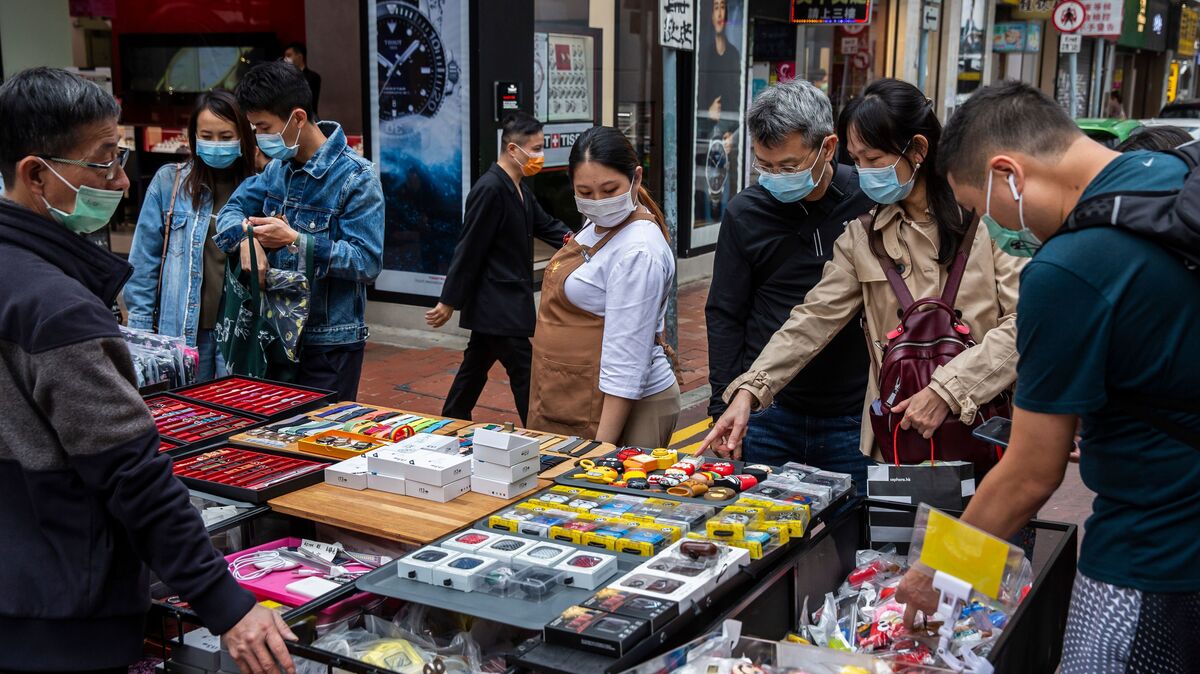
People wearing face masks as a precautionary measure against the novel coronavirus look at electronic accessories for sale from a street vendor in the Causeway Bay district of Hong Kong on Sunday. Isaac Lawrence/AFP via Getty Images hide caption

toggle caption
Isaac Lawrence/AFP via Getty Images

Nearly 4,000 cases and more than 700 deaths have been reported in Germany and some 1,400 infections and more than 230 deaths in Switzerland. Hundreds of cases and scores of deaths have been reported also in the Netherlands, Sweden, Norway, Denmark, Austria, Belgium and Greece.

Asia

New cases in China, where the epidemic began, have been decreasing steadily in recent weeks, with just 27 new cases reported in the WHO's latest situation report, which is updated every 24 hours. It is a long way from the peak of the crisis in China about a month ago, when Beijing reported more than 14,000 new infections in a single day. A total of about 81,000 cases have been reported there since December.

In recent days, the country has begun shifting its efforts from the internal spread of the virus to keeping new cases from abroad from entering.

The number of new cases is also in decline in South Korea and Japan — two countries that were hard hit as the infection spilled over from China in the early days of the epidemic. Seoul reported 76 new cases and Japan 64, according to WHO.

Although government officials have refrained from critiquing the rest of the world's response to the pandemic, some hospital officials haven't been as reticent.

Zhang Wenhong, director of the infectious diseases department at Shanghai Huashan Hospital affiliated with Fudan University, wrote on the hospital's social media account: "We had thought the world would synchronise controls with those taken in China – in the way that Singapore, Japan and South Korea have done."

"But Europe has become the new epicentre and brought us huge uncertainties," he wrote, according to the South China Morning Post.

Indonesia, a country whose health minister said last week was free of coronavirus, attributing its good fortune to prayer, now reports nearly 120 cases and nearly 50 deaths.

Middle East

In Iran, where the epidemic has infected some 14,000 people by official accounts, a 78-year-old member of the clerical body that chooses the country's supreme leader has reportedly died from COVID-19. The virus has killed some 700 people in Iran, but suspicions about the government's assessment of the epidemic within its borders has led some to question the official statistics as understated.

Elsewhere in the region, Qatar has reported more than 300 cases and 75 deaths; Bahrain more than 200 with one reported death; and Kuwait says it has more than 100 confirmed cases with 12 deaths.

A number of cases have been reported in a dozen other countries in the Eastern Mediterranean.

Canada and Latin America

In Canada, where last week Prime Minister Justin Trudeau announced that he and his family would self-isolate after his wife, Sophie Grégoire Trudeau, tested positive for coronavirus, there have been nearly 250 cases with 68 deaths.

Last week, the press secretary to Brazilian President Jair Bolsanaro tested positive for the virus after having met with President Trump at the Mar-a-Lago resort in Florida. More than 120 cases have been reported in Brazil according to the latest WHO report, with 23 deaths from the virus.

Africa

The continent of Africa, which faced the brunt of the 2014 Ebola outbreak, appears thus far to have been largely spared from COVID-19. According to the WHO, South Africa has had 38 cases, with 21 deaths from the virus, while Algeria has had 37 confirmed cases and Senegal 21, with each of those countries reporting 11 deaths.

Let's block ads! (Why?)


https://news.google.com/__i/rss/rd/articles/CBMia2h0dHBzOi8vd3d3Lm5wci5vcmcvc2VjdGlvbnMvZ29hdHNhbmRzb2RhLzIwMjAvMDMvMTYvODE2MzA5MjMyL2dsb2JhbC1kZWF0aHMtZnJvbS1jb3JvbmF2aXJ1cy1zdXJwYXNzLTYtMDAw0gEA?oc=5

2020-03-16 14:38:47Z
52780668539260

Amid coronavirus fears, Israel's Benjamin Netanyahu sees an opening - CNN

Netanyahu has called for a national emergency government, consisting of all of the parties in the Knesset -- except the Arab parties -- to deal with the impact of the coronavirus. "In light of the world and national crisis, we have to unite our strength and form a strong and stable government that can pass a budget and take tough decisions," he said in a statement Sunday.
Live updates: Coronavirus deaths pass 6,500 worldwide
But he never included the Joint List of Arab parties, accusing them repeatedly of supporting terror in keeping up with his campaign strategy of attacking the political factions that represent some 20% of the country's population.
He suffered a significant political setback on Sunday evening, when Israel's President announced that Netanyahu's main opponent, Blue and White leader Benny Gantz, had received enough support from lawmakers to get first crack at forming a new government. But Netanyahu continues to insist it is he, and not his inexperienced rival, who should be leading the country through the crisis.
Netanyahu's supporters see him as uniquely qualified to lead the country in this time of need. The longest serving prime minister in Israel's history has guided the country through several wars, dealt with dozens of world leaders, and largely become the face of Israel. To them, the coronavirus is one more challenge Netanyahu is sure to overcome.
His critics see things differently. They believe he is using a national emergency for his own political ends. Having failed to secure a governing majority after three straight elections, Netanyahu is now trying to leverage the coronavirus to post facto build a government, they argue.

Emergency government calls

On Sunday morning, citing the pandemic, Netanyahu suggested the formation of an immediate emergency government for six months, or a unity government which he would lead for two years, after which rival Benny Gantz would take over as Prime Minister.
Ben Caspit, author of The Netanyahu Years and a frequent critic of the Prime Minister, viewed Netanyahu's calls for unity with utmost skepticism. "It's impossible to disconnect his call for an 'emergency government' or a 'unity government' from the fact that he failed once again to muster a majority in the Knesset," wrote Caspit in Sunday's Ma'ariv newspaper. "This situation is without precedent: a prime minister who has thrice been unsuccessful in his bid to get reelected, who last received the public's confidence back in 2015, but who refuses to hand over the reins and who has been exploiting a national crisis to retain his grip on power."
Israel's Netanyahu indicted in corruption cases, hours before Mideast peace plan announced
There was no mention in Netanyahu's statements of his upcoming criminal trial on charges of bribery and fraud and breach of trust, a crucial sticking point since Gantz and his Blue and White party have refused to serve under a Prime Minister who has been indicted.
Originally scheduled to begin on Tuesday, the trial has now been delayed for more than two months after the Justice Minister, considered one of those closest to Netanyahu, declared a 24-hour "state of emergency" in the court system to deal with the spread of coronavirus. Within hours, the three judges appointed to preside over the Prime Minister's case had moved to postpone the trial opening until May 24th.
The coronavirus had done what Netanyahu's high-powered legal team could not -- delay the start of the trial and give him more time to lead the country.
Netanyahu's former Defense Minister, Moshe Ya'alon, who is now one of the top members of Gantz's Blue and White, tweeted on Saturday: "Anyone who criticized us when we warned of the dangers of Israel becoming like Erdogan's Turkey should think carefully about the cynical exploitation of the coronavirus crisis, for personal political needs, by a defendant facing trial."
There is no doubt that Israel is in a state of emergency because of the coronavirus, that will affect the economy, the military, the government, and the people. On the face of it, a unity government made up of the biggest parties might well offer the sort of strong and stable option that mainstream Israel is looking for in these trying times. Much less certain is how to get there.
Over the weekend, Gantz and Netanyahu were still trading barbs. On Sunday evening, Netanyahu accused Blue and White of "lying to its voters" because of its willingness to form a government with the support of the Arab parties. Last week, he tweeted that such a government would be a "disaster for Israel."
Gantz was just as acerbic. "Netanyahu, let's not manipulate the public," he said on Twitter. "If you're interested in unity, why postpone your trial at 1 a.m. and send an 'emergency unity' outline to the press, rather than sending your negotiating team to a meeting. As opposed to you, I will continue to support every appropriate governmental measure, leaving political considerations aside. When you get serious, we can talk."
In 2008, as corruption investigations were closing in on then-Prime Minister Ehud Olmert, Netanyahu said, "A prime minister steeped up to his neck in investigations doesn't have a moral or public mandate to make such fateful decisions regarding the state of Israel." Then the leader of the opposition, Netanyahu called on Olmert to resign, which he did a short time later.
Netanyahu now finds himself staring down his own words, as his critics call on him to heed his past advice.

Let's block ads! (Why?)


https://news.google.com/__i/rss/rd/articles/CBMiX2h0dHBzOi8vd3d3LmNubi5jb20vMjAyMC8wMy8xNi9taWRkbGVlYXN0L2lzcmFlbC1wb2xpdGljcy1uZXRhbnlhaHUtY29yb25hdmlydXMtaW50bC9pbmRleC5odG1s0gFjaHR0cHM6Ly9hbXAuY25uLmNvbS9jbm4vMjAyMC8wMy8xNi9taWRkbGVlYXN0L2lzcmFlbC1wb2xpdGljcy1uZXRhbnlhaHUtY29yb25hdmlydXMtaW50bC9pbmRleC5odG1s?oc=5

2020-03-16 15:34:48Z
52780663980393

In Afghanistan, Coronavirus Complicates War and Peace - The New York Times

KABUL, Afghanistan — When the coronavirus began spreading, many Afghans were in denial even after it became an obvious and deadly crisis in neighboring Iran.

Some touted their piety as a shield — they already washed and prayed five times a day. Others, even some officials, joked that the health system had been so bad, the country already so infested with germs and bacteria, that a new invading virus simply could not make it far.

That denial is crumbling now, as the 21st positive case has been announced in the country. Testing remains extremely limited — only roughly 250 tests have been conducted thus far — so Afghan officials and lawmakers fear that the number of infected is much higher in the absence of capacity to detect and slow the spread of the virus.

Most worrying is that Iran has disregarded the Afghan government’s plea to restrict border crossings, with as many as 15,000 people still crossing into Afghanistan daily. All of the 21 confirmed coronavirus cases in Afghanistan involved travelers who had returned from Iran, according to Wahidullah Mayar, a spokesman for the Afghan health ministry.

The virus is spreading at a time of raging war and a political crisis that has stalled governance in Afghanistan. Impoverished, with its health and nutrient systems gutted by the conflict, the country has always been extremely vulnerable.

The first positive case was reported in Herat Province, which shares a large border with Iran and is the main entry point to Afghanistan. Now, six other provinces have also reported cases of the virus, raising fears that infections have spread across the country without containment.

Much of the fear stems from the fact that Afghanistan hasn’t even been able to get the situation in the worst-hit province under control, with medical staff lacking some of the most basic equipment and government officials decrying the continuing flow of people from Iran and the lack of funding.

“We are in a situation where the politicians and even some parts of the government don’t feel how grave the danger is,” Abdul Qayoum Rahimi, Herat’s governor, said on Saturday. “If we don’t start acting, I am afraid there might come a day where we can’t even collect the dead."

The very prospect of being quarantined seemed to terrify patients. At the Shaidahe Hospital in Herat, 38 patients attacked staff members late Monday, then fled the hospital as police stood by.

Only one of the 38 patients had tested positive for the virus, said Dr. Abdul Hakim Tamana, director of public health for Herat Province. He said that 18 patients remained quarantined at Shaidahe Hospital.

A day earlier, a patient in Balkh Province in northern Afghanistan who had tested positive for the virus fled a hospital in the middle of the night to return home to his family, officials said.

Mr. Rahimi lamented the fact that Herat Province still lacked basic funding. The central government, in a meeting chaired by President Ashraf Ghani two weeks ago, announced that it had allocated $25 million for measures to prevent the spread of the virus and that a large share of it would be spent on Herat. But Mr. Rahimi said his province had only received $130,000 — and that sum hadn’t officially hit Herat’s accounts yet.

“We have had to borrow from companies to supply our hospitals,” he said.

In Herat, the doctors at the regional hospital that have dealt with processing the suspected cases said they were simply overwhelmed already. On Sunday, they had no masks until 11 a.m.

“I haven’t gotten close to my own wife and children after I came from work, isolating myself in a room in case I am carrying it since we didn’t have the right equipment,” said one doctor, who spoke on condition of anonymity fearing government retaliation. “When we say we are facing a shortage of equipment and that our staff is low, the officials say you can work or you can resign.”

The virus could also derail efforts to start direct talks between the Afghan government and the Taliban.

That process was already complicated. For weeks now, Zalmay Khalilzad, the U.S. envoy, has been in Kabul to try to work out a compromise over releasing thousands of Taliban prisoners, which the Afghan government has resisted, and getting the divided Afghan factions to agree on a united negotiating team.

The direct negotiations were scheduled to begin on March 10, with Qatar, Norway, and Germany talked about as likely hosts of the talks. Now, between the ongoing political crisis in Kabul and the advent of travel restrictions around the world because of the coronavirus, it is unclear when the talks could start even if the Afghan government side got back on track.

Mr. Ghani’s government had canceled large gatherings before his planned March 9 inauguration out of a fear of spread of the virus, and has continued that ban since. But thousands were invited to the palace for the oath-taking. Mr. Abdullah, a medical doctor who has disputed Mr. Ghani’s victory and declared a parallel government, held his own inauguration next door, which was also attended by thousands.

Social distancing is already a difficult task in a deeply communal society where homes often contain several generations of family members.

There were concerns that the American-led military coalition might also be exposed to the virus in Afghanistan.

A U.S. defense official said while any military personnel at risk of flulike symptoms have access to on-base medical care, COVID-19 tests were not available for them in Afghanistan. Samples of anyone with high-risk symptoms would be sent to labs in Germany. A batch of 300 U.S. soldiers who had returned from Afghanistan are being quarantined at Fort Bragg for 14 days, said Lt. Col. Mike Burns, a spokesman for the unit.

The task of distancing is even harder for soldiers amid a raging war. The Taliban is a guerrilla force, spread in small bands of dozens of fighters. But the Afghan Army and police are a regular force distributed in close quarters in bases, barracks, and dining halls of hundreds and thousands. They might be one of the most vulnerable groups, their immune systems weakened by exhaustion and poor diets and hygiene.

Interviews with members of the security forces around the country showed a clear split between what their officers and generals were saying on measures being taken, and what the soldiers were actually seeing. Many senior officials said they had started supplying the barracks with disinfectants, and canceling large gatherings. The soldiers said they hadn’t seen much beyond simple posters on personal hygiene taped in some barracks.

“How can anyone help us on the front lines? My personnel is busy fighting, surrounded by the enemy. God knows they don’t even know that coronavirus is spreading,” said Maj. Gulzar Kohi, who leads the Afghan Army unit in a restive district of northern Baghlan Province.

Major Kohi said his fighters had faced constant fire from the Taliban over several days, with the previous night’s battle, which left two of his men dead, lasting until the early hours of the morning.

“Coronavirus be damned,” said the major, who said he hadn’t slept in two days. “I am busy fighting another virus — the Taliban.”

Mujib Mashal and Najim Rahim reported from Kabul, and Asadullah Timory from Herat. Reporting was contributed by David Zucchino, Fahim Abed, and Fatima Faizi in Kabul, Taimoor Shah in Kandahar and Farooq Jan Mangal in Khost.

Let's block ads! (Why?)


https://news.google.com/__i/rss/rd/articles/CBMiSmh0dHBzOi8vd3d3Lm55dGltZXMuY29tLzIwMjAvMDMvMTYvd29ybGQvYXNpYS9hZmdoYW5pc3Rhbi1jb3JvbmF2aXJ1cy5odG1s0gFOaHR0cHM6Ly93d3cubnl0aW1lcy5jb20vMjAyMC8wMy8xNi93b3JsZC9hc2lhL2FmZ2hhbmlzdGFuLWNvcm9uYXZpcnVzLmFtcC5odG1s?oc=5

2020-03-16 14:15:32Z
52780660084411

Israel's president tasks Netanyahu rival Gantz with forming government - Reuters

JERUSALEM (Reuters) - Israeli opposition leader Benny Gantz received an official mandate on Monday to try to form Israel’s next government, and called on Prime Minister Benjamin Netanyahu to join him in a unity administration.

In a sharp blow to Netanyahu, who had declared victory in a March 2 election, 61 of parliament’s 120 legislators voiced support for Gantz, leader of the centrist Blue and White party, in consultations with Israeli President Reuven Rivlin on Sunday.

At a televised ceremony, Rivlin gave Gantz 28 days, with the option of a two-week extension, to assemble a ruling coalition.

But Gantz’s backers include opposing forces - the Joint List of Arab parties, and the far-right Yisrael Beiteinu faction led by former defense minister Avigdor Lieberman - that complicate efforts to form a viable government without wider support.

Netanyahu and Lieberman have proposed a six-month “national emergency government” grouping Blue and White and the prime minister’s right-wing Likud party, to confront the coronavirus crisis.

“I give you my word, I will do all in my ability to establish within a few days as broad and patriotic a government as possible,” Gantz said at the nomination ceremony, without going into details.

Israel has held three inconclusive elections in less than a year, and Netanyahu faces a criminal indictment on corruption charges, which he denies.

Gantz, who in failed coalition negotiations with Netanyahu after a national ballot in September insisted on serving first as prime minister in a “rotating” leadership arrangement, called on his rival to agree to a unity deal now.

“The time has come for an end to empty words,” Gantz said at the ceremony. “It’s time to set aside our swords and unite our tribes and defeat hatred.”

Reporting by Jeffrey Heller; Editing by Rami Ayyub and Mark Heinrich

Let's block ads! (Why?)


https://news.google.com/__i/rss/rd/articles/CBMihgFodHRwczovL3d3dy5yZXV0ZXJzLmNvbS9hcnRpY2xlL3VzLWlzcmFlbC1wb2xpdGljcy9pc3JhZWxzLXByZXNpZGVudC10YXNrcy1uZXRhbnlhaHUtcml2YWwtZ2FudHotd2l0aC1mb3JtaW5nLWdvdmVybm1lbnQtaWRVU0tCTjIxMzFESdIBNGh0dHBzOi8vbW9iaWxlLnJldXRlcnMuY29tL2FydGljbGUvYW1wL2lkVVNLQk4yMTMxREk?oc=5

2020-03-16 14:20:52Z
52780663980393