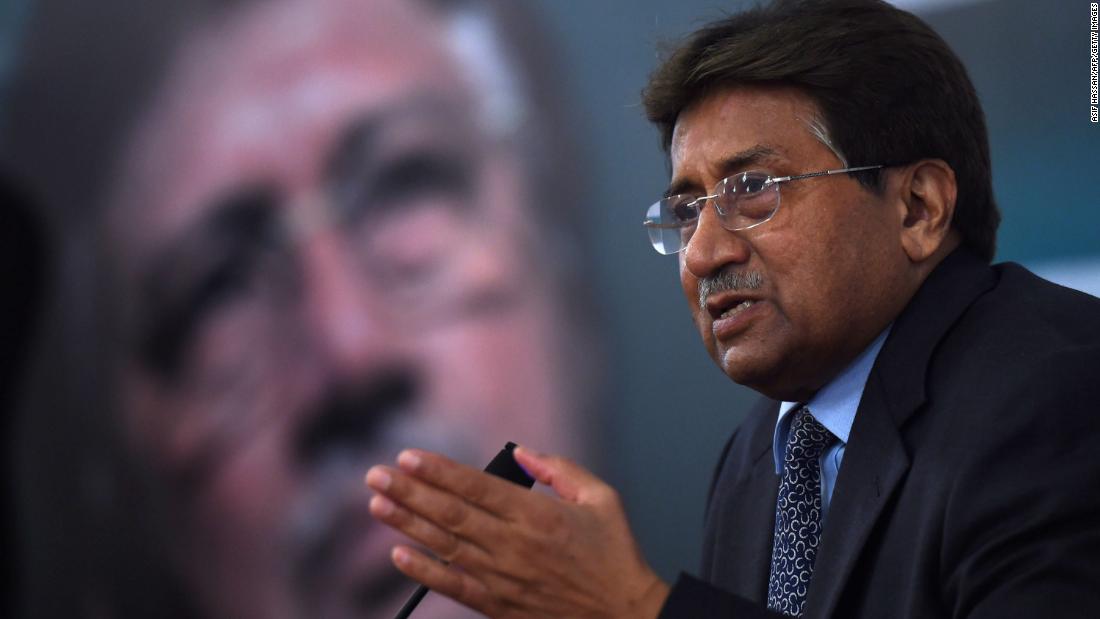
A three-member special court in Islamabad on Tuesday convicted Musharraf of violating the constitution by unlawfully declaring emergency rule while he was in power, in a case that had been pending since 2013.
The 76-year-old former leader, who has lived in self-imposed exile in Dubai in the United Arab Emirates for more than three years, has the option to appeal the verdict.
Musharraf seized power in a military coup in 1999 and ruled Pakistan as President until 2008.
He was indicted in 2014 on a total of five charges, including three counts of subverting, suspending and changing the country's constitution, firing Pakistan's chief justice, and imposing emergency rule.
It's the first time in Pakistan's history that an army chief has been tried and found guilty of treason. Under Pakistan's constitution, high treason is a crime that carries the death penalty or life imprisonment.
The special court ruled on the death sentence by a two to one majority, with one of the three judges not backing the death sentence but agreeing on a conviction.
Musharraf has been living in Dubai since 2016 after Pakistan's Supreme Court lifted a travel ban allowing him to leave the country to seek medical treatment. From his hospital bed in Dubai earlier this month, the former leader said in a video statement that he was innocent and the treason case was "baseless."
Web of court cases
Musharraf earlier went into exile in 2008, returning to Pakistan in 2013 with the aim of running in the country's national elections. But his plans unraveled as he became entangled in a web of court cases relating to his time in power.
In 2007, Musharraf declared a state of emergency, suspended Pakistan's constitution, replaced the chief judge and blacked out independent TV outlets.
Musharraf said he did so to stabilize the country and to fight rising Islamist extremism. The action drew sharp criticism from the United States and democracy advocates. Pakistanis openly called for his removal.
Under pressure from the West, Musharraf later lifted the state of emergency and called elections in which his party fared badly.
Musharraf stepped down in August 2008 after the governing coalition began taking steps to impeach him. Prosecutors say Musharraf violated Pakistan's constitution by imposing the state of emergency.
A wave of protests against a new citizenship law has broken out in cities across India, as demonstrators fear it could endanger the nation’s Muslim minority and chip away at the government’s secular identity.
The unrest has spread to more than a dozen cities, and Prime Minister Narendra Modi has responded by deploying troops, enacting a curfew and shutting down the internet. Violent police confrontations have followed; the police fatally shot several young men in Assam State, beat unarmed students with wooden poles in New Delhi, and used tear gas and batons to disperse protests elsewhere.
The citizenship law, which passed both houses of Parliament last week, was seen by critics as part of Mr. Modi’s broader push to transform India into a place where being Indian is synonymous with being Hindu. India, with a population of 1.3 billion, is about 80 percent Hindu and about 14 percent Muslim.
The law, paired with a citizenship test that has left nearly two million people in danger of being declared stateless, has Indian Muslims fearing they are being targeted at a time when there has been a surge of anti-Muslim sentiment.
Here is the background to understand what is happening.
What is in the citizenship law that ignited the protests?
The law, called the Citizenship Amendment Act, applies a religious test to whether illegal migrants from neighboring countries can be fast-tracked for Indian citizenship. It would apply to Hindus, Christians, Sikhs, Buddhists, Parsees and Jains — but not Muslims.
Government officials have said the law is intended to protect persecuted religious minorities in some neighboring countries. But it would not protect persecuted Muslims, including the Rohingya in neighboring Myanmar.
What is the citizenship test?
All 33 million residents of Assam, a state bordering Myanmar and Bangladesh, had to provide documentary evidence, such as a property deed or a birth certificate, showing that they or their ancestors lived in India before 1971. Those who could not would be declared foreign migrants, at risk of being sent to huge new detention camps.
More than two million people, many of them Muslims, failed to pass the test and could end up stateless. The governing party of Mr. Modi has vowed to extend the test to other parts of India.
The government has said the test was intended to root out undocumented immigrants from Bangladesh. India’s home minister, Amit Shah, has repeatedly referred to these migrants as “termites.”
What do the Indian Muslims fear?
Many of India’s roughly 200 million Muslims see the new citizenship law as blatantly anti-Muslim. Constitutional scholars say that it is the first time India has passed a law that treats people differently based on their religion, and that it flies in the face of the country’s commitment to equality.
Some worry that the citizenship test and the new citizenship law could be used in tandem to strip them of rights they’ve held for decades and send them off to detention camps. They could be declared foreign migrants by failing the citizenship test, then denied protection from the new citizenship law because it doesn’t include Muslims.
Why are some non-Muslims opposed?
There’s growing concern among progressives and Indians of other faiths that Mr. Modi is trying to dismantle India’s secular traditions and turn the country into a religious state as a homeland for Hindus. Many of Mr. Modi’s supporters among the Hindu right support the nationalist push, and Mr. Modi himself comes from an ideological background that emphasizes Hindu supremacy. But there are many Hindus who want to keep India secular, as India’s founders, such as Mohandas K. Gandhi, had wanted.
In Assam, protests were led by Hindus who feared that the citizenship law could allow migrants to settle there and take their land. In this state, it’s not so much a rivalry between Hindus and Muslims. It’s more a case of locals versus foreigners. Many of the indigenous Assamese don’t want any new migrants, no matter what religion they subscribe to.
Russia and China on Monday proposed easing some sanctions against nuclear-armed North Korea, on condition the government commits to Security Council resolutions on denuclearisation, in a move the United States described as premature.
The proposal, in a draft resolution which surprised several diplomatic missions, suggested the Security Council lift a ban on North Korea exporting statues, seafood and textiles and was aimed at encouraging dialogue between the North and the US, Russia said.
More:
A State Department official dismissed the proposal, telling Reuters the UN Security Council should not be considering "premature sanctions relief" for North Korea as it is "threatening to conduct an escalated provocation, refusing to meet to discuss denuclearisation".
The draft also called for a ban to be lifted on North Koreans working abroad and the termination of a 2017 requirement that all such workers had to be repatriated by next week.
It would also exempt inter-Korean rail and road cooperation projects from UN sanctions.
'Not rushing'
It was not immediately clear when, or if, the draft resolution could be put to a vote in the 15-member Security Council. A resolution needs nine votes in favour and no vetoes by the United States, France, Britain, Russia or China to pass.
"We're not rushing things," Russia's UN Ambassador Vassily Nebenzia told Reuters, adding that negotiations with council members would begin on Tuesday. He said the sanctions they had proposed lifting were "not directly related to the North Korea nuclear programme, this is a humanitarian issue."
Nuclear negotiations have been largely stalled since the collapse of a February summit in Hanoi between US President Donald Trump and North Korean leader Kim Jong Un, and the North has been issuing increasingly strident declarations as it pushes the US to make concessions by the end of the year as a condition of resuming talks.
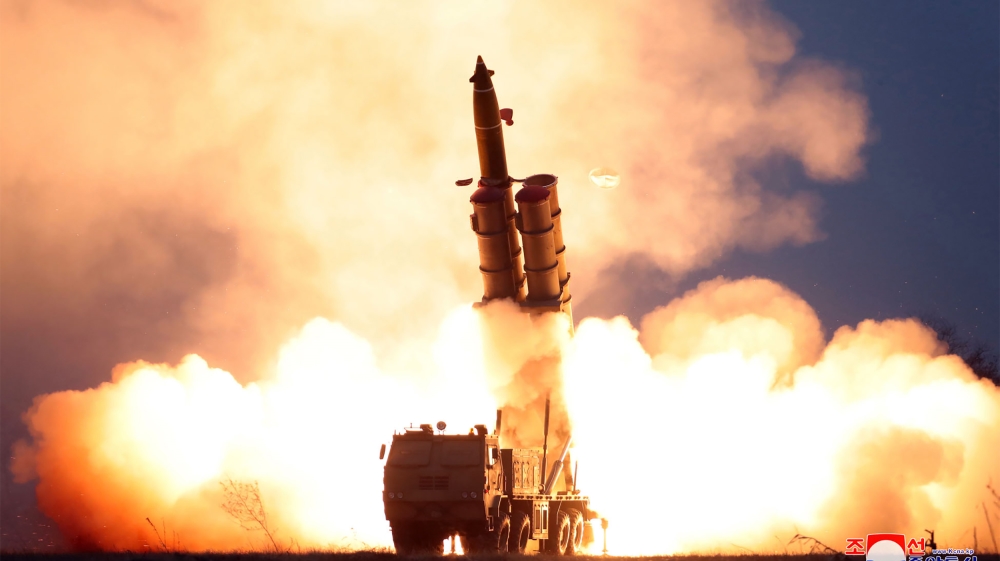
It has also carried out some 13 ballistic missile launches since May.
Trump on Monday said he would be disappointed if something was "in the works" in North Korea and the US was watching activities in the country closely.
The sanctions on industries that Russia and China have proposed lifting earned North Korea hundreds of millions of dollars and were put in place in 2016 and 2017 to try and cut off funding for Pyongyang's nuclear and missile programmes.
North Korea has carried out a number of missile tests since May, releasing undated and unlocated pictures through its official Korean Central News Agency [KCNA via AFP]
The US, Britain and France have insisted that no UN sanctions should be lifted until North Korea gives up its nuclear and ballistic missile programmes. Pyongyang has been subject to UN sanctions because of those programmes since 2006.
"On North Korea, as in the past, it's very important that the council maintains unity," German UN Ambassador Christoph Heusgen said on Monday.
Dialogue
China and Russia, which had cautiously backed pressure against North Korea after its past nuclear tests, had indicated last week they would reject further sanctions.
At a council meeting on North Korea last week - called by the US - China's UN Ambassador Zhang Jun said sanctions should be adjusted to "head off a dramatic reversal" of the situation.
Nebenzia said the draft resolution was aimed at encouraging talks between the US and North Korea.
"That's the whole idea, we don't do this resolution in spite, we really want to facilitate," he added.
The draft welcomes "the continuation of the dialogue between the United States and the DPRK at all levels, aimed at establishing new US-DPRK relations, building mutual confidence and joining efforts to build a lasting and stable peace on the Korean Peninsula in a staged and synchronized manner." DPRK stands for the Democratic People's Republic of Korea.
The draft text also calls for the "prompt resumption of the six-party talks" which involved China, the two Koreas, the US, Russia and Japan. Those talks lasted from 2003-2009.
Tourists walk with shopping bags in front of Grand Lisboa Casino in Macau on December 15, 2019.
Eduardo Leal | AFP | Getty Images
China is reportedly set to announce new financial policies in Macao in a potential snub to protest-stricken Hong Kong, said Richard McGregor, senior fellow at Sydney-based think tank, the Lowy Institute.
President Xi Jinping will be visiting Macao this week to commemorate the city's 20th anniversary return to China. His visit and the reported economic incentives are meant to send a "signal to Hong Kong," said McGregor.
According to Reuters, Beijing is set to unveil a slew of policies including the establishment of a yuan-denominated stock exchange in the Chinese special administration region. The new incentives also include the acceleration of a yuan settlement center that is already in the works, and the allocation of more land in mainland China for Macao to develop, Reuters reported.
Hong Kong and Macao are both semi-autonomous regions of China that have their own legal, administrative and judicial systems from the mainland. But since early June, Hong Kong has been crippled by widespread pro-democracy protests as some of its citizens lobby for greater independence from the mainland.
McGregor said the possible financial incentives are an attempt to put pressure on Hong Kong, and in the longer term, to build up Macao.
"I think it's trolling Hong Kong if you like, it's attempting to say 'look, you think you've got some special services that you offer China, well we can put them in Macao," he told CNBC's "Squawk Box" on Tuesday.
No substitute for Hong Kong
McGregor pointed out that it is unlikely for Macao or any other Chinese city to replace Hong Kong's significance in the near future.
"If China could have replicated Hong Kong, frankly in Shanghai or Shenzhen, and all the things Hong Kong can do, particularly in financial services, China would have done it already," he said.
Hong Kong is a former British colony that returned to Chinese rule in 1997. Under the "one country, two systems" structure, its citizens are granted some degree of financial and legal independence from the mainland.
The same system applies to neighboring Macao, a former Portuguese colony that returned to Chinese rule in 2000. And from Beijing's perspective, Macao is the token success story of the policy working out, said McGregor.
Macao's economic vibrancy is fully dependent on the casino industry and "at the mercy of Beijing," McGregor explained, noting that gambling is not legal in the mainland.
Therefore Beijing has the power to "turn that tap on and off and stop high rollers coming there, so Macao is fulfilling its function, and China is pretty happy with it," he said.
'One country, two systems'
Beijing has been trying to sell the "one country, two systems" framework to Taiwan for years, but the recent social unrest in Hong Kong has undermined the credibility of that principle, said McGregor.
"Clearly it's not working in Hong Kong, and clearly it is not attractive in Taiwan," McGregor said about the policy.
As Taiwan gears up for the upcoming polls, it appears likely that Tsai will win again, said McGregor. "That's a big problem for Beijing," he said, pointing out that she was "anti-Beijing."
Xi is currently under a lot of pressure on many fronts, McGregor said.
Even as ongoing protests in Hong Kong continue to threaten Xi's grip on power, Taiwan's elections might also boost anti-China sentiments. On the U.S. front, there's the trade war, and domestically, there is an economic slowdown in China.
But McGregor said he is confident that Xi will not be "shunned" domestically, but he might be left with no choice but "to share power more than he has been willing to do thus far."
WATCH: What is Hong Kong's relationship with China?
Side by side, the Allies and former enemy Germany together marked the 75th anniversary of one of the most important battles in World War II — the Battle of the Bulge, which stopped Adolf Hitler's last-ditch offensive to turn the tide of the war.
At dawn on Dec. 16, 1944, over 200,000 German soldiers started the most unexpected breakthrough through the dense woods of Belgium and Luxembourg's hilly Ardennes. Making the most of the surprise move, the cold, freezing weather and wearied U.S. troops, the Germans pierced the front line so deeply it came to be known as the Battle of the Bulge.
Initially outnumbered, U.S. troops delayed the attack enough in fierce fighting to allow reinforcements to stream in and turn the tide of the battle by Christmas. After a month of fighting, the move into Germany was unstoppable.
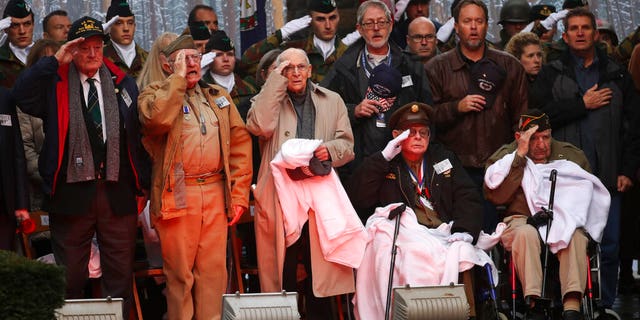
U.S. Battle of the Bulge veterans, front row, listen to the U.S. national anthem during a ceremony to commemorate the 75th anniversary of the Battle of the Bulge at the Mardasson Memorial in Bastogne, Belgium on Monday, Dec. 16, 2019. The Battle of the Bulge, also called Battle of the Ardennes, took place between Dec. 1944 and Jan. 1945 and was the last major German offensive on the Western Front during World War II.
(AP)
U.S. Secretary of Defense Mark Esper paid tribute to over 19,000 U.S. troops who died in one of the bloodiest battles in the nation's history.
“Their efforts not only defended America but also ensured that the peoples of Europe would be free again," Esper said, calling the Battle of the Bulge “one of the greatest in American history."
Even though German deaths also exceeded well over 10,000 in the battle that stretched deep into January, German President Frank-Walter Steinmeier took special time to thank the U.S. troops.
“On this day, we Germans would like to thank the United States of America. The American armed forces, together with their allies, liberated Europe and they also liberated Germany. We thank you," Steinmeier said.
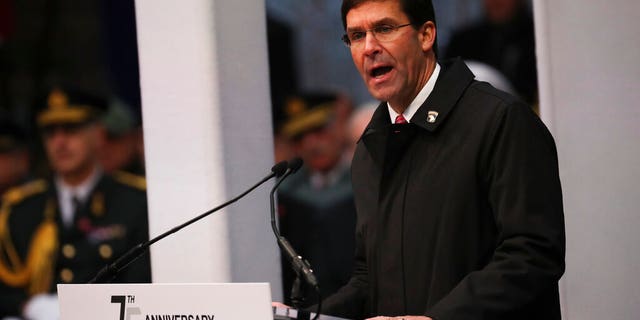
U.S. Secretary of Defence Mark Esper gives a speech during a ceremony to commemorate the 75th anniversary of the Battle of the Bulge at the Mardasson Memorial in Bastogne, Belgium
(AP)
“Those who died were victims of hatred, delusion, and a destructive fury that originated from my country," he said.
Germany is now an ally of the United States and its wartime partners, united in the NATO alliance. During the poignant ceremonies under leaden skies and rain at the star-shaped Mardasson memorial in Bastogne, the current discord between the United States and several European allies over trade and security were never mentioned.
Even if it was relatively warm 6 degrees Centigrade (43 degrees Fahrenheit) compared to the shivering conditions 75 years ago, there was also a fog hanging low.
Hitler had hoped the advance would change the course of World War II by forcing U.S. and British troops to sue for peace, thus freeing Germany to focus on the rapidly advancing Soviet armies in the east.
Out of the blue at dawn, over 200,000 German troops counter-attacked across the front line in Belgium and Luxembourg, smashing into battle-weary U.S. soldiers positioned in terrain as foreign to them as it was familiar to the Germans.
Yet somehow, the Americans blunted the advance and started turning back the enemy for good, setting Allied troops on a roll that would end the war in Europe less than five months later.
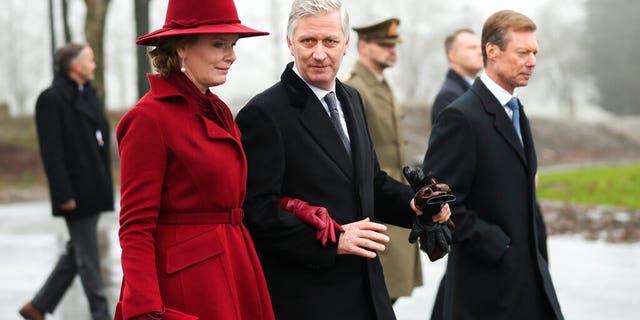
Belgium's King Philippe, center, Belgium's Queen Mathilde and Luxembourg's Grand Duke Henri, right, leave at the end of a ceremony to commemorate the 75th anniversary of the Battle of the Bulge at the Mardasson Memorial in Bastogne, Belgium on Monday, Dec. 16, 2019.
(AP)
This battle gained fame not so much for the commanders' tactics but for the resilience of small units hampered by poor communications that stood shoulder to shoulder to deny Hitler the quick breakthrough he so desperately needed. Even though the Americans were often pushed back, they were able to delay the German advance in its crucial initial stages.
“It was ultimately the intrepid, indomitable spirit of the American soldier that brought victory," Esper said.
When the fortunes of war turned, it was most visible in the southern Ardennes town of Bastogne, where surrounded U.S. troops were cut off for days with little ammunition or food.
When Brig. Gen. Anthony C. McAuliffe of the 101st Airborne received a Dec. 22 ultimatum to surrender or face total destruction, he offered one of the most famous — and brief — replies in military history: "Nuts." Four days later, U.S. troops broke the Nazi encirclement.
“News of their fierce defense quickly spread, boosting the morale of allied forces all along the Western Front,” Esper said.
After the fighting in the Battle of the Bulge ended on Jan. 28, 1945, Allied forces invaded Germany, eventually leading to the Nazi surrender and the end of the war in Europe.
Mr Johnson is also expected to carry out a mini cabinet reshuffle.
He needs to fill posts made vacant by those who stood down ahead of the general election, including the culture and Welsh secretary posts.
The prime minister has also cleared a parliamentary report into alleged Russian interference in UK democracy for publication.
The Queen will formally open Parliament on Thursday when she sets out the government's legislative programme.
On Monday, the prime minister's official spokesman told a Westminster briefing: "We plan to start the process [of the withdrawal agreement bill] before Christmas and will do so in the proper constitutional way in discussion with the Speaker."
Asked if the legislation would be identical to that introduced in the last Parliament, the spokesman said: "You will have to wait for it to be published but it will reflect the agreement that we made with the EU on our withdrawal."
Media playback is unsupported on your device
With the large majority, the bill is expected to pass through Parliament in time to meet Boris Johnson's promise for the UK to leave the EU on 31 January.
Mr Johnson then has to negotiate a new trade agreement with the EU and have it ratified before the end of the post-Brexit transition period that ends on 31 December 2020. He has repeatedly said that the transition period will not be extended.
The Queen's Speech is also expected to include legislation linked to pledges made during the election campaign - most notably a guarantee on NHS funding.
The prime minister's spokesman has also said Mr Johnson has "carefully considered" a report from the Commons Intelligence and Security Committee into alleged Russian interference in UK democracy.
"He is content publication would not prejudice the functions of those bodies that safeguard our national security," the spokesman said.
"Publication will be a matter for the new ISC in due course."
Elsewhere, moves to get the Northern Ireland government at Stormont up and running again are also expected, with talks resuming on Monday.
New Conservative MPs have been posting pictures of themselves on their first day including the members for Bishop Auckland and Stoke-on-Trent North - Dehenna Davison and Jonathan Gullis.
Meanwhile, the fallout from Labour's defeat continues.
Labour's general secretary says party officials are likely to meet early in the new year to agree the timetable for replacing Jeremy Corbyn as leader.
Mr Corbyn wants the process to begin "swiftly", Jennie Formby said, so his successor can be in place by the end of March.
She has written to members of Labour's National Executive Committee (NEC) recommending a provisional date of 6 January for the meeting, with the process beginning the following day.
Both Jeremy Corbyn and John McDonnell said on Sunday that they took the blame for Labour's "catastrophic" defeat in Thursday's election.
Speaking to the Today programme, shadow transport secretary Andy McDonald accused the BBC of having "played your part" in Mr Corbyn's defeat and said the corporation needed to "have a look in the mirror".
Meanwhile, MP Stephen Kinnock told BBC Breakfast the main problems were "weak and incompetent leadership" as well as the decision to support another Brexit referendum and a "Christmas wishlist" manifesto.
The race for their replacements has already begun, with Wigan MP Lisa Nandy saying for the first time she was "seriously thinking about" running.
Other possible contenders are shadow Brexit secretary Sir Keir Starmer, shadow business secretary Rebecca Long-Bailey, shadow education secretary Angela Rayner, Jess Phillips, who is an outspoken critic of Jeremy Corbyn, and shadow foreign secretary Emily Thornberry.
A new intake of 47 SNP MPs will also be taking their seats on Tuesday.
She said the Conservatives, who lost seven of their 13 seats in Scotland, had been "defeated comprehensively" and that the new MPs would continue to press for independence.
What will happen this week?
Tuesday
Proceedings begin when MPs gather for their first duty: to elect the Speaker, Sir Lindsay Hoyle, who replaced John Bercow in November. Technically, MPs can hold a vote on this motion but this has never happened in practice.
Later in the day, the Speaker will begin the process of swearing in MPs, who are required to take an oath of allegiance to the Crown, or, if they object to this, a solemn affirmation. Those who speak or vote without having done so are deprived of their seat "as if they were dead" under the Parliamentary Oaths Act of 1866.
Two to three days are usually set aside for this process.
Thursday
The state opening of Parliament. The Queen's Speech is the centrepiece of this, when she will read a speech written by ministers setting out the government's programme of legislation for the parliamentary session. A couple of hours after the speech is delivered, MPs will begin debating its contents - a process which usually takes days.
Friday
Depending on how rapidly Boris Johnson wants to move, the debate on the Queen's Speech could continue into Friday.
The government will introduce the Withdrawal Agreement Bill - the legislation that will implement Brexit - to Parliament.
After the debate on the Queen's Speech is concluded, MPs will vote on whether to approve it. Not since 1924 has a government's Queen Speech been defeated.