Under Spanish law, a sexual attack can only be classified as an assault or rape if the perpetrator uses violence or intimidation. Because the 14-year-old victim was unconscious, the five were convicted of a lesser charge of sexual abuse.
The case renewed pressure on the government to reform the law and specify that any sexual act without consent is an assault.
The Barcelona court sentenced the five men to 10 to 12 years in prison, despite the prosecution arguing they should be charged with assault.
The attack happened at a party in Manresa, a town northwest of Barcelona, in 2016. The court heard that the group was partying in an abandoned factory, when the victim consumed "alcohol and drugs" and became unconscious.
The men then took turns performing sexual acts on the teenager, according to a statement published on the court's website.
"The sexual attack on the victim was extremely intense and especially denigrating, and in addition, it was produced on a minor who was in a helpless situation," the court said in the press release.
However, the court said the victim was "in a state of unconsciousness ... without being able to determine and accept or oppose the sexual relations maintained with defendants, who could perform sexual acts without using any type of violence or intimidation."
The court said the attack had to be classified as sexual abuse because "it has been proven that the victim, while the events took place ... was in a state of unconsciousness," according to a statement published on its website.
The court also awarded the victim 12,000 euros ($13,400) in damages. Two more men attending the party were acquitted of all crimes, the court said.
Echoes of 'Wolf Pack' case
The hearing sparked protests across Spain reminiscent of the response to a similar case in which five men, dubbed "the Wolf Pack," were originally acquitted of rape and convicted of abuse. Spain's Supreme Court overturned the decision in June, after a year of demonstrations, sentencing the men to 15 years in prison for rape.
The case shocked the nation and prompted widespread outrage, which was ultimately diverted towards Spain's judicial system.
However, while the "Wolf Pack" controversy stemmed from the interpretation of the law and what constitutes intimidation, the Manresa attack put a spotlight on what activists said is a flaw in the Spanish legal system.
The court in Barcelona said in the press release that the attack "cannot fit into any other criminal typology" because the attackers "could perform sexual acts without using any type of violence or intimidation."
That explanation has sparked more calls for the law to be changed. Protesters gathered in front of the court during the months-long hearing, holding placards that read: "It's rape."
The Spanish Association of Women Judges has previously called for a reform of the law, urging the government to act quickly.
Lucia Avilés, a judge and a member of the association, said on Twitter on Friday that the issue has not yet been addressed, despite the fact that Spain has signed and ratified the Istanbul Convention on Violence Against Women, which stipulates that sex without consent is rape.
SEOUL (Reuters) - Successful sanctions evasion, economic lifelines from China and U.S. President Donald Trump’s impeachment woes may be among the factors that have emboldened North Korea in nuclear negotiations, analysts and officials say.
Both Trump and North Korean leader Kim Jong Un continue to play up the personal rapport they say they developed during three face-to-face meetings. But North Korea has said in recent days that it is losing patience, giving the United States until the end of the year to change its negotiating stance.
North Korea has tested the limits of engagement with a string of missile launches, including two fired on Thursday, and experts warn that the lack of a concrete arms control agreement has allowed the country to continue producing nuclear weapons.
The missile tests have practical value for the North Korean military’s efforts to modernize its arsenal. But they also underscore Pyongyang’s increasingly belligerent position in the face of what it sees as an inflexible and hostile United States.
In a best-case scenario, Thursday’s launch was an attempt to make the December deadline feel more urgent to the U.S., said Andray Abrahamian, a visiting scholar with George Mason University Korea.
“Still, I think that Pyongyang has concluded they can do without a deal if they must,” he said. “The sad thing is I think that will lock in the current state of affairs, with its downsides for all stakeholders, for years to come.”
‘NOT SO PROMISING’
Trump’s reelection battle and the impeachment inquiry against him may have led Kim to overestimate North Korea’s leverage, said one diplomat in Seoul, who spoke on condition of anonymity because of the sensitivity of the negotiations.
“It looks like Kim has a serious delusion that he is capable of helping or ruining Trump’s reelection, but no one in Pyongyang can stand up to the unerring leader and say he’s mistaken – you don’t want to be dead,” the diplomat told Reuters. “And Trump is all Kim has. In order to denuclearize, Kim needs confidence that Trump will be reelected.”
The Americans, meanwhile, came into working-level talks on Oct. 5 in Stockholm with the position that North Korea must completely and irreversibly dismantle its nuclear program, and pushed for a moratorium on weapons tests as part of a first step, the diplomat said.
Although some media reports said the United States planned to propose temporarily lifting sanctions on coal and textile exports, the diplomat said the talks in Stockholm did not get into details.
“The U.S. can’t take the risk of easing sanctions first, having already given a lot of gifts to Kim without substantial progress on denuclearization, including summits,” the diplomat said. “Sanctions are basically all they have to press North Korea.”
When American negotiators tried to set a time for another round of talks, North Korean officials were uncooperative, the diplomat said.
“The prospects are not so promising,” the diplomat added.
ECONOMIC LIFELINES
Although United Nations sanctions remain in place, some trade with China appears to have increased, and political relations between Beijing and Pyongyang have improved dramatically.
Kim and China’s president, Xi Jinping, have met several times, and the two countries exchange delegations of government officials.
A huge influx of Chinese tourists over the past year appears to be a major source of cash for the North Korean government, according to research by Korea Risk Group, which monitors North Korea.
Korea Risk Group chief executive Chad O’Carroll estimates as many as 350,000 Chinese tourists have visited this year, potentially netting the North Korean authorities up to $175 million.
That’s more than North Korea was making from the Kaesong Industrial Complex - jointly operated with South Korea before it was shuttered in 2016 - and is almost certainly part of why Kim is showing less interest in U.S. proposals, O’Carroll said.
The United States and South Korea suggested tourism, rather than resuming the Kaesong operation, as a potential concession to the North after the failed second summit between Trump and Kim in Hanoi in February, the Seoul-based diplomat said.
“That’s based on the consensus that any sanctions relief should be immediately reversible, but once the 120-plus factories are put back in, it’s difficult to shut it down and pull them out again,” the diplomat said.
The United Nations, meanwhile, has reported that North Korea is successfully evading many of the sanctions, and that the government may have stolen as much as $2 billion through cyber attacks.
“Stockholm suggests Pyongyang is also fine with their ‘Chinese backstop’, i.e. whatever agreement they have on lax sanctions enforcement,” Abrahamian said. “I worry that instead of trying to get a deal, they think Trump will be more desperate for a win than he actually is and will miss the window.”
INTERNAL DEBATE
Trump and Kim’s second meeting abruptly fell apart when both sides refused to budge, with North Korea demanding wide-ranging sanctions relief and the Americans insisting on concrete disarmament steps.
“It’s very clear that the failure of Hanoi triggered a debate inside North Korea about whether Kim’s path - moving down the road to denuclearization - was the right way to go,” said Joel Wit, a senior fellow at the Stimson Center in Washington.
For now, North Korea seems inclined to avoid engaging further with the United States or South Korea until they make more concessions, Wit said.
FILE PHOTO: People watch a TV broadcast showing a file footage for a news report on North Korea firing two projectiles, possibly missiles, into the sea between the Korean peninsula and Japan, in Seoul, South Korea, October 31, 2019. REUTERS/Heo Ran/File Photo
Other analysts are skeptical that Kim will ever give up his hard-won nuclear weapons, but say the opportunity for even a limited arms control deal may be slipping away.
“North Korea appears to be interested only in a deal under its terms to the exact letter,” said Duyeon Kim, with the Washington-based Center for a New American Security.
“Pyongyang is able to demand more, be tougher, and raise the bar because its confidence comes from qualitative and quantitative advancements in its nuclear weapons,” Kim said.
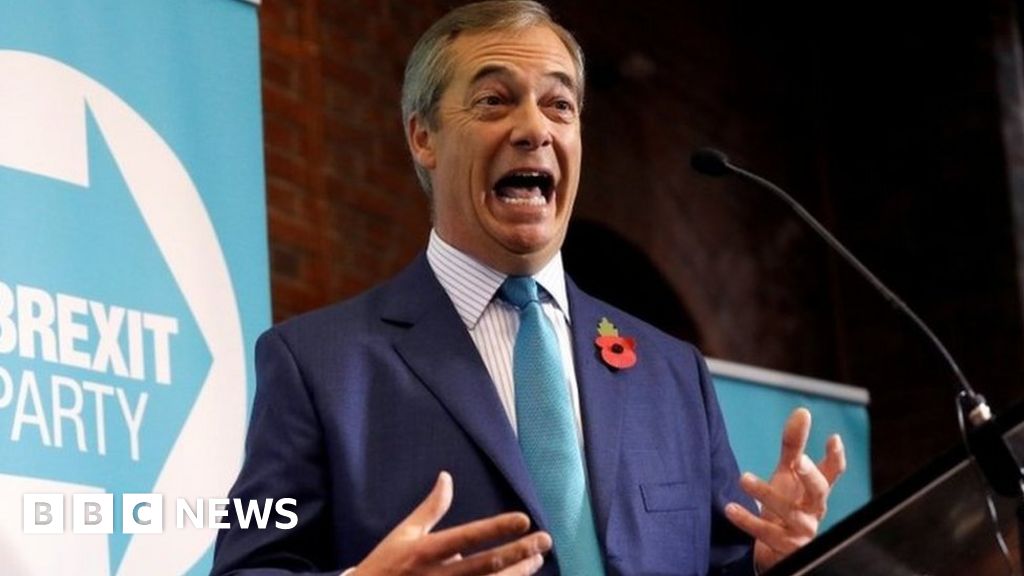
Nigel Farage has called on Boris Johnson to ditch his Brexit deal and "build a Leave alliance".
At the launch of the Brexit Party's election campaign, the leader said bringing the parties together was "the only way" forward.
But he warned Mr Johnson that if he turned down his offer, the party would field candidates in "every single seat" in England, Scotland and Wales.
The Conservatives have consistently ruled out a formal pact with the party.
A Tory source told the BBC: "A vote for Farage risks letting Jeremy Corbyn into Downing Street via the back door. It will not get Brexit done and it will create another gridlocked Parliament that doesn't work."
Recent opinion polls have shown the Conservatives with a double-digit lead over Labour.
But some Tories fear that Mr Farage's candidates could split the pro-Brexit vote and prevent their party from winning a majority in 12 December poll.
BBC Political Correspondent Alex Forsyth said the risk for the Brexit Party was that they could help Labour win seats by taking votes away from Conservative candidates, and that could lead to another EU referendum under a Jeremy Corbyn-led government.
'It is not Brexit'
Mr Farage has been critical of Mr Johnson's failure to deliver on his promise that the UK would leave by Halloween.
He used the launch to condemn the PM's deal, urging him to "drop [it] because it is not Brexit".
Instead, Mr Farage urged him to pursue a free trade agreement with the EU - similar to the deal the bloc has with Canada - and to impose a new deadline of 1 July 2020 to get it signed off.
If an agreement was not done by then, the UK should leave the EU without a deal and move to World Trade Organisation trading rules.
"I would view that as totally reasonable," he said. "That really would be Brexit."
But Mr Farage said if Mr Johnson did not pursue the route, the Brexit Party would contest every seat in the country - with 500 candidates ready to sign the forms to stand on Monday.
"The Brexit Party would be the only party standing at these elections that actually represents Brexit," he said.
Labour targets
The party leader also attacked Labour for a "complete and utter betrayal on Brexit" - and said his party would target Labour seats in the Midlands and North of England.
He said Labour's plan to renegotiate a deal then put it to a referendum was offering a choice of "remain or effectively remain".
Mr Farage said there were five million Labour voters who had supported Leave in the 2016 EU referendum, meaning his party "posed a very major problem" for Jeremy Corbyn.
"So many Labour Leave seats are represented by Remain members of Parliament," he said. "We view those constituencies around the country among our top targets."
He ridiculed the reported Conservative plan to target "Workington man" - Leave-supporting traditional Labour voters in northern towns - saying Tories needed get out of London more.
The potential agreements would see the Liberal Democrats, Greens and Plaid Cymru stand aside for each other to ensure the election of as many MPs who back a second Brexit referendum as possible.
Green Party co-leader Jonathan Bartley said it was "no secret" that the his party was "talking to the Lib Dems and Plaid" but "nothing has been finalised".
LONDON (Reuters) - As Britain’s “Brexit election” campaign swings into action, it may not be the country’s exit from the European Union which takes centre stage but another national obsession - the health service.
British Prime Minister Boris Johnson greets and speaks to nurses at National Institute for Health Research at the Cambridge Clinical Research Facility, in Addenbrooke's Hospital in Cambridge, Britain October 31, 2019. Alastair Grant/Pool via REUTERS
Prime Minister Boris Johnson has cast the Dec. 12 election as necessary to break the deadlock in parliament over Brexit, telling voters that only by returning his Conservatives with a majority can the country finally quit the European Union.
But many supporters of the opposition Labour Party, whose ambiguous position over Brexit has alienated some voters, believe the best chance of winning power is to focus the debate on other issues.
The state-run National Health Service (NHS), which has provided free at the point of use healthcare for more than 70 years, is a hugely emotive issue. Opinion polls consistently show voters cite it as the second biggest issue after Brexit.
Struggling under the pressure of record demand due to a growing and ageing population, as well as cut backs to social care services, the NHS has warned it faces a shortfall in funding despite government promises of extra money.
Despite its cherished status, complaints about long waiting times for consultations and operations, crumbling hospitals and staff shortages are a regular feature of public discourse.
Labour plan to make the NHS a big part of their campaign.
“This government has put our NHS into crisis, and this election is a once-in-a-generation chance to end privatisation in our NHS, give it the funding it needs,” Labour leader Jeremy Corbyn said on Wednesday, attacking Johnson in parliament.
Corbyn’s central charge: the NHS is at risk of being sold off to American corporations in any post-Brexit trade deal Johnson’s government does with U.S. President Donald Trump.
“Labour won’t let Donald Trump get his hands on our National Health Service,” Corbyn said to cheers from the audience at his campaign launch in southwest London on Thursday.
“Quite bluntly, it’s not for sale,” he said, as the crowd rose to its feet and chanted: “Not for sale, not for sale.”
Johnson has repeatedly said the NHS would not be on the table in any trade talks but opposition lawmakers say they do not trust him.
Trump, who said during a visit to Britain in June that everything including health would be on the table in trade talks but then backtracked and said health would not be, told LBC radio that Corbyn’s claim was ridiculous and he did not know where it came from.
Asked about whether the health service would be up for grabs in trade talks, Trump said: “No, not at all, we wouldn’t even be involved in that, no.”
“No. It’s not for us to have anything to do with your healthcare system,” he said. “No, we’re just talking about trade.”
WINTER CRISIS?
The face of a “Leave” campaign which promised to spend the money Britain sends to the EU on the NHS instead, Johnson’s message to voters is he would deliver Brexit so Britain can move on to focus on priorities such as health, education and policing.
“BackBoris for more NHS funding so that you and your family get the care you need,” the Conservatives said on Twitter, as Johnson visited a hospital on his first day of campaigning. He has done at least 9 hospital visits since taking office in July.
During one such visit he was confronted by a Labour activist and father of a sick child, who said the care his baby daughter had received had not been acceptable and that the health service had been destroyed by the Conservatives.
The NHS led two newspaper front pages on Thursday, with the Labour-supporting Daily Mirror splashing: “Election warning: Boris and Trump plot NHS sell-off”, while the pro-Conservative Daily Mail read: “Poll: Boris more trusted than Corbyn on NHS”.
Created by a Labour government in 1948, the NHS is one of the biggest employers in the world and in 2019-20 is due to account for 166 billion pounds ($215.04 billion), or around 20 percent, of Britain’s annual public spending.
It has traditionally been strong ground for Labour, with polls usually showing them as more trusted on the NHS. A December election, Britain’s first winter vote since 1923, could play to that strength.
Pressure on the NHS increases during the winter months, adding to public concern and fuelling newspaper headlines about the annual “NHS winter crisis”.
“Most years you see a spike in the issues tracker for the NHS in the winter months as you get stories about winter crisis, waiting times going up,” said Chris Curtis, Political Research Manager at polling firm YouGov.
YouGov’s latest research showed 32 percent of voters viewed Labour as best able to handle the NHS, versus 26 percent for the Conservatives. In contrast, just 9 percent believed Labour was best on Brexit, compared to 24 percent for the Conservatives.
“It is much better for Labour to be focusing on the NHS than it is for them to be focusing on Brexit,” said Curtis. “It is very likely that that could end up helping Labour in this campaign.”
Many opinion polls give Johnson’s Conservatives a double digit lead over Labour, but it is early days in a six-week campaign.
At the last snap election, in 2017, Johnson’s predecessor Theresa May saw her party’s large poll lead all but evaporate during the campaign, ultimately losing her small majority in parliament on election day.
($1 = 0.77 pounds)
Additional reporting by Elizabeth Piper; editing by Guy Faulconbridge and Angus MacSwan
SEOUL (Reuters) - Successful sanctions evasion, economic lifelines from China and U.S. President Donald Trump’s impeachment woes may be among the factors that have emboldened North Korea in nuclear negotiations, analysts and officials say.
Both Trump and North Korean leader Kim Jong Un continue to play up the personal rapport they say they developed during three face-to-face meetings. But North Korea has said in recent days that it is losing patience, giving the United States until the end of the year to change its negotiating stance.
North Korea has tested the limits of engagement with a string of missile launches, including two fired on Thursday, and experts warn that the lack of a concrete arms control agreement has allowed the country to continue producing nuclear weapons.
The missile tests have practical value for the North Korean military’s efforts to modernize its arsenal. But they also underscore Pyongyang’s increasingly belligerent position in the face of what it sees as an inflexible and hostile United States.
In a best-case scenario, Thursday’s launch was an attempt to make the December deadline feel more urgent to the U.S., said Andray Abrahamian, a visiting scholar with George Mason University Korea.
“Still, I think that Pyongyang has concluded they can do without a deal if they must,” he said. “The sad thing is I think that will lock in the current state of affairs, with its downsides for all stakeholders, for years to come.”
‘NOT SO PROMISING’
Trump’s reelection battle and the impeachment inquiry against him may have led Kim to overestimate North Korea’s leverage, said one diplomat in Seoul, who spoke on condition of anonymity because of the sensitivity of the negotiations.
“It looks like Kim has a serious delusion that he is capable of helping or ruining Trump’s reelection, but no one in Pyongyang can stand up to the unerring leader and say he’s mistaken – you don’t want to be dead,” the diplomat told Reuters. “And Trump is all Kim has. In order to denuclearize, Kim needs confidence that Trump will be reelected.”
The Americans, meanwhile, came into working-level talks on Oct. 5 in Stockholm with the position that North Korea must completely and irreversibly dismantle its nuclear program, and pushed for a moratorium on weapons tests as part of a first step, the diplomat said.
Although some media reports said the United States planned to propose temporarily lifting sanctions on coal and textile exports, the diplomat said the talks in Stockholm did not get into details.
“The U.S. can’t take the risk of easing sanctions first, having already given a lot of gifts to Kim without substantial progress on denuclearization, including summits,” the diplomat said. “Sanctions are basically all they have to press North Korea.”
When American negotiators tried to set a time for another round of talks, North Korean officials were uncooperative, the diplomat said.
“The prospects are not so promising,” the diplomat added.
ECONOMIC LIFELINES
Although United Nations sanctions remain in place, some trade with China appears to have increased, and political relations between Beijing and Pyongyang have improved dramatically.
Kim and China’s president, Xi Jinping, have met several times, and the two countries exchange delegations of government officials.
A huge influx of Chinese tourists over the past year appears to be a major source of cash for the North Korean government, according to research by Korea Risk Group, which monitors North Korea.
Korea Risk Group chief executive Chad O’Carroll estimates as many as 350,000 Chinese tourists have visited this year, potentially netting the North Korean authorities up to $175 million.
That’s more than North Korea was making from the Kaesong Industrial Complex - jointly operated with South Korea before it was shuttered in 2016 - and is almost certainly part of why Kim is showing less interest in U.S. proposals, O’Carroll said.
The United States and South Korea suggested tourism, rather than resuming the Kaesong operation, as a potential concession to the North after the failed second summit between Trump and Kim in Hanoi in February, the Seoul-based diplomat said.
“That’s based on the consensus that any sanctions relief should be immediately reversible, but once the 120-plus factories are put back in, it’s difficult to shut it down and pull them out again,” the diplomat said.
The United Nations, meanwhile, has reported that North Korea is successfully evading many of the sanctions, and that the government may have stolen as much as $2 billion through cyber attacks.
“Stockholm suggests Pyongyang is also fine with their ‘Chinese backstop’, i.e. whatever agreement they have on lax sanctions enforcement,” Abrahamian said. “I worry that instead of trying to get a deal, they think Trump will be more desperate for a win than he actually is and will miss the window.”
INTERNAL DEBATE
Trump and Kim’s second meeting abruptly fell apart when both sides refused to budge, with North Korea demanding wide-ranging sanctions relief and the Americans insisting on concrete disarmament steps.
“It’s very clear that the failure of Hanoi triggered a debate inside North Korea about whether Kim’s path - moving down the road to denuclearization - was the right way to go,” said Joel Wit, a senior fellow at the Stimson Center in Washington.
For now, North Korea seems inclined to avoid engaging further with the United States or South Korea until they make more concessions, Wit said.
FILE PHOTO: People watch a TV broadcast showing a file footage for a news report on North Korea firing two projectiles, possibly missiles, into the sea between the Korean peninsula and Japan, in Seoul, South Korea, October 31, 2019. REUTERS/Heo Ran/File Photo
Other analysts are skeptical that Kim will ever give up his hard-won nuclear weapons, but say the opportunity for even a limited arms control deal may be slipping away.
“North Korea appears to be interested only in a deal under its terms to the exact letter,” said Duyeon Kim, with the Washington-based Center for a New American Security.
“Pyongyang is able to demand more, be tougher, and raise the bar because its confidence comes from qualitative and quantitative advancements in its nuclear weapons,” Kim said.
LONDON (Reuters) - As Britain’s “Brexit election” campaign swings into action, it may not be the country’s exit from the European Union which takes centre stage but another national obsession - the health service.
British Prime Minister Boris Johnson greets and speaks to nurses at National Institute for Health Research at the Cambridge Clinical Research Facility, in Addenbrooke's Hospital in Cambridge, Britain October 31, 2019. Alastair Grant/Pool via REUTERS
Prime Minister Boris Johnson has cast the Dec. 12 election as necessary to break the deadlock in parliament over Brexit, telling voters that only by returning his Conservatives with a majority can the country finally quit the European Union.
But many supporters of the opposition Labour Party, whose ambiguous position over Brexit has alienated some voters, believe the best chance of winning power is to focus the debate on other issues.
The state-run National Health Service (NHS), which has provided free at the point of use healthcare for more than 70 years, is a hugely emotive issue. Opinion polls consistently show voters cite it as the second biggest issue after Brexit.
Struggling under the pressure of record demand due to a growing and ageing population, as well as cut backs to social care services, the NHS has warned it faces a shortfall in funding despite government promises of extra money.
Despite its cherished status, complaints about long waiting times for consultations and operations, crumbling hospitals and staff shortages are a regular feature of public discourse.
Labour plan to make the NHS a big part of their campaign.
“This government has put our NHS into crisis, and this election is a once-in-a-generation chance to end privatisation in our NHS, give it the funding it needs,” Labour leader Jeremy Corbyn said on Wednesday, attacking Johnson in parliament.
Corbyn’s central charge: the NHS is at risk of being sold off to American corporations in any post-Brexit trade deal Johnson’s government does with U.S. President Donald Trump.
“Labour won’t let Donald Trump get his hands on our National Health Service,” Corbyn said to cheers from the audience at his campaign launch in southwest London on Thursday.
“Quite bluntly, it’s not for sale,” he said, as the crowd rose to its feet and chanted: “Not for sale, not for sale.”
Johnson has repeatedly said the NHS would not be on the table in any trade talks but opposition lawmakers say they do not trust him.
Trump, who said during a visit to Britain in June that everything including health would be on the table in trade talks but then backtracked and said health would not be, told LBC radio that Corbyn’s claim was ridiculous and he did not know where it came from.
Asked about whether the health service would be up for grabs in trade talks, Trump said: “No, not at all, we wouldn’t even be involved in that, no.”
“No. It’s not for us to have anything to do with your healthcare system,” he said. “No, we’re just talking about trade.”
WINTER CRISIS?
The face of a “Leave” campaign which promised to spend the money Britain sends to the EU on the NHS instead, Johnson’s message to voters is he would deliver Brexit so Britain can move on to focus on priorities such as health, education and policing.
“BackBoris for more NHS funding so that you and your family get the care you need,” the Conservatives said on Twitter, as Johnson visited a hospital on his first day of campaigning. He has done at least 9 hospital visits since taking office in July.
During one such visit he was confronted by a Labour activist and father of a sick child, who said the care his baby daughter had received had not been acceptable and that the health service had been destroyed by the Conservatives.
The NHS led two newspaper front pages on Thursday, with the Labour-supporting Daily Mirror splashing: “Election warning: Boris and Trump plot NHS sell-off”, while the pro-Conservative Daily Mail read: “Poll: Boris more trusted than Corbyn on NHS”.
Created by a Labour government in 1948, the NHS is one of the biggest employers in the world and in 2019-20 is due to account for 166 billion pounds ($215.04 billion), or around 20 percent, of Britain’s annual public spending.
It has traditionally been strong ground for Labour, with polls usually showing them as more trusted on the NHS. A December election, Britain’s first winter vote since 1923, could play to that strength.
Pressure on the NHS increases during the winter months, adding to public concern and fuelling newspaper headlines about the annual “NHS winter crisis”.
“Most years you see a spike in the issues tracker for the NHS in the winter months as you get stories about winter crisis, waiting times going up,” said Chris Curtis, Political Research Manager at polling firm YouGov.
YouGov’s latest research showed 32 percent of voters viewed Labour as best able to handle the NHS, versus 26 percent for the Conservatives. In contrast, just 9 percent believed Labour was best on Brexit, compared to 24 percent for the Conservatives.
“It is much better for Labour to be focusing on the NHS than it is for them to be focusing on Brexit,” said Curtis. “It is very likely that that could end up helping Labour in this campaign.”
Many opinion polls give Johnson’s Conservatives a double digit lead over Labour, but it is early days in a six-week campaign.
At the last snap election, in 2017, Johnson’s predecessor Theresa May saw her party’s large poll lead all but evaporate during the campaign, ultimately losing her small majority in parliament on election day.
($1 = 0.77 pounds)
Additional reporting by Elizabeth Piper; editing by Guy Faulconbridge and Angus MacSwan
The four-day plenum, which ended Thursday, came at a time of huge pressure on Chinese President X Jinping's government, including an ongoing trade war with the United States, a slowing domestic economy and violent protests in the former British colony.
The official communique only contained broad references to "increasing challenges at home and abroad." No definite plans or new policies were presented by the lengthy document.
One thing that was made clear though was that Xi is still firmly in charge, despite the recent troubles.
"The plenary session calls for the entire party and peoples of all nationalities to unite more closely around the Party Central Committee with comrade Xi Jinping as the core," the statement said.
The Communist Party Central Committee's almost 400 members meet semi-annually to formulate new policy and approve personnel changes at the top level of government. The committee met for its fourth plenum in Beijing this week.
Among praise for the government and Communist Party buzzwords, there was an ominous message from the Chinese government for Hong Kong protesters, now in their 21st week of demonstrations.
"We must establish and improve the legal system and enforcement mechanism for safeguarding national security in (Hong Kong and Macao)," the official statement read.
Safeguarding national security
Hong Kong has now been a thorn in the Chinese government's side for more than four months.
Mass protests which began over a controversial China extradition law have grown into more violent demonstrations over fears around Beijing's tightening grip on the important financial hub.
Until now, the Chinese government has been relatively restrained on the protests, stating their support for the Hong Kong government and their faith in local authorities to resolve the crisis.
But there have been hints of tougher action by Beijing if the demonstrations grew out of control or if they crossed any of the Communist Party's "bottom lines."
"Don't ever misjudge the situation and mistake our restraint for weakness," Yang Guang, spokesman for mainland China's Hong Kong and Macao Affairs Office, said in August.
It is almost certain that the situation in Hong Kong was widely discussed behind closed doors in Beijing during the fourth plenum this week but very little of that appears in the final communique.
"Hong Kong and Macao must be governed in strict accordance with the Constitution and the Basic Law, and the long-term prosperity and stability of Hong Kong and Macao should be safeguarded," the statement said.
It then stated the need to "improve" the legal system and enforcement mechanism in Hong Kong and Macao.
That is likely to be a euphemism for enacting Hong Kong's hugely controversial Article 23 national security law, according to Willy Lam, an adjunct professor at the Chinese University of Hong Kong and longtime analyst of Chinese politics.
"Of course we don't have hard and fast evidence but I think a logical conclusion would be the introduction of Article 23," Lam said, adding that Chinese officials had been pushing for it behind closed doors for some time.
Part of the Basic Law, Hong Kong's de facto constitution, Article 23 calls on the local government to "enact laws on its own to prohibit any act of treason, secession, sedition, subversion against the Central People's Government."
But attempts to bring it into force in 2003 led to massive protests and it hasn't been touched since.
"It would be very divisive, especially after what happened in the past four or five months," Lam said. "If Beijing were to introduce Article 23, then the stormy weather will be back. It will exacerbate conditions."
Xi triumphant
The Communist Party's plenum meetings are one of the country's main forums for major changes of party policy and have previously changed the course of Chinese history.
In 1978, it was during a plenum that then-Paramount Leader Deng Xiaoping began the policy of economic opening which would turn China into an economic powerhouse.
It was at the second plenum in January 2018 that the Communist Party agreed to remove term limits on the office of the Chinese presidency, effectively allowing Xi to remain president for life.
In the lead-up to this week's plenum, there were rumors of possible personnel changes at the top levels of the Chinese government which could begin to outline a successor to Xi.
The Party Secretary of industrial city Chongqing, Chen Min'er, was reported to be in the running for a seat on the Communist Party's Standing Committee. It would have been a huge promotion and a clear sign of big things to come.
It followed whispers of dissatisfaction with Xi and his tight grip on power. Since the trade war with the US began in mid-2018, it had been rumored that opposition to the Chinese president was growing behind closed doors. So far, Xi has even refused to nominate any potential successor, a break from modern Communist Party tradition and a sign that he retains a significant hold on power.
In the end, there were no major changes, and no personnel announcements other than the automatic promotion of two new alternate members to the Central Committee.
Instead the president and his signature Xi Jinping Thought are mentioned prominently in the communique, from domestic and international policy to military advancement.
"We must firmly establish the guiding position of Xi Jinping's strong military thinking in national defense and army building," the statement says.
If the communique is an accurate representation of what happened behind closed doors, Xi Jinping is here to stay.